

The company profits at risk from rising carbon prices

The extent to which company profits and investor returns could be at risk from tougher climate policies and higher carbon prices has been set out by a new model developed by Schroders.
The “Carbon Value at Risk” (Carbon VaR) framework, developed by the Sustainable investment team, highlights the inadequacies of traditional measures of climate risk and the problems investors face evaluating the impact of climate change on company profits.
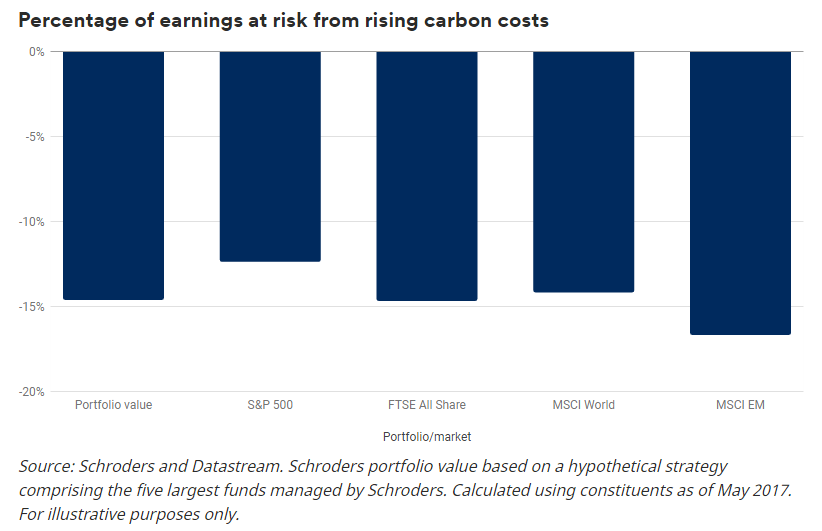
Carbon VaR shows almost half of listed global companies would face a rise or fall of more than 20% in earnings if carbon prices rose to $100 a tonne.
A carbon price is a cost applied to pollution to encourage companies and other organisations to reduce the amount of greenhouse gases they emit.
Unlike usual carbon footprint measures, Carbon VaR focuses on companies’ business models and profit drivers rather than purely environmental measures.
The analysis shows carbon prices will have to be far higher than recent levels, reaching over $100 if the internationally agreed target of 2°C for global warming limit is to be met. (Go to our to find out our latest prediction of where we stand on likely future warming.)
The effects on industries, companies and financial markets would be significant and widespread. Measuring and managing those risks is critical and requires the sort of innovative thinking Schroders is introducing today.
What is Carbon Value at Risk?
Carbon VaR measures the impact of rising carbon costs on a company’s profitability more accurately than those provided by carbon footprint analyses.
The effects of rising carbon prices on companies will be both dynamic and complex:
- Companies’ costs will rise in proportion to the total emissions generated by themselves and their suppliers.
- Selling prices are likely to rise to offset cost increases at an industry level.
- Demand should fall reflecting the sensitivity of customers to prices in each market affected, shrinking companies’ sales and costs.
Carbon VaR takes these linkages into account to gauge the impact on industry profits, using an estimating process to capture the three key variables of emissions, price and changing demand.
It’s also important to include all greenhouse gas emissions required to produce and sell a product, which conventional measures of carbon exposure do not.
The analysis also underlines the inadequacies of traditional measures of climate risk.
The problem with carbon footprints
Carbon footprints have become one of the most familiar ways for investors to gauge the impact of their investments on the environment.
A carbon footprint is a measure of the impact our activities have on the environment measured in units of carbon dioxide. So, if you drive a car to get to work or take a plane to go on holiday you leave a carbon footprint.
Businesses are the same. Everyday their operations create carbon emissions. A company’s carbon footprint typically relates the emissions it generates to its revenue or market capitalisation.
Such measures of “carbon intensity”, even if they are consistent, are often poor indicators of the effects of climate change on profitability or value. As a result, they provide little clue to the effect of carbon emissions on company earnings.
The curious case of Apple and Samsung
The example of Apple and Samsung is worth considering.
The two rivals sell fundamentally similar consumer electronics. Yet Samsung’s carbon footprint is significantly higher than Apple’s, because Apple outsources most of its manufacturing whereas Samsung manufactures more products itself.
In climate terms, this is an irrelevance: the emissions created by producing and selling both sets of products are in reality much the same.
To get an accurate picture, an investor clearly needs to get a handle not just on the company’s own emissions, but also those emanating from its suppliers. Carbon footprints, as currently conceived, don’t incorporate that information.
It follows that investors who rely on carbon footprints to guide their portfolios may face risks that they and their managers are not addressing.
Without innovative tools to help navigate a new environment of carbon reduction, investors will find it hard to reach their investment destinations, which is why the Carbon VaR model was created.
Important Information: The views and opinions contained herein are those of Andrew Howard, head of sustainable investment research, and may not necessarily represent views expressed or reflected in other Schroders communications, strategies or funds. This material is intended to be for information purposes only and is not intended as promotional material in any respect. The material is not intended as an offer or solicitation for the purchase or sale of any financial instrument. The material is not intended to provide and should not be relied on for accounting, legal or tax advice, or investment recommendations. Reliance should not be placed on the views and information in this document when taking individual investment and/or strategic decisions. Past performance is not a guide to future performance and may not be repeated. The value of investments and the income from them may go down as well as up and investors may not get back the amounts originally invested. All investments involve risks including the risk of possible loss of principal. Information herein is believed to be reliable but Schroders does not warrant its completeness or accuracy. Reliance should not be placed on the views and information in this document when taking individual investment and/or strategic decisions. Some information quoted was obtained from external sources we consider to be reliable. No responsibility can be accepted for errors of fact obtained from third parties, and this data may change with market conditions. This does not exclude any duty or liability that Schroders has to its customers under any regulatory system. MSCI: Third party data is owned or licensed by the data provider and may not be reproduced or extracted and used for any other purposes without the data provider’s consent. Third party data is provided without any warranties of any kind. The data provider and issuer of the document shall have no liability in connection with the third party data. The Prospectus and/or schroders.com contains additional disclaimers which apply to third party data. Regions/sectors shown for illustrative purposes only and should not be viewed as a recommendation to buy/sell. The opinions in this document include some forecasted views. We believe we are basing our expectations and beliefs on reasonable assumptions within the bounds of what we currently know. However, there is no guarantee than any forecasts or opinions will be realised. These views and opinions may change. Issued by Schroder Investment Management Limited, 31 Gresham Street, London EC2V 7QA. Registration No. 1893220 England. Authorised and regulated by the Financial Conduct Authority.