
The Strait of Hormuz proves fossil fuels are essential for food security

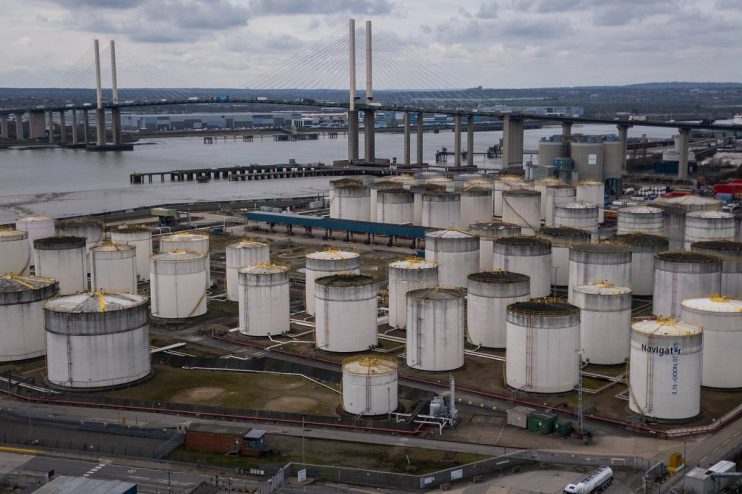
Carbon emissions are not a threat to food security – the war in the Middle East is highlighting that the much bigger food challenge for the world is not having enough access to fossil fuels, says Bjorn Lomborg
For years, climate campaigners have claimed that our food supply is under grave threat from climate change caused by excessive fossil fuel use. Ironically, the war in the Middle East is highlighting that the much bigger food challenge for the world is not having enough access to fossil fuels.
Today, half of all the calories we consume are only possible because they are produced with artificial fertilizers, overwhelmingly from natural gas. Without fossil fuels, half the global population would suffer a severe lack of food.
The conflict in the Middle East and blocking of the Hormuz Strait is not just driving up global energy prices. Crucially, a quarter of the world’s fertilizer normally passes through the Strait, and the blockade is holding back much of the fertilizer that will help grow the food that will feed the world in the coming year. The UN estimates that this could drive up fertilizer prices 15-20 per cent and push at least another 45m people into acute hunger.
And yet for the last decades, we’ve been told ad nauseam that fossil fuel use driving global warming was the big challenge to the world’s food supply. That claim is almost entirely wrong.
This climate-apocalyptic argument was only ever given any attention because we lost sight of the marvel of one of humanity’s greatest achievements in the modern age: our ability to tackle food security.
Over the past 125 years, food has become dramatically cheaper and more abundant, thanks to soaring productivity and innovation. Far from a looming apocalypse, the data reveals a story of remarkable progress, with climate change posing only a relatively minor hurdle. Radical emission cuts risk making food scarcer and more expensive for the world’s most vulnerable.
Consider the arc of history. In 1928, the League of Nations estimated that more than two-thirds of humanity endured constant hunger. Today, fewer than one in ten people worldwide go hungry – a rate that dipped below seven per cent before disruptions like COVID-19 and Russia’s invasion of Ukraine.
Quintupling cereal production
This isn’t luck; it’s the result of humanity quintupling cereal production since 1926 while more than halving global food prices in real terms. Incomes have surged, lifting billions out of extreme poverty and enabling families to afford more nutritious meals. This has avoided more than 4bn people starving, a testament to agricultural ingenuity and economic growth.
Even now, positives abound. The UN’s April forecast points to another record-breaking global harvest for 2025/26 because crops were already planted before the crisis.
Still, there are concerns for next season, and roughly 670m people continue to suffer from food insecurity today. In regions like sub-Saharan Africa, where crop yields lag far behind global averages, the barriers are clear and should be surmountable: Poor yields, subsistence farming and most importantly, lack of fertilizer, pesticides and mechanized handling.
Yet, Western NGOs and campaigners, well-fed but overly-worried about climate change, have railed against artificial fertilizers because they are fossil fuel based. Backed by rich donors and foundations, they blithely suggest that Africa should go organic, despite evidence showing this reduces harvests and food security. When Sri Lanka went organic in 2021, rice yields, the country’s staple food, plunged by more than 30 per cent with other crops showing massive declines.
Climate activists paint a dire picture of rising temperatures devastating crops and fueling famine, but they are mostly wrong. Climate change will alter farming conditions, benefiting some areas, challenging others, with a net negative but negligible impact. One peer-reviewed study equates the effect on agriculture to shaving less than 0.06 per cent from global GDP by century’s end. CO₂ is also a natural fertilizer. Elevated CO₂ levels have greened the planet, adding leaves with the equivalent area larger than the continent of Australia since 2000 alone.
Without climate change, global food calories are expected to rise 51 per cent by 2050 from 2010 levels. Even under an extreme warming scenario, global food calories would still rise, just slightly less at 49 per cent.
Drastic emission cuts are a bad policy if we want to boost food security. Climate policy is a blunt, expensive tool: Even aggressive action takes decades or centuries to measurably affect weather, costing hundreds of trillions while boosting calorie availability by under 0.1 per cent. Prioritizing economic growth, by contrast, is over 100-times more effective, increasing food access by more than 10 per cent in years, not centuries.
And emission reductions harm food production more than climate change. They inflate costs for fertilizers, tractor fuel, and land, pricing out small farmers. Naïve models often overlook that, but careful research clearly shows that a low-emission future with high carbon prices overall means 50m more people hungry by mid-century.
The lesson from today’s geopolitical shocks is clear: food security depends less on distant climate projections than on reliable access to energy and agricultural inputs. If the goal is to reduce hunger, especially in poorer regions, the priority should be making fertilizer more accessible – not restricting the very resources that make large-scale food production possible.
Bjorn Lomborg is Ppresident of the Copenhagen Consensus, visiting fellow at Stanford University’s Hoover Institution, and author of “False Alarm” and “Best Things First”.