The companies leading on climate aren’t waiting for 2050


Setting a net zero target and delivering one are not the same thing. As London Climate Action Week draws to a close, it’s clear that the gap between the two is where the real work begins.
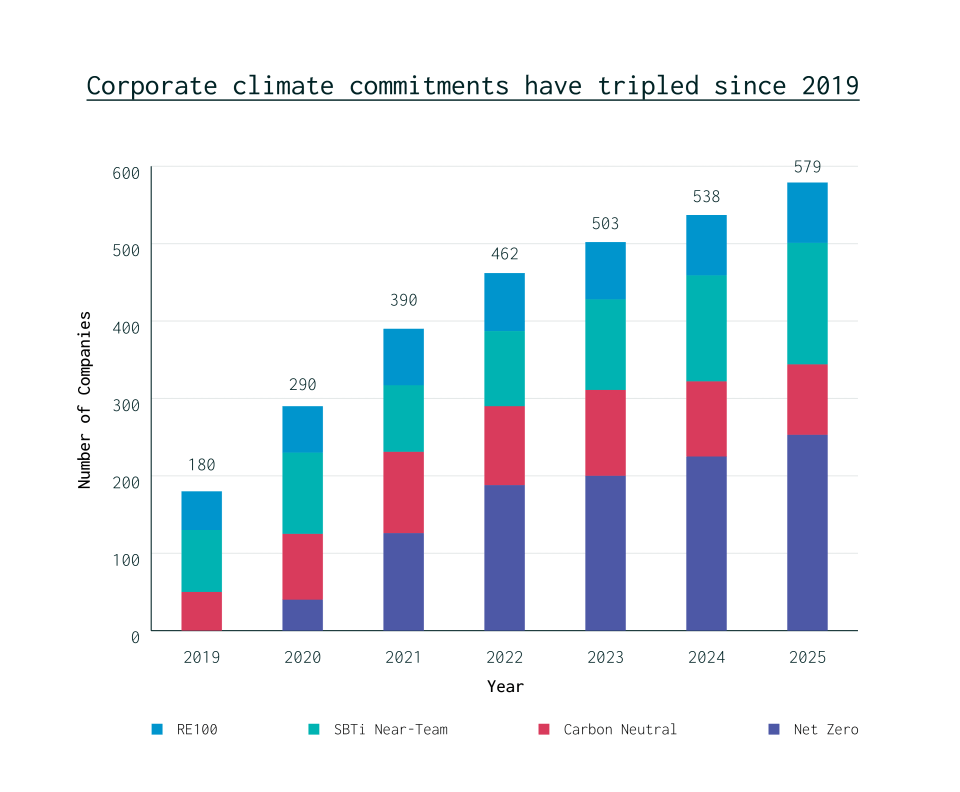
Since 2019, climate commitments among the world’s largest companies have tripled. But as targets mature and scrutiny increases, the conversation is shifting from ambition to execution. Our latest analysis of the Fortune Global 500– companies that collectively account for more than a third of global GDP- found that 72 per cent now hold at least one climate commitment, up from just 24 per cent in 2019. That is not a sustainability story but an economic one.
This signals that climate action has quietly moved up the balance sheet from an area owned by a department to shaping strategic decisions and operational compliance. What was once treated as a reputational consideration is now embedded into how leading businesses plan, invest, grow and compete.
What is perhaps less visible is how the nature of those commitments is changing and as corporate climate strategies mature, so too does the conversation around how those commitments are delivered.
As climate commitments advance from carbon neutral to net zero, there is rising pressure to ensure a credible roadmap for future action, with 63 per cent of all targets now due from 2030 onwards, compared with 11 per cent in 2019.
Companies are transitioning from short-term neutrality pledges towards long-term operational strategy through net zero goals. That reflects a hard-won recognition that transforming supply chains, business models and energy use takes time, and that serious climate leadership requires serious planning horizons.
Yet, there is an important distinction between setting a future target and taking action today.
The risks associated with climate change are not waiting for 2040 or 2050 and neither are the financing needs of the climate solutions required to address them. The most credible climate
strategies begin with reducing internal emissions with businesses investing in operational efficiencies, renewable energy, supply chain engagement and innovation to drive down their carbon footprint. This is the primary focus for decarbonisation, but leading companies must also increasingly recognise that reducing emissions within their own operations is only part of the solution.
Achieving global climate goals will also require substantial investment in projects that avoid, reduce and remove emissions at scale. From protecting forests and restoring ecosystems to scaling clean energy and carbon removal technologies, these projects need long-term, predictable funding to grow, attract further capital, and deliver impact to the communities they serve. Providing finance to high-quality carbon projects today helps ensure those projects can continue to operate and scale, while also building the future supply of credits that companies will need as they move towards net zero.
Industry forecasts suggest demand for voluntary carbon credits could increase more than fifteen-fold by 2030 as more organisations work towards ambitious climate goals. The companies that understand this and are leading on climate are already preparing for that future.
Our analysis found that more than 44 per cent of Fortune Global 500 companies now explicitly state an intention to use carbon credits as part of their climate strategy, a 75 per cent increase since 2022 and 2025. Perhaps most tellingly, companies with net zero commitments are 11 times more likely to use carbon credits than those without them.
This trend is important and shows that the businesses setting the most ambitious targets are not treating carbon credits as a short-cut or a substitute for reducing emissions. They are incorporating them into broader, long-term climate strategies alongside genuine efforts to decarbonise their own operations.
We’re seeing companies use carbon credits to address hard-to-abate emissions, navigate the complexity of Scope 3 emissions and support climate solutions beyond their own value chains.
Carbon credits are not sitting on the sidelines of corporate climate action but are now part of how ambitious organisations are planning for the future.
This has implications for how carbon markets need to develop. Scaling to meet that demand requires a fundamental shift from fragmented, project-by-project activity to infrastructure-like systems capable of originating and delivering high-integrity supply at volume.
Large-scale carbon projects typically take seven to ten years from initiation to issuance. The companies that are building their net zero strategies today will need credible, high-integrity supply in the years ahead. The investment decisions that determine whether that supply exists need to be made well before that demand arrives.
The companies making the greatest progress understand that climate leadership is not defined by a target year alone. The carbon market must now deliver by building the infrastructure, standards and high-integrity supply that corporate demand will require. That means acting now – the projects that will deliver credits in 2030 need capital today. The organisations that move fast will be better placed to meet their commitments. But those that wait may find the market has moved without them. The question I ask you is a simple one: where do you and your organisation see yourselves in 2030?