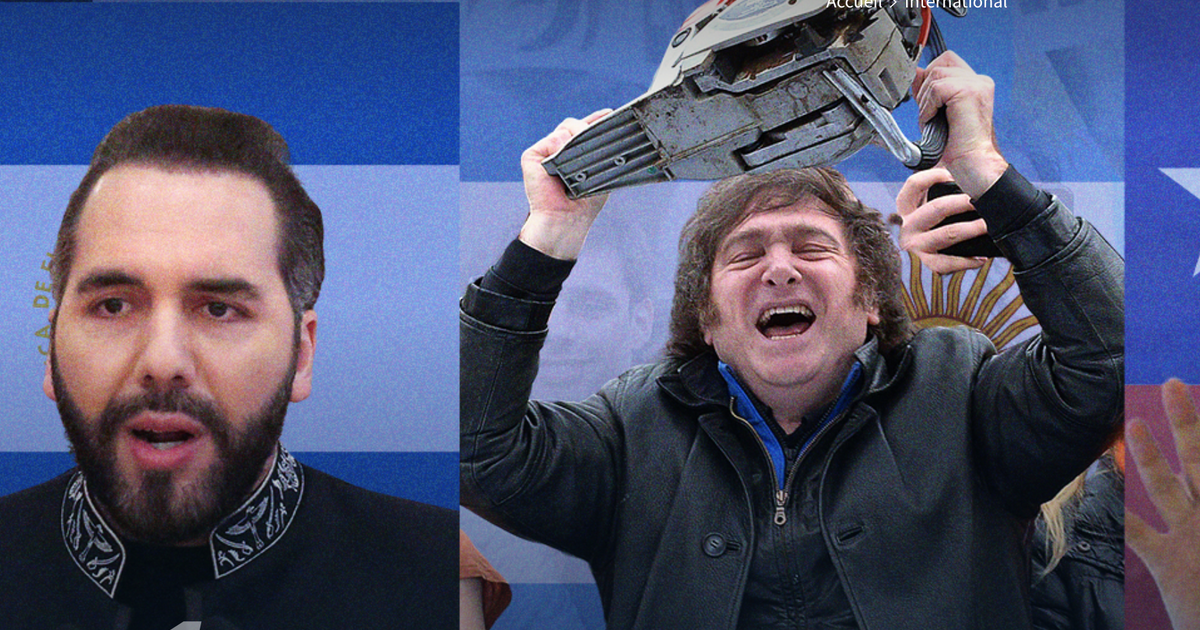
A blue wave is sweeping across Latin America. It runs from Nayib Bukele’s El Salvador to José Antonio Kast’s Chile. It can take on varying shades. The lighter one of the centrist right of Rodrigo Paz, whose election in October ended 20 years of socialist dominance in Bolivia. But it is often dark blue, as in Argentina’s Javier Milei, the populist and libertarian president elected in 2023, who already sees the end of his term looming. It now covers 11 of the region’s 19 countries and could continue to expand in the coming months.
At the beginning of April, in Peru, Keiko Fujimori, the daughter of former autocratic president Alberto Fujimori, came out on top in the first round of the presidential election on a platform of restoring order, fighting crime and expelling undocumented migrants. The second round is scheduled for June and is expected to pit her against a candidate from the radical left.
At the end of May, another presidential election will take place in Colombia. After the term of left-wing president Gustavo Petro, a former Marxist guerrilla fighter, the campaign of conservative Paloma Valencia appears to be gaining momentum.
In October, in Brazil, President Luis Inácio da Silva, 80, a candidate for re-election to a fourth term, will face Flavio Bolsonaro, 44. Endorsed by former president Jair Bolsonaro, his son is seeing his popularity rise in the polls. Less charismatic than his father, this determined man defines himself as conservative; he highlights his membership in an evangelical church. He is now closing in on the icon of the Brazilian left. His program focuses on fighting insecurity and denouncing the politicization of the justice system.
Libertarian rock star
Is there a common thread between Javier Milei, the libertarian rock star fond of budget cuts wielded like a chainsaw, and the placid José Antonio Kast, Chile’s new president, who does not disavow Pinochet’s legacy? A professor of political science at the Catholic University of Chile in Santiago, where he heads the “Laboratory for the Study of the Far Right,” Cristóbal Rovira Kaltwasser sees real similarities in substance, above all. “Ideologically, they are very close. They want tough policies against crime and are very conservative on moral issues: abortion, same-sex marriage. They perceive the left—whether Hugo Chávez, Lula or Gabriel Boric (the former president of Chile)—as a demonic enemy that must be destroyed. More broadly, they are in tune with global far-right movements. They share the same ideas and use the same strategies as those seen in Hungary, Spain, and France.”
Like Brazil, Chile and Argentina retain a very vivid memory of far-right dictatorships, from which these movements may stem, as is the case with Kast’s Republican Party, or with which they maintain alliances of convenience, as in Argentina. “The major difference,” continues Rovira, “is that the old far right did not like elections, whereas these parties have discovered that the ballot box brings them victory.”
But this victory often comes at the expense of a more moderate conservative right, whether Argentina’s Republican Proposal party or Chile’s Independent Democratic Union. “Created under the Pinochet era, the UDI gradually became a conventional right-wing party,” the academic continues, expressing concern at seeing this “conventional” right gradually disappear from the South American political landscape. Given these countries’ recent history, he sees this as a risk for democracy.
The long shadow of the subprime crisis
A brief trip back in time is necessary to trace the roots of this revival of the right. In 2008, the subprime crisis shook the entire world. It hit Latin America hard, in a region emerging from a decade of economic boom where a middle class had been beginning to take shape.
“Latin America’s economic model is based on exporting raw materials. The region was hit head-on by the crisis, and it quickly turned into a social crisis, for which left-wing parties, worn down by time in power, paid the price,” explains Christophe Ventura, research director at the Institute for International and Strategic Relations (IRIS) and a specialist in South America. It was from that point on that right-wing parties managed to break with the old dominance of the left in Latin America: Mauricio Macri became president of Argentina in 2015, Jair Bolsonaro was elected in Brazil in 2019.
The Covid pandemic provided a second acceleration, the researcher continues: lockdowns had very harsh consequences in these countries where the informal economy still plays a major role. From then on, when Milei denounces the “caste” of civil servants and politicians suffocating the country under regulations, Argentines listen. These parties, Ventura concludes, “did not need Trump to emerge and win. But since his return to the White House, he has offered them a very clear strategy of alignment.”
The meeting held in early March in Florida, under the aegis of the American president, was the latest illustration. It aimed to present a new security initiative called “Shield of the Americas,” whose objective is to combat drug trafficking cartels. Donald Trump had invited the heads of state of 11 countries led by conservatives, sending them a very clear message: stand with us in this fight and we will support you. Left-wing leaders, such as Claudia Sheinbaum, president of Mexico, and President Lula, were not invited.
This meeting followed by a few weeks the high-profile capture of Venezuelan president Nicolás Maduro and his wife in Caracas, at the end of a spectacular operation by U.S. special forces. Maduro and his wife are currently behind bars in the United States, where they are being prosecuted for drug trafficking. According to Donald Trump, this was the birth of the “Donroe” doctrine, his interpretation of the Monroe Doctrine, through which he seeks to reassert control over the entire American continent in the face of the threat posed by his main rival, China.
Beijing’s hand
Taking advantage of the American withdrawal initiated during Donald Trump’s first term, Beijing has since steadily increased its economic grip on Latin America. Between 2010 and 2024, trade between China and Latin America rose from $10 billion to more than $510 billion. China is the leading trading partner for countries such as Argentina, Peru, and Bolivia. It is also a strategic outlet for the mining industry and agriculture. But Donald Trump views the growing influence of his Chinese rival with concern and has decided to put an end to it.
Latin American leaders know they must send him clear signals in this regard. Thus, a few days before his inauguration, José Antonio Kast put an end, in a move seen as spectacular in Chile, to a submarine cable project linking China to Peru, which had displeased Trump. In Argentina, the step-by-step fight against Chinese investment is said to be an obsession of the American ambassador. “I remember a meeting between the Argentine prime minister and the U.S. ambassador where the latter was incredibly angry: ‘We’ve had enough of China! Why don’t you block them here? And why did you accept that contract?’ We were stunned,” recalls one source. The anecdote underscores how, despite American political pressure, China has become an economic partner that Latin America cannot do without.
This is now the core challenge for this new right: it is no longer a matter of convincing but of acting, and of delivering results—the proof, as it promised, of its ability to change the order of things; to restore prosperity; to ensure security. Yet in Argentina, after two years in power, Milei has not yet succeeded in turning the economy around. If he wants to remain in power and carry out the “revolution” he promised Argentines, the coming months will be decisive.