

May the forest be with you! Putting a price on nature


Natural resources are often seen as free inputs that any company may use to produce an output. The exploitation cost alone is how firms assess a natural asset’s monetary value. In this way, natural resources tend to be seen as infinite: there is no clear sense of how overexploitation can destroy surrounding ecosystems.
Today, many firms want to avoid harming the environment, but they lack the motivation to follow through. After all, some studies have shown very little empirical connection between corporate social performance (CSP) and corporate financial performance (CFP).
Some researchers have also found that while the economic benefits of an unpolluted environment and stable climate would be enjoyed by all, the negative costs of pollution and emissions — climate change or other ecological damage — have not affected individual firms. Companies therefore have little direct incentive to take positive action. Which may explain why, in the face of the current environmental crisis, many haven’t: environmental policies are often expensive and their benefits on the other side not always easy to quantify.
Towards a methodology
So, to avoid a tragedy of the commons, we need to develop a formal method to price nature assets based on their role in their ecosystems and their utilitarian value in the medium and long term. Including the toll a company demands from nature in its valuation economically incentivises that firm to find more responsible ways to produce.
Nature pricing means assigning a monetary value to a specific environmental service. For example, researchers have worked to quantify the cost of deforestation in coastal zones where trees help prevent flooding and other environmental hazards. Others have investigated the dollar value in benefits the pangolin brings to its ecosystem to help fight wildlife trafficking. In these ways, researchers have sought to put a price tag on each output companies extract from nature and thus supply them with financial justification to take a more positive course.
Colorado State University-based professor, Edward B. Barbier, has investigated how to reshape economic models to account for nature’s contribution to human prosperity and survival. He wanted to include a valuation framework that costs in the regulating, provisioning and supporting services nature provides us.
Economists, ecologists, and other scientists have made substantial progress on this front and have assessed the welfare contribution of important ecosystem services by applying environmental valuation methods.
But all these efforts suffer from a lack of data. This is one reason why the UK’s Department for Environment, Food and Rural Affairs (Defra) finds it important to maintain an Ecosystem Services Valuation Database (ESVD) that gathers nature assets valuation-related material. This project offers greater visibility into the models used and allows for better understanding and further analysis.
Ecosystem Services as a Function of Environmental Services (Biome) in US Dollars per Hectare per Year

Among the early takeaways of these explorations is that waste treatment, tourism and protection from extreme events are nature’s most lucrative contributions to human life in terms of their economic value.
At the very least, this should incentivise better protection of our marine and wetland environments. These play crucial roles in our wastewater treatment systems and are worth, in this scope, more than $150k (more than £108k) per hectare, per year.
To be sure, ecosystem services are not strictly comparable: waste treatment and protection against environmental hazards are regulating services, while tourism is a cultural one. Their pricing methodologies thus vary greatly.
Climate change and ecosystem conservation
But what about climate change-related ecosystem services? How does nature protect us from global warming and how would we price these services?
Climate change results from the combination of two main elements. Earth’s natural warming process is driven by greenhouse gases that prevent some of the sun’s radiation from leaving the atmosphere and thus keep the temperature warm enough to sustain life. The difference between the radiation that stays in the atmosphere and what is released is called radiative forcing.
Human activities increase the concentration of greenhouse gases in the atmosphere. At a certain point, too much radiation is trapped, increasing the radiative forcing and exacerbating climate change.
Carbon dioxide contributes to this radiative forcing. Thus ecosystems that can recapture carbon are essential to mitigating climate change. According to a carbon-emissions-based valuation method, for example, Brazil’s Amazonian rainforest represents about 16% of the total value of ecosystem services involved in carbon recapture.
Carbon Recapture by Country (in US Dollars)
| Austria | $79,000 | Nepal | $3.1 billion | |
| Brazil | $3.75 billion | Paraguay | $45.8 million | |
| China | $1.17 million | South Africa | $7 million | |
| Costa Rica | 0 | Thailand | $704 million | |
| Kenya | $2.1 million | United Kingdom | $8.91 billion | |
| India | $2.45 million | United States | $6.35 billion | |
| Italy | $4.43 million |
Brazil: Main Ecosystem Services
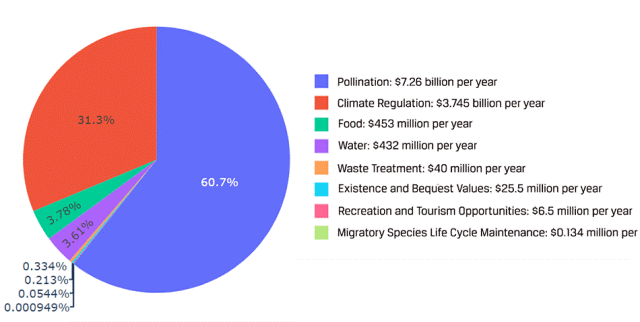
Protect the rainforest, fight climate change
The Amazon rainforest is home to unique biomes that are threatened by industrial farming and wildlife trafficking. What these activities remove and destroy is not so easily replaced or replicated. And carbon recapture is only one of the ecosystem services the rainforest provides.
This lesson is a critical one. While efforts have to be made to calculate the prices of nature assets and integrate them into our company valuations, we need to remember that there is no way to price the irreplaceable or to accurately value that without which humanity couldn’t survive.
Companies may treat natural resources as infinite. They aren’t. But the price of nature truly is.
If you liked this post, don’t forget to subscribe to the Enterprising Investor.
By, Ophélia Miralles, an alliance manager at Renctas, a non-governmental organization (NGO) that works to preserve biodiversity and combat wildlife trafficking in Brazil.
All posts are the opinion of the author. As such, they should not be construed as investment advice, nor do the opinions expressed necessarily reflect the views of CFA Institute or the author’s employer.
Image credit: ©Getty Images / luoman