
Long commutes aren’t just boring, they’re holding back the economy

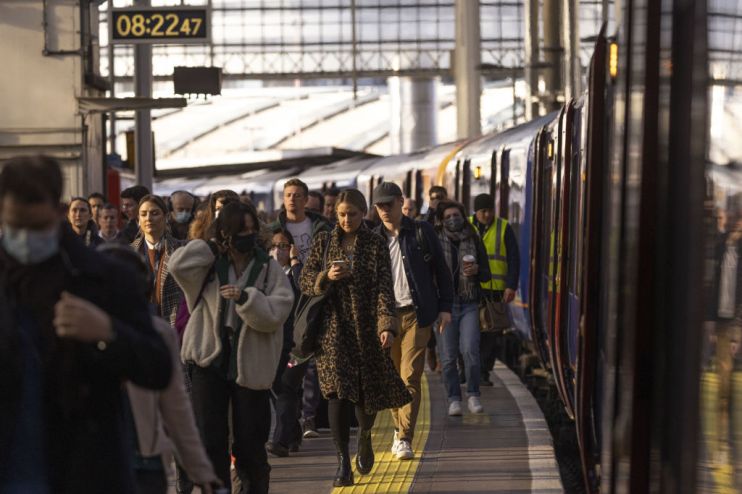
Adding more trams, trains and buses to the UK’s major cities will not only make our morning commutes quicker, it will also help improve the economy, Chris Dorrell writes
Anyone naive enough to think that this election would see some serious debate about how to fix Britain’s broken economy will have been disappointed by the campaign so far.
Remember, there’s one dominant issue holding back the UK economy which both parties are deeply conscious of. It is not immigration, it is not pensioners and it is not lazy 18 year-olds who could be in the army. More than anything else it’s sluggish productivity growth.
This is particularly true outside of London (and that’s not just the gloating of a London paper). Tackling the under-performance of the UK’s other cities is a major challenge, but the potential benefits are huge.
The Resolution Foundation estimates that if Manchester and Birmingham’s productivity gap compared to London was narrowed in line with Lyon and Toulouse with Paris, then gross value added (GVA) would increase by almost £20bn a year.
There’s a whole host of reasons why British cities underperform their potential, but a large part of the answer – and perhaps an unexpected part – is poor transport links.
Cities are so valuable for boosting growth because it allows firms to benefit from what economists call ‘agglomeration effects’. Agglomeration refers to the benefits that workers and firms get from being close to one another, such as the exchange of ideas and a larger labour market.
A wide range of research shows that these agglomeration effects are very significant, particularly in an economy where many work in the knowledge-intensive services sector. It is no coincidence that London and Paris, Europe’s two largest cities, are also the most productive.
However, Britain’s cities are effectively made smaller by poor transport networks, which prevent people from accessing the city centre.
Britain Remade, a research group focused on boosting economic growth, have put together some striking comparisons of how the transport links in Britain’s cities compare to European peers.
Birmingham and Munich are roughly the same size. Yet during rush hour, nearly three quarters (74 per cent) of Munich’s population can reach the city centre within 30 minutes through public transport while only 34 per cent of Birmingham’s can.
It’s the same story if you look at Leeds and Marseille. Some 87 per cent of people who live in Marseille can get to the city centre in half an hour compared to just 38 per cent in Leeds.
Britain Remade said that outside London the public transport networks verge from not good enough to non-existent.
Only seven British cities have a tram network compared to 60 German cities. In France, every single urban area with more than 150,000 residents has a tram or a metro whereas 30 British cities that size go without.
A long commute is not just really boring. It is, in economic terms, wasted time (and famously time is money). Better transport networks also means cities are more likely to benefit from those all-important agglomeration effects.
Part of the reason why British cities are so under-served is down to cost. The UK pays more than twice the European average per mile of new tramlines while for undergrounds and metro lines, it pays more than three times the European average. This is not an attractive proposition for investors.
As soon as you start asking why it is so expensive to build transport links and a familiar villain appears: the planning system.
To take another (Britain Remade) example, if the planning permission for the 3.3 mile Portishead branch line near Bristol was laid out end to end, it would be four-and-a-half times longer than the proposed railway itself.
There’s a lot of other things that need to fall into place for the UK’s major cities to fulfil their economic potential but fixing the transport system is a good place to start. Let’s hope the manifestos have something of interest to say.