
The Debate: Should delivery robots be allowed on pavements?

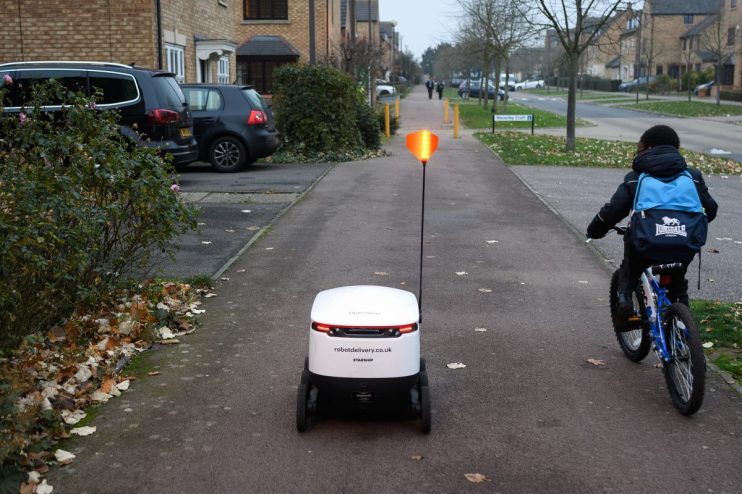
Are delivery robots a sign of progress or a threat to pedestrians? We hear both cases in this week’s Debate
YES: 93 per cent of Cambridgeshire residents said they liked or loved their local pavement robots
Delivery robots are one of the most promising developments of the UK’s upcoming mobility technological revolution. This is not surprising: what was once seen as something seen out of a futuristic film has been a common sight on pavements across Milton Keynes, Bristol, Leeds and beyond for quite some time now.
The benefits the residents of these cities are already reaping are widespread. Thanks to delivery robots, there is greater support for vulnerable and house-bound people who can now access shopping and medicine thanks to low-emission deliveries. At a time when economic growth is central to the future of our country, these robots are creating high-quality jobs and revenue in manufacturing, maintenance and deployment while also helping independent businesses and restaurants lower their costs and access new customers.
While these advantages are tangible, so are the challenges. Critics raise issues with pavement safety and accessibility, especially for those who have mobility or visibility impairments.
That is why the UK needs a national regulatory framework that prioritises safety and accessibility for all. UK-wide regulation is out-dated, with a 200-year-old law designed for horses and carts consigning pavement robots to a legal grey-area and significantly restricting their use. This creates uncertainty, confusion and delay, leaving local authorities as unilateral decision-makers, operators without investment certainty, and the public without guaranteed regulatory protection.
Cambridgeshire County Council’s own survey found that 93 per cent of residents liked or loved their local pavement delivery robots. The UK should lead on the responsible deployment of these robots at scale, seizing the benefits not just for its own economy but for all its citizens, too.
Rory Daniels is head of emerging technology and innovation at TechUK
NO: Delivery robots have already been banned in US cities for injuring dogs and clogging pavements
Delivery robots are operating on pavements across the UK, causing chaos for pedestrians, despite having no clear laws allowing their use. We’re calling for action to protect pedestrians and keep pavements for people.
You might think delivery robots look cute and harmless, but for older and disabled people and parents with buggies, they are dangerous.
Delivery robots have already been banned from cities in the US and Canada, following reports of robots injuring people and dogs, and clogging pavements.
In the UK, our pavements are already full of obstacles, from pavement parking to wheelie bins, preventing many disabled people from leaving their homes. Now we’re adding another barrier – one that can move into your path, stop without warning, even crash into you.
The Highways Act prohibits “carriages” from operating on pavements, but it’s unclear if this includes – or excludes – delivery robots. In this uncertainty, trials are going ahead in towns and cities across the UK without consultation. Many councils have not given permission for them at all. Private profit is being prioritised over people.
So, what’s the case for them? The companies behind these robots say that they are taking cars off the road for deliveries, but most of these deliveries are being done by bicycle anyway and for those less mobile, having a human deliver to you is more helpful. The argument for reducing emissions just isn’t there.
Living Streets is calling on the government not to legalise delivery robots – and to put a stop to the pavement overload.
Catherine Woodhead is chief executive of Living Streets
The Verdict
Should we allow delivery robots on our pavements? It’s a far more complex question than first meets the eye. For starters, those who objectors complain on the behalf of – the disabled, elderly and parents – are also those who are likely to benefit most from the robots’ services. Starship Technologies, who make the robots currently being trialled across the UK, say 25 per cent of their regular customers have a disability or live with someone who does. But it’s also true that hundreds of robots trawling down pathways can’t be too helpful for those with mobility issues.
So what to do? The government is currently trying to allow delivery robots to operate under the same category as e-scooters, but it’s likely to leave a lot of grey area still. A couple robots may not be too troublesome, but how many is too many? How fast should they go? Should they have faces? The future is here. For City PM’s part, we think a robot lane, perhaps for use by slow walkers also, could clear up multiple problems.