
Labour’s new quarry tax is rock bottom green policy

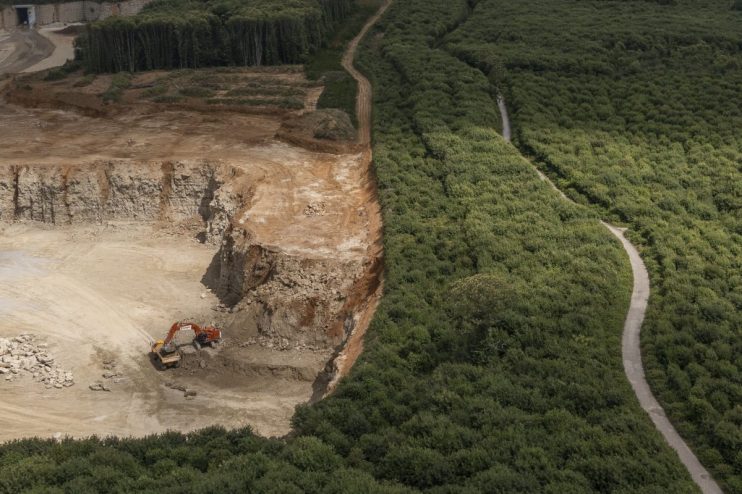
A man’s freedom to fill up his quarry absent extortion must stand, writes Charlie Amos in response to Labour’s expanded landfill tax which will add £25,000 to the cost of building a house
A key target for this Labour government is building 300,000 homes every year; yet last year, only 217,911 homes were built. It is very strange then Labour wishes to introduce a quarry tax as of next year, which, on average, would add £25,000 to the cost of building a new house. It seems this government is more focused on pointless green targets to get us to a ‘circular economy’ than cheaply housing people. Plus, taxing people to simply fill in their own holes in the ground is a gross violation of private property which has no place in a free society.
As of 2027, the government intends to extend the scope of the landfill tax to include inert waste materials being used to fill in quarried land. Along with standardising the rate of the landfill tax from 2030, this means for each tonne of clay, chalk and soil put into an old quarry, businesses will have to pay at least £126.15 instead of the current rate of £4.05. Now if you dig up your garden in order to get the potatoes you planted earlier in the year out, you should be free to fill it back up with soil without charge; analogously, if a quarry owner has dug out the iron ore from his land, he should be free to fill it back up with soil without charge too. To demand payment for each shovel of soil that goes into the ground is simply extortion, a blatant violation of private property. Imagine your neighbour making this demand!
This extortion is unacceptable. A natural principle of human respect demands people are free to pursue their own happiness in thheir own way absent coercion. Sticking to it promotes the proper harmony of individuals in civil society, where none are used as the mere tools to the fickle fancies of others, ensuring the recognition of each as an ultimate value in themselves. This moral precept is natural because it does not depend for its truth upon laws or social conventions, rather, they depend for their righteousness on it. As well as the direct wrong of breaching the harmony of civil society via state plunder, the quarry tax will also have the inevitable result of diminishing the prosperity of people too. Three effects are certain.
Consequences of the quarry tax
First, the price of housebuilding will go up massively. The Mineral Products Association estimates the additional cost to build a house to be £22,000 to £28,000, about 10 per cent of the average house price of £269,000. And this figure only concerns the direct cost of waste disposal from construction. Second, the quarry tax will reduce the extraction of raw materials in Britain because the overall cost, taking into account the legally required refilling, will go up substantially. It is estimated that up to 50 quarries supporting hundreds of jobs may have to close as a result. This is especially worrying today as the replacement rate for raw materials is at an historic low: for every 100 tonnes of sand and gravel sold in the last 10 years, only 61 tonnes of new permissions have been granted. Third, where open cast mining companies go bust, local communities will be faced with massive unfilled quarries which are unsightly.
What can be said in favour of the government’s plans? It might be thought the quarry tax simply amounts to a Pigouvian tax to internalise any negative externality of putting stuff back in the ground. The problem with this counter is the quarry tax is on inert materials such as clay, chalk and soil which have no such spillover effects. And as Ronald Coase has argued, provided property rights are clear and transaction costs are low, private parties can deal with spillover effects efficiently anyway. Indeed, taxing inert materials will actually create negative externalities by increasing fly-tipping as the government’s own documents themselves concede. Why? Because when faced with paying £126 to deposit rocks legally, or, £50 for a white van man to dump them in a field, many will choose the latter. Fly-tipping already costs the country about £200m a year; this figure doesn’t need to be added to.
Another defence of the quarry tax is that, by charging for infill, recycling is encouraged. This helps meet the government’s ‘circular economy ambitions’. Two rebuttals. One: there isn’t really much other use for clay, chalk and soil. Two, why is recycling a good thing per se. If the cost to recycle a material is more than getting the material afresh, it is inefficient to go with the former option: or, put another way, it makes sense to use disposable plates at a big party because the cost of using proper plates is massive in washing up. Some may say we can’t take afresh forever; true, but when rocks or soil become scarce their price will increase, then recycling will become efficient and then – and only then – it should be pursued.
Britain’s housing crisis, decline in heavy industry and spike in fly-tipping will only be made worse by Labour’s rock bottom policy of a quarry tax, established on the dubious basis of creating a ‘circular economy’. As with most green policies, such as banning plastic straws and cutlery, it shows a total disregard for private property and for people generally enjoying life with cheap goods. A man’s freedom to fill up his quarry absent extortion must stand: the quarry tax must be opposed.
Charlie Amos is a writer