
Happy birthday Adam Smith, your ideas are still fresh at 302

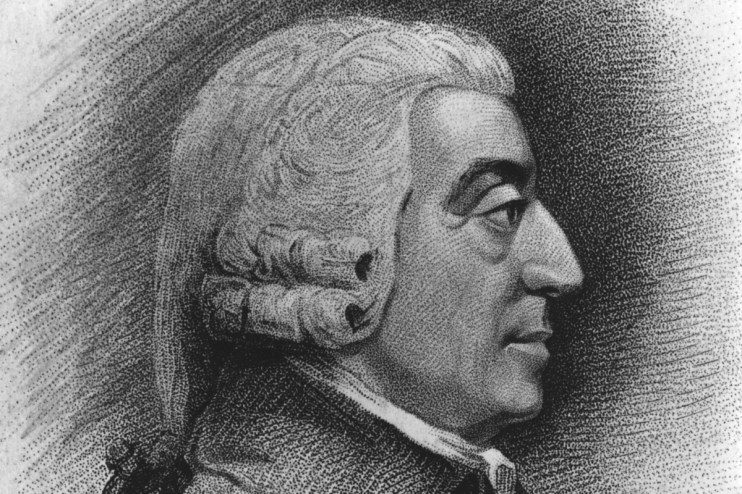
On the 302nd anniversary of Adam Smith’s baptism, his enduring insights into free trade and the folly of protectionism remain a powerful rebuttal to today’s rising economic nationalism, says Eliot Wilson
Three hundred and two years ago today, in 1723, in the Old Kirk in Kirkcaldy, a baby was baptised. His precise date of birth is unknown, and his father, a senior solicitor and customs official, had died a few months previously. The widowed Margaret Smith, from a local landowning family, gave her only child the name her husband had borne: Adam.
The Scotland into which Adam Smith was born had a population of a little over a million and, although it was one of the most urbanised societies in Europe, its burghs were small: Edinburgh was home to 50,000, Glasgow 15,000, Aberdeen and Dundee around 10,000. Nowhere else came close. The Royal Burgh of Kirkcaldy, on the north shore of the Firth of Forth, counted perhaps 1,500 inhabitants, a trading port fringed with coal mines, its modest shipbuilding industry gradually growing.
One event 16 years before Smith’s birth had changed the economic context for Kikrkcaldy and for Scotland, and it is easy to imagine the child steeped in it: the passage of the Acts of Union 1707, which had brought England and Scotland together as a single political unit. The acts created a customs and monetary union, equalising “the Laws concerning Regulation of Trade, Customs, and… Excises”, and gave to Scots “full Freedom and Intercourse of Trade and Navigation to and from any port or place within the said United Kingdom and the Dominions and Plantations thereunto belonging”. This represented a massive step forward in free trade.
Margaret Smith never remarried, and she and her only son forged a close bond. He was an intelligent child, educated between the ages of six and 14 at the Burgh School of Kirkcaldy before going up to the University of Glasgow to read moral philosophy. Having mastered Latin and Greek at school, he was admitted directly to third-year classes, though aged only 14, and studied logic, metaphysics and natural philosophy as well as his favoured moral philosophy.
Like many students in that era, Smith did not graduate but simply finished his studies; but he won the Snell Exhibition, an award for students from Glasgow to study at Balliol College, Oxford. He hated it. “In the University of Oxford, he later wrote, “the greater part of the public professors have, for these many years, given up altogether even the pretence of teaching.” But he spent six years immersing himself in the volumes of the Bodleian Library, before returning to Scotland in 1746.
Professor of rhetoric
In 1751, he was appointed Professor of Logic and Rhetoric at Glasgow, before becoming Professor of Moral Philosophy in 1752. He drew on his lectures and academic work for The Theory of Moral Sentiments (1759), his first published volume, which argued that mankind had no innate morality, but rather an unconscious, transactional sociability: society works because we are endowed with empathy and want to coexist peacefully and profitably.
The book was a success and drew students to Glasgow and Smith’s tuition. The moral philosopher was now turning more towards jurisprudence and economics, proposing that the source of national wealth was labour, not gold and silver. He gave up his chair at Glasgow in 1764 and by the end of the decade had returned to Kirkcaldy, where he occupied himself in writing the book that would change the world.
The Wealth of Nations was less a statement of doctrine and more an observation of what in fact already happened
An Inquiry into the Nature and Causes of the Wealth of Nations was published in 1776, when Smith was almost 53. It depicted the economy as regulated by an “invisible hand” which was driven by individual self-interest. Production increased through division of labour, maximised by freedom to trade without interruption or limitation. In particular he argued that government intervention in the economy, especially through protectionist measures like tariffs, were almost always counter-productive.
The impact of The Wealth of Nations was immediate. Elements of Smith’s thinking found their way into Lord North’s budgets of 1777 and 1778. He was cited approvingly by William Pitt and William Gladstone, and by Benjamin Franklin and James Madison (and banned by the Spanish Inquisition). Smith died in 1790, disappointed he had not achieved more, but he had essentially invented economics and demonstrated how markets operated. That was part of his genius: The Wealth of Nations was less a statement of doctrine and more an observation of what in fact already happened.
President Trump is teetotal, but one phrase of Smith’s rings especially true in this time of overheating ideology.
“Very good grapes can be raised in Scotland, and very good wine too can be made of them at about thirty times the expense for which at least equally good wine can be brought from foreign countries. Would it be a reasonable law to prohibit the importation of all foreign wines, merely to encourage the making of claret and burgundy in Scotland?”
No, it would not.