
EU referendum: Disunited Kingdom – how far apart are we on the EU and could England vote to take the UK out despite other nations voting to stay in?

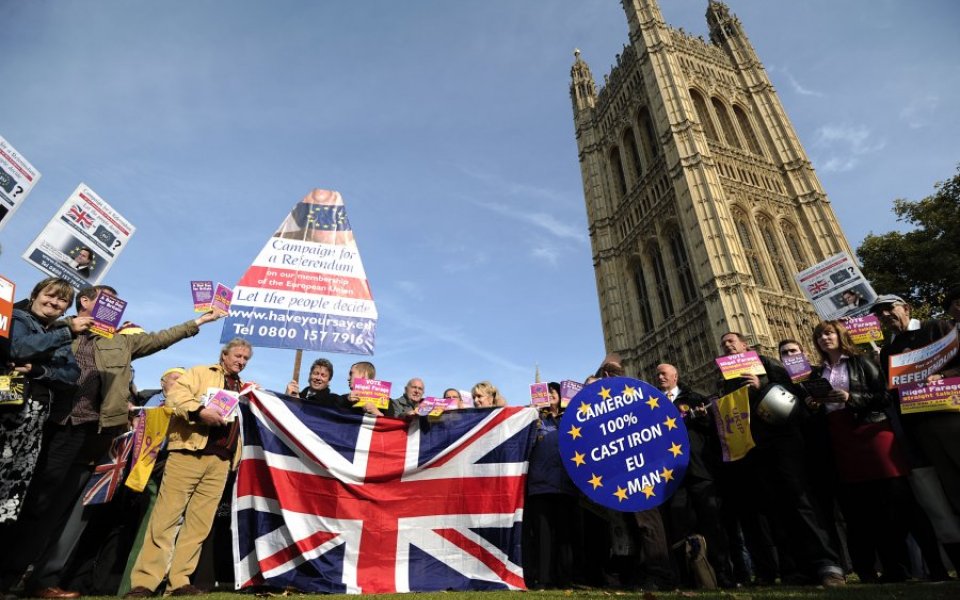
The surprise outright victory of David Cameron’s Conservative party at this year’s General Election means that we are now certain there will be a referendum on Britain’s future in the European Union (EU). At some point before the end of 2017, we will be asked whether we think the UK should remain a member of the EU or leave the EU.
Although the date of the referendum is yet to be set, the long campaign is already well underway and the battle lines are starting to be drawn. One such line, it appears, is that between England and the other nations of the UK. Assertions (not least from leaders of the nationalist parties in Scotland and Wales) about the constitutional implications of a vote by England to leave the EU while the rest of the UK votes to remain have become so commonplace one might be forgiven for thinking such an outcome was almost inevitable.
In a paper published today as part of our Economic and Social Research Council-funded project, ‘What UK Thinks:EU’, we assess the evidence to date on the gap between England and the rest of the UK.
Read more: Lord Lamont talks Osborne, EU and Varoufakis
Overall, recent polling suggests that attitudes to the EU across Britain as a whole are extremely finely balanced. Based on averaging the six most recent polls (excluding those people who have yet to make up their minds), at present "Remain" have a lead of just two percentage points over "Leave" – 51 per cent favour remaining, 49 per cent leaving. However, at present, a majority in each of the four constituent nations of the UK say they would vote to remain in the EU. A vote that divides the UK on national lines is by no means a necessary outcome.
At the same time, all recent survey and polling data do indeed point to a sizeable gap between England and Scotland (typically between 12 and 17 percentage points) in the level of support for remaining in the EU, and to a somewhat smaller gap between England and Wales (typically around 5 percentage points). Based on recent online polling (to mid-November) in each country, on average 52 per cent of people in England, compared with 64 per cent in Scotland and 55 per cent in Wales, would vote to remain in the EU.
There are fewer reliable sources of data on attitudes to the EU in Northern Ireland, but if recent polls there are accurate then Northern Ireland may be even more enthusiastic than Scotland about remaining in the EU, with as many as 75 per cent supporting remaining in the EU.
Read more: Ukip’s sole MP senses wave of support for Out campaign
If Scotland, Wales and Northern Ireland voted as these polls indicate, then it would only take a relatively small shift among voters in England before we were faced with one of two potentially constitutionally unsettling outcomes. First, if a narrow majority, if between 50 per cent and 52.4 per cent of people in England voted in favour of leaving the EU, the UK may nonetheless be kept in the EU by the votes of people in Scotland, Wales and Northern Ireland.
Conversely, if the leave vote in England reached 52.5 per cent or more, then England could take the UK out of the EU even though majorities in Scotland, Wales and Northern Ireland vote to remain. So while a constitutionally uncomfortable outcome is by no means guaranteed, it is clearly a possibility if the polls as they currently stand are an accurate reflection of the balance of public opinion.
If this were the outcome, then the constitutional implications of the EU referendum may extend well beyond the specific question of whether or not the UK remains in the EU.