
Employers think Gen Z has forgotten how to work – are they right?

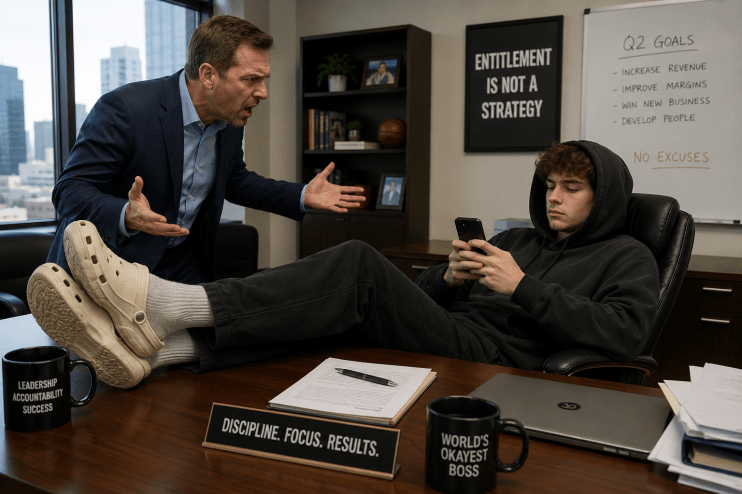
Over half of UK employers are worried about Gen Z behaviour and professionalism. Here’s three things they can do, according to Eliza Filby
‘Why won’t our graduates just pick up the phone?’ is the most frequent complaint I hear from leaders. It may be the point of most frustration but it’s far from the most outrageous. I’ve been told of new recruits prioritising Pilates over deadlines, meeting a major client in a hoodie and crocs, bringing their parents to their annual review – and this is before we get on to AI generated slop masquerading as work.
So, I wasn’t surprised to hear last week that over half of UK employers are worried about graduate behaviour and professionalism. Employers cited concerns about their communication skills, motivation, resilience and workplace etiquette – with AI applications (surprise, surprise) not helpful in deciphering talent at the application stage. In fact, it’s creating a glaring discrepancy between the application and the applicant.
Given the woeful state of the current graduate employment market, why aren’t these youngsters more grateful, deferential and fastidious? I hear you cry! But brush aside any generational prejudice for a moment, because in all these complaints, employers are missing the deeper story. This lack of traditional professionalism isn’t an indictment of a generation, but an indication of how the workplace has changed. It also helpfully hints at a way forward.
Parental dependency
Let’s look at a generation who are coming through your doors. Thanks to modern parenting, tech and education culture, your new professional recruits are a product of time-short, working parents who were prone to over-parent and under develop resilience and independence in their offspring. Parents who were less likely to enforce chores in the home, and more focused on homework and extra-curricular activities than part-time paid work or unsupervised play. Your new recruits were recipients of an exam-focused and individualised education system where everything seemed high stakes, failure wasn’t an option and anxiety was the by-product. They experienced a digital youth with no landline, a lockdown and a tertiary education system dominated by a customer ethos, some buyer’s remorse, and definitely ChatGPT. They’ve come of age in an algorithm-centric world where everything is bespoke, feedback is constant, anything can be delivered to your door, and you can get through most days without friction or speaking face to face to anyone. Finally, they’ve entered adulthood in an economy where parental dependency is a lifeline and a leg up, they have £50k student debt and rising, and even as employees on a relatively (sometimes very) good wage, they will still be more reliant on their parents than their company when it comes to buying a home. And yet leaders still expect these young workers to arrive fully formed, professionally fluent and full of hunger and deference.
I exaggerate here, of course, but some if not most of this is true for the majority of professional class in the UK and frankly, most of the western world. You may disregard generational labels, but as an employer, I would entreat you to understand how the world has changed. Many know this situation intimately of course; they tolerate some of this with their kids at home even if they are unwilling to understand it at work.
So, what is to be done? Aside from a revolution in the economy, education and parenting, I would suggest there are three things that employers can do. Because in running a business, we need to deal with how the world is, not how it was or how we would like it to be.
Fix recruitment
Firstly, recruitment is in a terrible mess. And while AI sorting is making it worse, it’s not the main problem; false marketing is. Most major companies seeking to hire the “highest achieving” are guilty of what I would call corporate airbrushing. The website, marketing blurbs, even the company Tiktok emphasizes how fun, glamourous and fulfilling it is to work there. Is it really accurate to talk more about the company’s CSR record than the relentless working hours, for example? Tell the truth, and seek out the people with the right attitudes, aspirations and realistic view of what it takes to progress.
And it’s highly likely that AI may be screening these people out because they are impossible to find from a traditional CV. If you want the most committed candidates, seek out those who are supporting their parents, rather than those funded by them. If you want creativity; it will be those with a non-linear path. If you want those deferential, it will be those who grew up in more religious or multi-generational households. You can’t determine or ask this of course, but my point is it’s got nothing to do with exams.
Etiquette
Secondly, the best companies in the world are realising that etiquette training is now a necessity and are making it a core part of the onboarding. Setting expectations early means fewer frustrations later down the line. The biggest problem I see is that guardrails aren’t set, only expected, and managers are too nice to say any different. So young people remain ignorant, leaders get frustrated and together it creates a horrible culture.
But there’s a bigger problem: No one is being trained properly because of the speed of digitalisation and the disconnection caused by hybrid working. Employers complaining about graduates lacking workplace polish would do well to interrogate how they’ve dismantled many of the structures that once taught people how to behave professionally in the first place. Older generations learned workplace behaviour by proximity. You overheard difficult phone calls. You watched how managers handled conflict. You observed office etiquette, hierarchy and diplomacy. Everyone is awkward at 21, but previous generations at least had the opportunity to learn through embarrassment, observation and repetition. As workplaces have optimised for productivity and flexibility, they’ve destroyed the moments, the space and the time for their new recruits to learn and I’m afraid AI is making this worse. It’s not skills that are lacking; its socialisation and the time to fail.
Reciprocal responsibility
Thirdly, help your new recruits understand the deal. And I’m not talking about money versus time. I’ve given a lot of speeches helping C-suite understand Gen Z, but focusing only on the top doesn’t solve the problem, because the awareness is only going one way. In a transactional world, where we all think in terms of ‘I’ not ‘we’, one of the most valuable things you can do for them is to help them generate a sense of reciprocal responsibility. This is the hardest bit because it requires time and investment and it can only come if someone feels heard, taught and valued in the first place.
Workplaces are dealing with several revolutions simultaneously: the collapse of traditional career ladders, the rise of hybrid work, economic stagnation, AI disruption and a generation that has grown up differently. So yes, some young workers probably do need to learn how to write a proper email and turn up to meetings on time. But companies also need to rebuild the environments where younger people actually learn how work works.
Dr Eliza Filby is a historian of generations and author of the Sunday Times bestseller Inheritocracy