

Carbon Offsets vs Carbon Credits

Carbon carbon carbon… if you don’t know what it is, I can only imagine you’ve been hibernating under a rock since dinosaurs roamed the Earth, and what is now coal was once trees.
It’s a hot topic of conversation, just like our current climate, and the increasing number of heatwaves in the UK and across the world. But before we delve into the details of offsets and credits, let’s go back to the basics.
What is carbon?
Carbon is made up of one type of atom. This means carbon is an element. Atoms of carbon can be arranged in different patterns which means that there are different forms of carbon. Each form of carbon, such as diamonds, graphite, and graphene, has its own unique properties.
In this instance, we want to focus on carbon dioxide (CO2) and carbon dioxide equivalents (CO2e), as it is these greenhouse gases (GHGs) that contribute to global warming and climate change, and where carbon offsets and carbon credits come into play.
CO2 is created when one carbon atom bonds with two Oxygen atoms. This chemical process creates a gas that not only surrounds us in the air, but is also soluble in water, and found in groundwater, lakes, oceans, and the rapidly melting ice caps.
The concentration of CO2 in the Earth’s atmosphere, prior to the industrial revolution which began in 1760, was regulated extremely efficiently by organisms and geological phenomena. Examples include trees, plants and algae using photosynthesis to absorb CO2 and producing pure Oxygen as a result.
However, since 1760, the burning of fossil fuels such as coal, gas and oil by us humans has been the primary cause of CO2 concentration levels increasing to frightening levels, and beyond the capacity that these wonderful organisms and geological phenomena can handle.
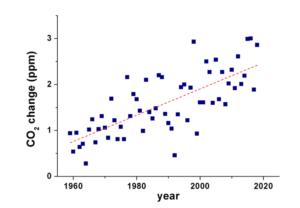
Since 1960, the atmospheric CO2 annual growth rise is 300%.
(Source)
This is not good news.
To address the global crisis of climate change, world leaders and scientists have set ambitious, necessary goals for worldwide emissions reductions. In the landmark Paris Agreement, 193 parties (192 countries plus the European Union) agreed to try to curb their carbon emissions enough to limit the increase in global temperatures to less than 2 degrees Celsius. In 2018, though, the Panel on Climate Change reported that even a temperature increase of 1.5 degrees Celsius would be catastrophic for the planet.
We are currently on track to a 2.7 degrees world by 2100
(Source)
Businesses, and in fact anyone, can look to understand the carbon emissions they create from their everyday activities – and this is where carbon offsetting and carbon credits can be factored in.
Carbon offsets and carbon credits
At their core, both carbon offsets and carbon credits are accounting mechanisms. They provide a way to balance the scales of carbon pollution. The big idea behind credits and offsets is that since CO2, and CO2e, are the same gases anywhere in the world, it doesn’t matter where emissions are reduced. For both consumers and companies, it makes financial sense to reduce emissions where it is cheapest and easiest to do so, even if that does not involve their own operations.
Carbon offsets and carbon credits serve two different purposes
– A carbon offset is the removal of GHGs from the atmosphere and is usually a voluntary action by a company or an individual, for example an individual choosing to offset the emissions from a flight.
– A carbon credit is the reduction of GHGs released into the atmosphere and typically isn’t voluntary, for example an energy-intensive organisation required to achieve compliance with GHG emission reduction requirements
Carbon offsets are produced by independent organisations, schemes or projects that either pull CO2e emissions from the atmosphere (for example through nature-based solutions such as tree-planting) or that displace fossil-fuel emissions from conventional power plants (for example through renewable energy development) The offsets are then sold to companies that emit (or have emitted) CO2e. In a sense, offset-producing organisations or schemes are directly funded by those companies that emit GHGs.
Carbon credits, on the other hand, are generally “created” by the government. Governments limit the amount of GHGs organisations can emit by placing a cap on them—a specific number of tons of CO2e that the company can emit. Each of those tons are referred to as a carbon credit.
Is one better than the other?
They both have their benefits and flaws – what is key is carrying out quality research to understand what carbon offsets, and carbon credits, mean for you and your business.
The very first step (and often the most complicated), is understanding your baseline data. How much carbon do you emit on a daily/ weekly/ monthly/ annual basis? However frequently you choose to measure, drilling down and understanding what these figures are, is necessary to subsequently know how many carbon offsets or carbon credits are required.
Currently, in the UK, The Emissions Trading Scheme (ETS) only applies to energy intensive industries, the power generation sector and aviation.
Any business or consumer should ALWAYS try and reduce their emissions wherever practically possible, and as much as they possibly can. Carbon offsets and carbon credits should not be used as a scapegoat to making little or no change to the way you do business and the emissions you create in a business or personal capacity. They need to go hand in hand whilst reducing your emissions.
Skepticism over the real carbon-removing credentials of projects is growing, and only a tiny fraction of projects actually remove CO2 from the air. Whilst the demand for carbon markets offsets increase, so will the money-making cowboy companies out there looking to make an easy buck without doing any of the work. To prevent falling prey to these, look for the Gold Standard logo certification mark program for non-governmental emission reductions projects in the Clean Development Mechanism, the Voluntary Carbon Market, and other climate and development interventions.Here at FuturePlus we understand that the world of carbon can be confusing. We can provide guidance on projects that support local communities, biodiversity, ecosystems, plus more. On top of this, we have a number of partners who specialise in helping businesses understand their carbon footprints. So why not get in touch and start your journey here: [email protected]