Skip to content
Friday 24 July 2026London --:--Frankfurt --:--Zurich --:--
NewslettersSearchEN · DE
City PM

European business, markets and politics

FTSE 100
10,686.23
+0.44%
DAX
24,944.61
+0.73%
CAC 40
8,324.14
+0.30%
STOXX 50
6,253.18
+0.69%
  • Europe
  • Markets
  • Business
  • Economy
  • Technology
  • Politics
  • Opinion
More
GermanyFranceBankingAIEnergyFintechPropertyCapital Markets
  • Germany
  • France
  • Europe
  • Markets
  • Business
  • Economy
  • Technology
  • Politics
  • Opinion
  • DE
Tuesday 14 June 2022 11:01 am  |  Updated:  Tuesday 14 June 2022 5:12 pm

Brits’ living standards drop at quickest pace in over a decade

Preparations Are Made Around London For Queen Elizabeth II's Platinum Jubilee
Take pay home dropped 2.2 per cent over the three months to April, the steepest drop since 2011, according to the Office for National Statistics (ONS) (Photo by Carl Court/Getty Images)

Brits’ living standards are falling at the fastest pace in over a decade caused by historically high inflation outstripping pay, reveals official figures published today.

Take home pay, accounting for price rises, dropped 2.2 per cent over the three months to April, the steepest fall since 2011, according to the Office for National Statistics (ONS).

The figures underscore the scale of pressure households’ budgets are under from a cost of living crunch driven by soaring energy bills, tax hikes and rising petrol prices.

Despite trailing price rises, nominal wage growth of 4.2 per cent “was above the pre-pandemic norm and… will probably give a majority on the [monetary policy committee] the green light to raise bank rate this week,” Martin Beck, chief economic adviser to the EY Item Club, said.

The Bank of England is expected to lift rates by at least 25 basis points to 1.25 per cent this Thursday. Some investors think governor Andrew Bailey and co will go further and hoist them 50 basis points.
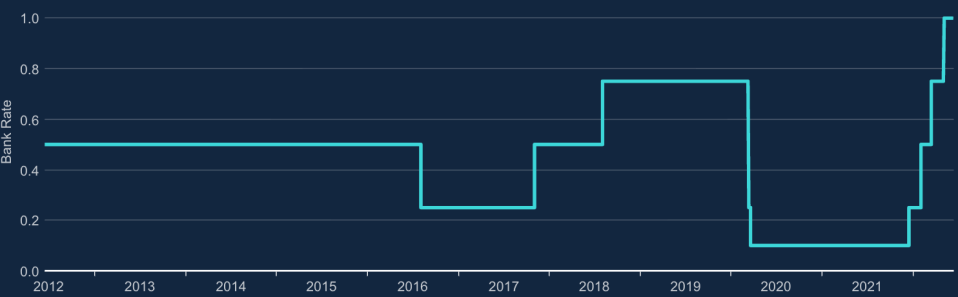
The Bank of England has hiked rates at each of its last four meetings, taking them to a 13-year high of one per cent (SOURCE: Bank of England)

Higher rates will tighten the screw on a British economy that is in the teeth of a slump, primarily caused by households cooling spending in response to rampant living cost jumps.

Output has not grown since the first month of this year and contracted in March and April 0.1 per cent and 0.3 per cent respectively.

The cost of living climbed to nine per cent in April, the highest rate since the 1980s, but is forecast to top 10 per cent later this year.

The UK is suffering from higher inflation compared to the US and eurozone due to extreme tightness in its labour market and exposure to European energy prices that have surged since Moscow sent troops into Ukraine.

Analysts have warned strong upward wage pressures caused by tension in the jobs market may result in high inflation being embedded in the economy over the long-run.

Read more

IHT receipts hit record high as Rachel Reeves’ frozen bands raid plague Brits

Inheritance tax receipts are on track for a record breaking year

Workers tend to demand pay bumps amid price rises, prompting firms to hike prices and, in turn, sparking more pay increase demands. This process is known as a wage/price spiral.

However, today’s figures suggested tension in the labour market may be unwinding.

Joblessness jumped to 3.8 per cent in April and economic inactivity dropped for the first time since last October.

This rise in the number of available workers should, in theory, keep a lid on wage growth by weakening workers’ bargaining power.

“It is possible that this is the very first signs that the weakening in economic activity since the start of the year is filtering through into a slightly less tight labour market,” Paul Dales, chief UK economist at Capital Economics, said.

Although easing the inflation outlook, early signs of softness in the jobs market will strengthen fears the UK economy is headed for contraction this quarter and may even tip into recession – defined as two consecutive quarters of contraction – this year.

Demand for workers remains extremely strong, with vacancies jumping to another record of 1.3m, while the ratio of vacancies to every 100 employee jobs also remained at a record high over the three months to April.
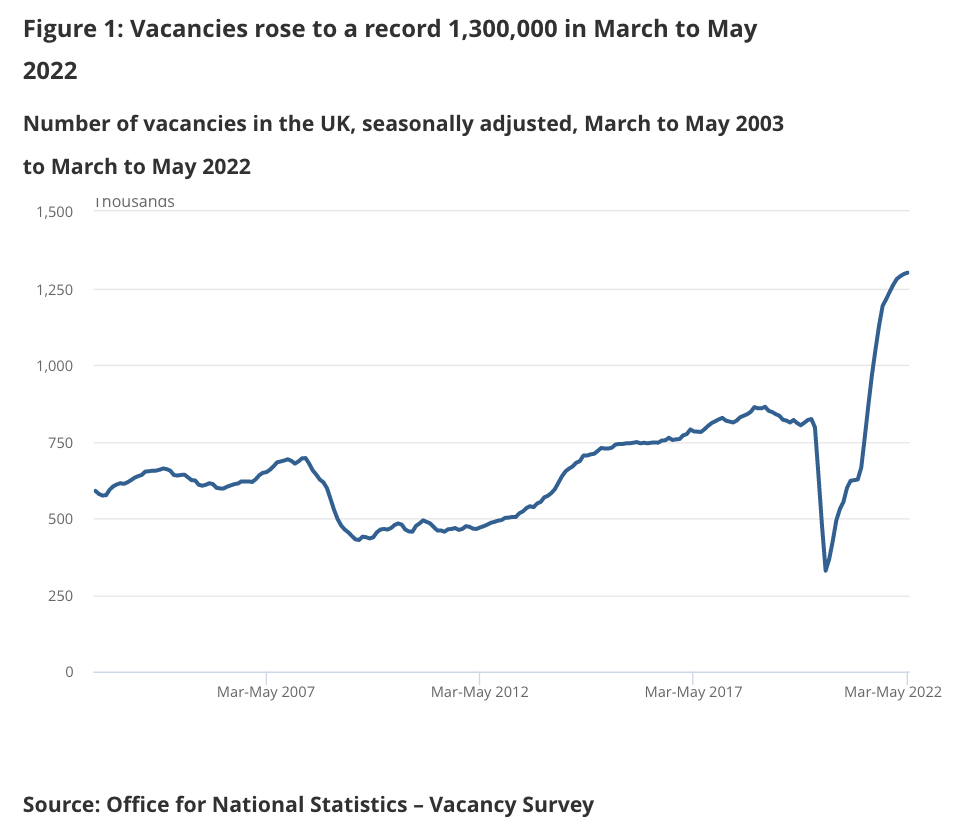
Vacancies have smashed record highs for several months in a row

Businesses are struggling to find workers amid a shallower labour market, prompting them to curb activity. This could weaken UK growth by hamstringing firms’ capacity to step up production to meet demand.

“There is not yet any sign of the economic slowdown affecting the jobs market, but if we don’t address the fact that there are not enough people looking for work, this could put another dampener on the UK’s economic growth,” Neil Carberry, chief executive of the Recruitment and Employment Confederation, said.

Read more

FCA eyes tougher AI rules as Brits turn to chatbots for financial advice

An all-party parliamentary group said on Tuesday that the FCA's treatment of both internal and external whistleblowers was “alarming”.

Share this article

  • Facebook
  • X
  • LinkedIn
  • WhatsApp
  • Email

Similarly tagged content:

Sections

  • Markets & Economics
  • News

Categories

  • Economics

Related Topics

  • UK jobs, employment and wages

Trending Articles

  • BT braces for loss of 800,000 customers as it banks on fibre to keep turnaround ‘on track’

  • Regulator flags BDO’s ‘unacceptable’ audit issues for fifth year in a row 

  • Tax rises ‘guaranteed’ as Healey faces £22bn black hole from Burnham spending plans

  • ‘We are going to run out’: Mitie marks eleventh mega takeover of 2026

  • Greek wine perfectly suits summer. These 5 bottles are the best

More from City PM

  • IHT receipts hit record high as Rachel Reeves’ frozen bands raid plague Brits

    Personal Finance
    Inheritance tax receipts are on track for a record breaking year
  • FCA eyes tougher AI rules as Brits turn to chatbots for financial advice

    AI
    An all-party parliamentary group said on Tuesday that the FCA's treatment of both internal and external whistleblowers was “alarming”.
  • OBR misery makes tax rises inevitable

    Opinion
    Treasury Department building with government bonds signage, representing financial management and bond issuance responsibi...
  • The City will bid good riddance to Rachel Reeves

    Opinion
    Reeves Bank exterior with modern architecture, showcasing its sleek design and prominent logo on a sunny day.
  • Wealthy Brits fear Burnham tax consequences

    Personal Finance
    Andy Burnham, Mayor of Greater Manchester, speaking at a podium with microphones.
  • ‘False dawn’: June inflation falls to 2.6 per cent but analysts say rises ahead

    Economics
    Till sales growth slowed to 2.7 per cent in the last four weeks
  • Brits dodge the high street as heatwave boosts online shopping

    Retail
    Shoppers carrying various retail bags, including New Look and M&S Food, on a paved street, indicating retail sales activity.
  • Businesses can’t keep waiting for political stability

    Opinion
    Canada boundary dragon statue symbolizing economic uncertainty amidst political instability
CityPM

Independent European business, markets and political news for decision-makers.

Morning Briefing

Europe

  • Germany
  • France
  • Europe
  • UK & Ireland

Business

  • Markets
  • Banking
  • Technology
  • Energy
  • Property
  • Fintech

Editorial

  • Opinion
  • Editorial Policy
  • Corrections
  • Contact

Company

  • About City PM
  • Privacy Policy
  • Terms of Use
  • Cookie Policy
© 2026 City PM Ltd · Published by CityPM Media, Bahnhofstrasse 65, 8001 Zürich, Switzerland
Privacy · Terms · Cookies · Facebook