
After British Steel, what else will the government nab for national security?

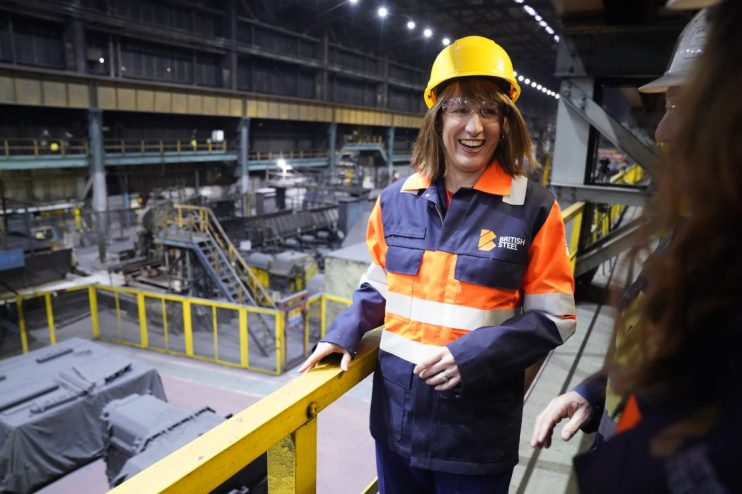
The potential nationalisation of British Steel in the name of ‘national security’ must make us ask what the government will justify next, writes Eliot Wilson
The dust has settled on the latest chapter of the British Steel saga. Parliament was recalled on Saturday 12 April and the government hustled through legislation which allowed it to “take control” of the troubled company, though it has not yet nationalised it. Ministers put on their most serious faces, and business secretary Jonathan Reynolds told the House of Commons that he was acting “to protect this nation’s assets and economic security”.
Emergencies are a good opportunity for governments, because the loudly ticking clock which hangs over them allows difficult questions to be brushed aside and hectically muddy thinking to be ignored. In this case, that cannot be allowed. If British Steel was taken under public control as a matter of national and economic security, we are entitled to ask what criteria apply to this category. In other words, what else might the government do for the same reasons?
What is the criteria for ‘national security’?
Reynolds is not a big beast of his portfolio like Lords Mandelson or Heseltine, but he has a degree of political acuity, and he was at pains to stress that the situation of British Steel was “exceptional and unique”. This was partly to head off the complaints of the Scottish National Party that there was no such urgent assistance for the endangered oil refinery at Grangemouth. But the argument will not wash.
It is argued again and again that for the United Kingdom to lose the capacity to make virgin steel – produced from raw materials rather than recycled scrap steel – would be an unthinkable blow to our defence, resilience and sovereign industrial base. That may or may not be so. But it hardly seems plausible that this is the only form of manufacturing which we must protect at all costs. The nationalisation of Sheffield Forgemasters in 2021 because of its links with the production of nuclear submarines demonstrated that.
The government therefore needs to be much clearer and more systematic. There are two main questions which have to be answered: how does it define a critical industrial capacity which we cannot lose, and what principles guide the government’s plan to preserve them?
In answer to the first, no-one expects the Department for Business and Trade to issue a list of relevant companies, but parliamentarians and the public are entitled to understand how decisions in the future will be made. This, at the risk of sounding like a stern but regretful schoolmaster, is for the government’s own good: it would be much easier to explain which British Steel was a different case from Grangemouth or the Port Talbot Steelworks or Harland and Wolff if it could point to a consistent and coherent set of principles.
What is the future for British Steel?
The second question matters because of potential cost. While British Steel has not been nationalised, there seems to be a widespread expectation that public ownership is the inevitable next step. This may be an expensive enterprise, but where is it leading? Sheffield Forgemasters now seems ensconced under the ownership of the Ministry of Defence. If British Steel is nationalised, does the government intend to maintain it as a state-owned industry – because that is the ultimate guarantee of national security – or will it be a transitional period while a more stable private buyer is sought?
Donald Trump’s introduction of dramatic and swingeing tariffs has focused minds on how far the globalised and interdependent economy is compatible with the economic and industrial aspects of national security. It is easy to create doomsday scenarios to defend a policy and make any criticism seem foolish or irresponsible, but it is not always accurate. The absolute necessity of being able to produce virgin steel has been questioned in terms of its superiority over recycled steel, and in terms of the likelihood of the UK having no allied country which would supply it even in times of national emergency.
The industrial resilience of the United Kingdom is important, and the government should not be faulted for recognising that. But it can never be complete: a small island simply cannot aim at self-sufficiency on a kind of North Korean juche model. There will always be compromises and challenging decisions, and the government needs to be clear in intellectual terms how it will approach them. We cannot wait for the next moment of “exceptional and unique” crisis.
Eliot Wilson is a writer and strategic adviser