
The robotics revolution: Why investment in robots is booming

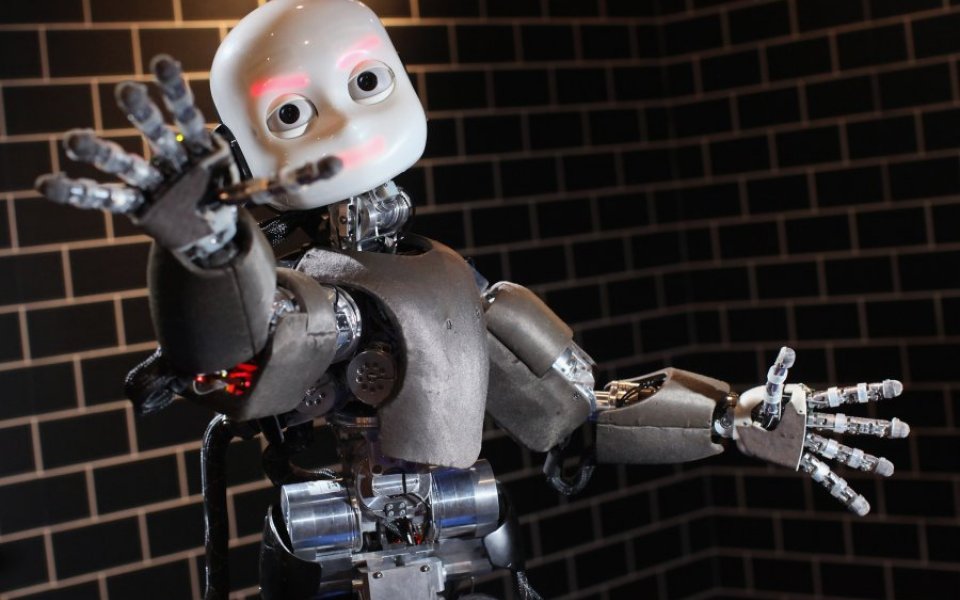
Robots are continuing their long march towards world domination. Their ultimate supremacy over humans is predicted to be reached in 2035, the point in time when robots will begin to develop at a faster rate than us mere humans can comprehend.
But right now, robots have reached a point of intelligence where they will soon be able to assist humans in every kind of industry, in ways previously unthinkable.
There’s talk of an “industrial revolution” just around the corner, one that’s akin to the rise of the internet.
“It’s similar to the internet and mobile phones. Everyone could see their potential but it took time for the technology to improve. We are getting to the stage where robots are going to be out and in our world, going from niche activities in car factories to the mainstream,” explains Matt Brett of Baillie Gifford.
GREAT LEAP FORWARD
It’s all down to the giant leaps that have been made in robotics. The most high profile innovations are Google’s driverless cars, Amazon’s delivery drones, and 3D printing. Other advancements include robots that perform surgery while doctors watch, crop-spraying and seed-spreading drones which will vastly improve processes in agriculture, and un-manned household gadgets including lawn mowers and vacuums.
In Japan, there are plans to have driverless taxis on the road by the time of the Tokyo Olympics in 2020, says Robert Brooke of Man GLG. The bottom line is that robotics and automation are now so advanced that they are spreading out from car factories, where they have generally been confined to, into all kinds of industries.
THE ANDROIDS ARRIVE
The technological tipping point has been the development of advanced sensors. This has given robots the ability to sense and interpret the world around them. Until now, robots working in factories have had to be kept in cages away from humans, as any person getting in their way could be killed or accidentally disfigured. As time has gone on, the price of this advanced technology has come down and has made the adoption of robotics more appealing.
“Now we have a huge generation of collaborative robots that can work alongside humans,” says Karen Kharmandarian of Pictet Asset Management. “It is going to change the way that we work and live.”
Sensitive humanoid robots which science fiction promised would one day be commonplace are also now emerging. The first batch of a model called Pepper, developed in the Far East and able to detect emotion, sold out immediately. “It was a surprise to the industry how popular it has proved,” says Richard Lightbound of Robo-Global.
THE ECONOMICS
Behind the tech, the real force behind greater interest in robotics and automation has been the need for greater productivity in the global economy. “When it comes to demand, the key drivers in industry are the ever-present ones of wanting to reduce costs while increasing productivity and reliability,” says Brooke. “In Japan, an additional element has been the declining workforce, meaning that maintaining production demands increased automation. A similar trend is also set to become a driving force in China over the next few years.”
THE NUMBERS
There are at least 3,700 public and private companies in the sector. Many are well-established, and there are 150 companies with a market capitalisation of over $200m. There were a lot of mergers and acquisitions in the sector last year, totalling $2bn. This kind of activity is usually a sign an industry is maturing, as smaller companies are swallowed up by larger ones which want to expand and develop them.

INVESTING
In investment terms, the sector is hotting up. Last year there was $1.3bn in equity funding, or money given by investors to the companies behind the tech.
For private investors, there aren’t many dedicated investment funds out there. Several have recently launched, which means they’re first movers in the sector and are yet to be proven. A more cautious approach would be to invest in a well-established Japanese equities fund, as some of these have investments in robots.
For those seeking pure exposure to the theme, one is the Pictet Robotics fund, which is run by a well-established investment house that also has funds invested in other emerging trends. The fund launched in October last year. The fund’s managers pick the best companies from around the world to invest in. At the moment it has invested in 56 companies. Nearly half of these are in the US, the engine of the world’s technology industry. The rest are in Japan, China and spread across Europe. The fund has a total expense ratio of 1.25 per cent.
A different way of investing is through an exchange traded fund (ETF). One is called the ROBO Global Robotics and Automation Go Ucits ETF. It’s only recently launched too, but a simulated back-dated performance is shown to the left. This gives investors the performance of a basket of 79 companies from 15 countries around the world. The ETF’s managers won’t fiddle with the selection of companies. It has a total expense ratio of 0.95 per cent.
ROBO STATS
15-20% – The rate at which the global market for nonmilitary drones is growing every year
121.9% – Compound annual growth rate of 3D printing equipment 2015-2019 (Gartner)
+36% – Growth in industrial robotics supply in China between 2008-2013