
| Updated:
Low pay and precarious employment: How the beauty industry scars young women for life

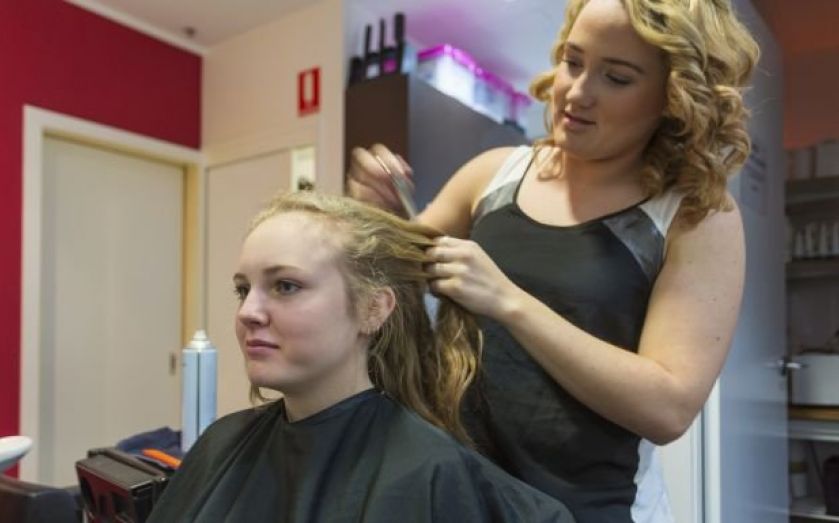
The career prospects of young women are being hindered by their tendency to apply to oversubscribed and often poorly paid jobs in industries such as hair and beauty, according to a report by the Young Women's Trust.
Called “Scarred for life?”, it shows that there are currently 418,000 women in England aged 18-24 who are not in employment, education or training (NEET). That is almost one in five young women, and there has been hardly any sign of improvement over the past decade.
Men, meanwhile, fare a little better. There are 320,000 men aged 18-24 who fall into the NEET category and they tend to find their way out of it after two years, whereas it takes an average of three years for women to find their feet.
What the report also shows is that once in employment, women who were unemployed in their youth can expect to earn an average of just £10,000 a year in their early thirties. Men who were unemployed in their youth will earn £21,000.
Why is this the case? Because of the types of jobs they are going for, according to the Young Women's Trust. It says that many young women chase oversubscribed jobs in the hairdressing and beauty industries, whereas young men are more likely to study facilitating subjects that are popular with employers and universities.
Furthermore, the beauty industry is more likely to subject employees to low paid, precarious employment. Evidence shows that while 27 per cent of female employees are paid below the living wage, 16 per cent of male employees are in the same position. It is likely that the jobs they are going for are the least secure and result in several periods of unemployment between low-paid jobs.
The report shows, for example, that while there are five jobs for every construction worker, each qualified practitioner in hair and beauty is competing with four other young people.
Unemployment higher for young women
The number of NEET individuals has remained consistently higher for women than for men over the past 13 years. According to the Office for National Statistics, the annual average during the time period was 430,000 NEET young women and 298,000 NEET young men.
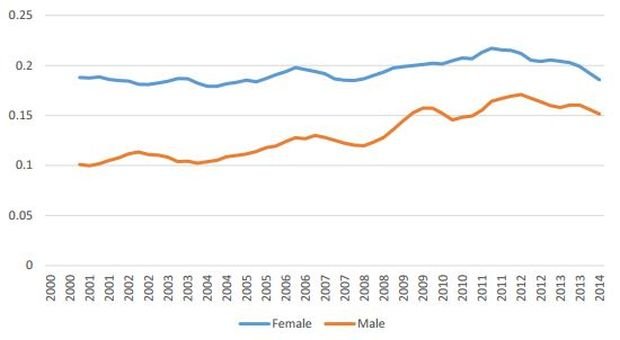
NEET levels for the genders between 2000 and 2014 (Source: Scarred for Life)
It should be noted, however, that fewer inactive women actually want jobs than inactive men do. In 2014, 24 per cent of inactive women wanted jobs in comparison to 29 per cent of inactive men. Inactive refers to those who are not employed and not taking part in any kind of education or training.
Dr Carole Easton, Chief Executive of Young Women's Trust, said: "Too many women are scarred for life by being NEET. Young women’s lives are being defined and determined by how they are at 18 or 20.”
It is not just the young women themselves who are feeling the effects of this trend. The cost of youth unemployment was over £10bn in 2012, and it is projected cost to the economy a further £28bn over the next decade.