
Will it work? Funding community energy projects

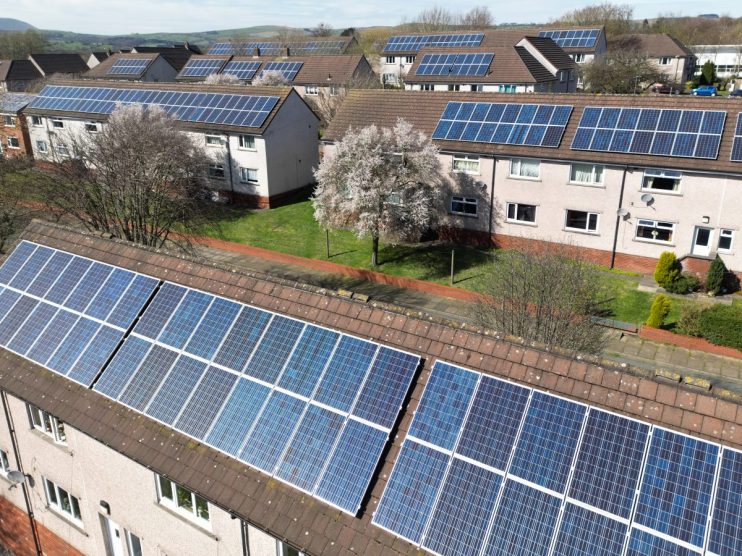
This election year politicians are giving us a barrage of policies. But will they actually work? In this column Sam Fowles takes policies on their own terms and asks whether they solve the problem they’re supposed to solve. This week: SNP plans to boost community energy projects
The SNP doesn’t want to govern the UK. But it might have a big influence on the next government’s policies. With some polls (albeit somewhat questionably) predicting a hung parliament, Sir Keir Starmer could find himself relying on SNP votes for a majority. So, what would the SNP ask for in return?
Setting aside the obvious (another independence referendum, which Labour has said it won’t grant), the SNP has long prioritised renewable energy. A particular favourite is community energy projects – these being green schemes set up, financed and owned (or partially-owned) by communities themselves. This dovetails with many in Labour (Ed Miliband has hinted at something similar).
What’s the Plan?
The SNP proposes a package of measures: grants and “soft” loans (where the state takes on some of the risk), state assistance to get projects off the ground (including feasibility studies and help with the legal and technical aspects) and a restored “feed-in tariff” whereby projects sell excess energy back to the grid.
Reasons to Get Excited
The measures have had a positive impact in Scotland. Between 2011 and 2023 community-owned renewable capacity increased from around 200MW to over 1000MW. Scotland now has enough community-owned capacity to power 25 per cent of households (or, alternatively, all of the UK’s street lights). This sits in a generally impressive Scottish renewables sector, producing equivalent to more than 100 per cent of Scotland’s electricity needs (about a quarter of all UK renewables generation).
Helpfully, the English community renewables sector offers a “control group” by which we can understand the comparative impact of the Scottish measures. In 2021 (the most up to date figures) England had less than 350MW equivalent capacity (Scotland had over 850MW at the time). Many projects stalled due to lack of capacity, failure of early-stage funding and insufficient access to expertise. Where Scotland provides professional support to community projects (often through charities like the Energy Saving Trust), England relies on volunteers). Growth in the English sector stalled since the government withdrew the feed-in tariff in 2017. It seems, therefore, that the Scottish measures have had a genuinely positive impact.
Does it Add Up?
But a positive impact for whom? Some 41 per cent of Scotland’s community renewables capacity is on “farm and estate” land. Land ownership tends to be more concentrated in Scotland than the rest of the UK. Half of all privately-owned rural land (approximately 7.9m acres) is owned by just 433 people or companies (including the Duke of Buccleuch and the owner of ASOS). It’s not clear whether the benefits of the Scottish government’s policies are going to genuine communities rather than aristocrats and billionaires.
Cause for Concern
The Scottish scheme relies heavily on subsidy. While the feed-in tariff is funded by energy suppliers, the rest of the scheme is paid for by the state. Critics will say that’s money the public purse isn’t getting back. But the energy industry, as a whole, is highly subsidised. From 2015-2023 the fossil fuel sector was handed £80bn by the state (renewables got around £60bn). The true subsidy to the fossil fuel industry is, according to the IMF, likely significantly larger when the cost of externalities is included. The real question for policy-makers isn’t one of “subsidy or no subsidy” but, rather, where it’s best to put the money.
How does it score?
Electoral appeal: 2/5
Value for money: 4/5
Effectiveness: 4/5
Originality: 3/5
Overall: 13/20
Verdict: It may not provide the lion’s share of energy any time soon, but communities down south would be grateful for some of Scotland’s measures.