
Why regenerative agriculture is the key to a better human

By Noam Bar CoFounder Ottolenghi & Kung Fu Mama, NED, Entrepreneur & Mentor
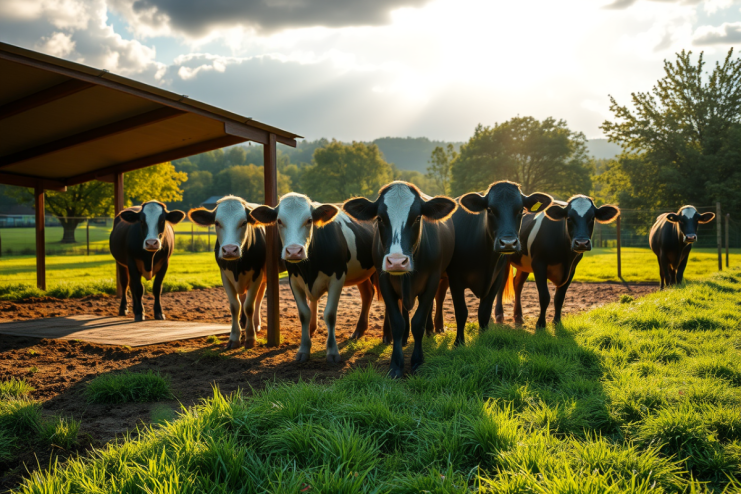
I was sceptical the first time I visited a regenerative cattle farm – inside the M25, in the suburbs of north-west London. The farmer, Jonathan, talked with boundless conviction about changing the way we grow food and how regenerative agriculture will save the world. I followed him, half-listening and half-entertained by the enthusiasm, until we arrived at the shed. It was midwinter and the cows were in an open shelter, chewing summer silage. I expected the usual ammonia-laden, nostril-burning air you get in most cow dwellings. Instead, the smell was different: it was manure, yes, but sweet, gentle and almost unobtrusive.
Smell is an ancient sense, part of our deepest systems and not governed by higher cerebral functions, so it cannot lie. The conviction was therefore immediate and resolute; it was my Damascus Moment; I was converted to the cause of regenerative agriculture.
This sparked a long-term passion that brought me to establish an organic kitchen garden for Ottolenghi, of which I am a co-founder in north London, and to be an advisor, customer, and vocal cheerleader for Wylde, the online regenerative farmers market.
The years of thinking about our food production practices and about their profound influence on our wellbeing as a species, convinced me that we must move towards a healthier food system.
Regenerative agriculture and gen evolve
When I was happily drafted to the cause of Gen Evolve, I realised that this acute need resonates perfectly with the principles behind the Gen-Evolve movement: restructuring and redesigning education, and hence life – through ownership, enterprise and cultivation of real-world skills.
The gestalt-based thinking that’s at the heart of Gen Evolve’s approach is also at the core of regenerative agriculture. Both rely on whole-systems thinking, on individuation of diagnosis and solution, on curiosity and on long-term thinking. Both approaches privilege patience, adaptation, the occasional trail-and-error and long-term stewardship over one-size-fits-all recipes and assessment; the healthy child and the healthy field are a mirror of each other.
Health, planet and society
Regenerative agriculture matters at three levels: health, ecology and economy. On the health front, food produced in biologically active soils tends to have richer micronutrient profile, plants that thrive in living soil can rely on a vast network of organisms, micro-organisms and fungi to facilitate access a broader spectrum of minerals and trace minerals. This means better nourishment for us and fewer dietary gaps to worry about. Regenerative methods also reduce reliance on synthetic pesticides and fertilisers, lowering chemical residues in food and environmental toxin loads in local communities.
For the planet, regenerative practices anchor carbon where it belongs, in the ground. Techniques such as cover cropping, rotational grazing and reduced tillage build soil organic matter, locking away carbon and improving resilience to extreme weather. Living roots year-round, richer margins and hedgerows assist biodiversity: insects, birds and soil microbes flourish where monoculture has flattened habitats. Better soil structure soaks up and holds water more effectively, which helps fields cope with drought and reduces runoff during heavy rain.
Achieving those ecological and health goals poses a challenge for us as a society. Historically, farmers were often undervalued, considered as simple people that did not manage to climb the urbanisation ladder – if not outright owned by the rich and powerful. This perception needs to flip. Farming, when done with care, is among the most consequential careers imaginable. It feeds us and heals the planet. A software update or a new marketing push might yield short-term gains; attentive soil management compounds benefit over decades.
That is where Gen Evolve’s involvement is crucial. Teaching children how food is produced, why soil matters and how ecosystems interweave and enrich each other will not be a niche extra-curricular activity in our school: expanding on these subjects is education as the highest calling and will be central to Gen Evolve’s curriculum.
The monoculture of bad education
I mentioned the resonance between comprehensive education and Gen Evolve’s approach; similarly, there’s a more sinister resonance between education that relies on one-model-fits-all and the industrial, chemically dependent mainstream agriculture, monoculture. Monoculture flattens complexity into uniform inputs: identical seeds, standardized fertiliser and routine pesticide regimes applied across fields regardless of microclimate or soil variability. The ecosystem of the soil is destroyed by the succession of chemicals applied to it and the micronutrients disappear. It’s a barren land on constant life sustenance.
Like bad education, this uniformity reduces the need for observation but increases chemical dependence (ref: ADHD drugs), erodes biodiversity (group-think citizenship) and externalises ecological costs (creation of non-participating members of society).
If schools, policymakers and consumers push for regenerative practices and embed them in curricula, farming can become an attractive, viable career for young people while restoring ecosystems and improving public health across communities for generations to come. Gen Evolve offers a practical route to effect that shift, by combining farming classes in-vivo, enterprise and real-world skills and by educating graduates who can steward land, innovate responsibly and build resilient eco-systems.
Career advantages of whole-systems thinking
Gen Evolve’s approach will also bring tangible career advantages: in an era of artificial intelligence and automation, human-centred skills become even more valuable. Many routinised, office-based roles will shift or contract soon, but decisions rooted in a complex local context, which cover crop suits a particular field, when to rest a paddock, how to manage a micro-wetland, will still depend on local knowledge, observation and judgement. Pupils studying regenerative farming will develop empathy for living systems, pattern recognition and adaptive decision making; qualities that would set them apart in the job market, either as farmers, or in other areas.
There is nothing I would love more than my sons, now eight years old, maturing to value work that resonates with the earth’s complexity, respecting its inherent wisdom and healing it. Whether they become farmers or bring regenerative thinking into other careers, the goal would be the same: educate children that treat nature and the human and natural environment around them, with attention, care, empathy, wisdom and skill, not as something to be patched up with chemicals or short-term fixes. This mix of science, craft, attention and care is where our focus as a society should be, and this is where Gen Evolve’s blueprint can make a real difference to our next generation.
Join the movement as a parent or an impact investor here ; www.genevolve.org