
Why don’t we mutualise British Steel?

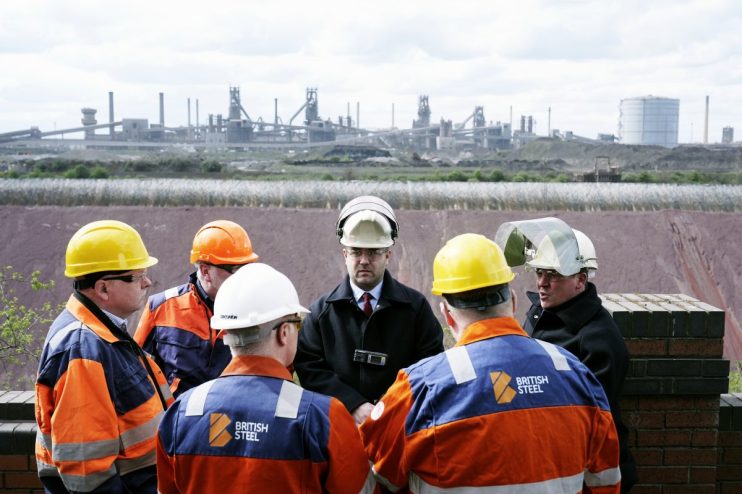
It’s not just nationalise or privatise, there is a third way for British Steel – and it’s a win-win, writes Bartek Staniszewski
On 12 April, the government took control of the Scunthorpe Steelworks to save it from closure, sparking renewed interest in the matter of nationalisation, and not just for British Steel. The SNP recently called for nationalising the oil refinery at Grangemouth while the Labour MP Brian Leishman called for the nationalisation of all “[k]ey essentials”. But private or nationalised are not the only options available to Labour. Instead, the government should consider selling failed industries to the workers who run them: mutualising them.
Nationalisation is fairly popular among the British public. Net support for nationalisation is positive among them not just in the case of steel, but also water, rail, energy, the National Grid, Royal Mail and care homes. Among Labour voters, there is even net support for nationalising Ticketmaster. But nationalisation is also expensive – nationalising just the water sector could cost as much as £90bn upfront – and continues to weigh down public finances as the state is forced to subsidise inefficient, failing industries. Public companies also tend to be badly run. Between 1997 and 2022, public sector productivity increased by only four per cent. By comparison, over the same period, in the UK private sector this was almost 40 per cent.
The benefits of mutualisation
Mutualisation shares none of those disadvantages. It is far less expensive, as the government can lend money to employees who wish to participate in the takeover and recoup it later without ever having to bear the burden of making up for the company’s losses. And it is great for productivity. In 2008, then-Prime Minister Tony Blair began selling some NHS Trusts to their employees forming so-called ‘public service mutuals’. Those mutuals have since averaged 3.7 per cent annual productivity growth, completely dwarfing the 0.3 per cent yearly productivity growth in public sector non-mutuals over the same period. Indeed, employee-owned companies are on average around 10 per cent more productive than even other private companies, let alone state-owned enterprises. When people have an actual stake in the business they work for, they consistently work harder and innovate more.
Importantly for “key essentials”, mutuals are also very resilient. Throughout the Covid-19 pandemic, the number of mutuals in the UK actually increased even as the overall number of businesses fell. Since employee-owned mutuals are not run for the benefit of disconnected shareholders – but rather for the very people who work for the business – they make decisions which prioritise job retention and long-term business stability over short-term profits.
Starmer can have his cake and eat it with British Steel
This would not be the first time that the UK government has looked at mutualisation as a golden mean between costly nationalisation and unpopular privatisation. Besides the aforementioned public service mutuals first created under Blair, mutualisation of state enterprises was also common in the Coalition period and under the governments of John Major and Margaret Thatcher, the latter of whom sold the National Freight Consortium to its employees in 1982. And although discussions took place last year to attempt the mutualisation of Royal Mail before it was sold off to the Czech billionaire Daniel Křetínský, this sadly failed to materialise.
As calls for nationalisation continue, the government should avoid buckling to popular pressure and going for the tried-and-failed option – steel was already nationalised twice, first in 1949 and then again in 1967, only to end up under state control again today. Mutualisation will not be right for all industries, but, in some cases, Starmer might just be able to both have his cake and eat it – take control away from corporations and put it into the hands of working people without the inefficient and expensive British state gobbling up yet more of the British economy.
Bartek Staniszewski is head of research at Bright Blue