Skip to content
City PM
  • Germany
  • France
  • Europe
  • Markets
  • Business
  • Opinion
  • DE
  • Germany
  • France
  • Europe
  • Markets
  • Business
  • Opinion
  • DE
Thursday 02 November 2023 4:31 pm  |  Updated:  Thursday 02 November 2023 4:37 pm

Why did the Bank of England opt for a ‘hawkish’ hold despite bleak growth outlook?

By: Chris Dorrell

Add as a preferred source on Google
The latest clutch of data is unlikely to change the Bank of England's thinking ahead of its decision on interest rates next week.

For the second time in a row, the Bank of England has left interest rates on hold.

Although markets were more or less certain that the Bank rate would be held at 5.25 per cent, the Bank’s hawkish tone caught them by surprise.

In a statement, the Monetary Policy Committee (MPC) said rates needed to be “restrictive for an extended period of time”.

Andrew Bailey, the Bank’s Governor, warned markets that it was “much too early” to be talking about cutting interest rates. Indeed, he said the MPC would be “watching closely to see if further rates increases are needed”.

Yael Selfin, chief economist at KPMG UK, characterised the decision as a “hawkish hold”.

Alongside the rate decision today, the Bank of England published its latest forecasts for the UK economy.

The forecasts made for bleak reading. The UK economy is expected to remain stagnant next year with some semblance of growth only returning in mid-2025. By then, unemployment will have picked up to around five per cent.

So why is the Bank talking about hiking rates further?

On one level the answer is simple. The Bank of England has a two per cent inflation target and inflation currently stands at 6.7 per cent.

Read more

Interest rates next change ‘far more likely down than up’

The Bank of England's Andrew Bailey will be closely monitoring movements in long-dated bonds

The forecasts suggest it will drop to around 4.5 per cent by the end of the year, largely thanks to falling energy and food prices. But next year progress will be much slower, with inflation only projected to fall to 3.1 per cent by the end of 2024.

This persistence in inflation – unlike the rapid rise from a supply shock – is predominantly domestically driven. The MPC said “second-round effects in domestic prices and wages are expected to take longer to unwind than they did to emerge”.

The reason is the UK labour market remains tight, which has supported strong wage growth. Despite unemployment rising faster than expected, wage growth – a key indicator of domestically driven inflation – remains at record levels.

The Bank itself acknowledged that “there is significant uncertainty about the rate of unemployment consistent with meeting the two per cent inflation target in the medium term”.

Reflecting this, the Bank of England increased its estimate of the equilibrium rate of unemployment from 4.25 per cent to 4.5 per cent. In effect, this means that the Bank thinks it needs to see a higher rate of unemployment in order to bring down wage growth, which in turn will bring down inflation in the medium term.

The Bank pointed out that employees have been seeking higher pay packets to compensate for rising prices but also noted there was evidence that “the efficiency with which vacancies are matched to those seeking work has decreased over recent years,” which also pushes up the equilibrium rate.

As Paul Dales, chief UK economist at Capital Economics summarised: “The Bank now thinks that the labour market will support wage growth by more for longer.”

This is the root of the Bank of England’s anxiety.

Read more

Inflation expectations at record high in interest rates signal

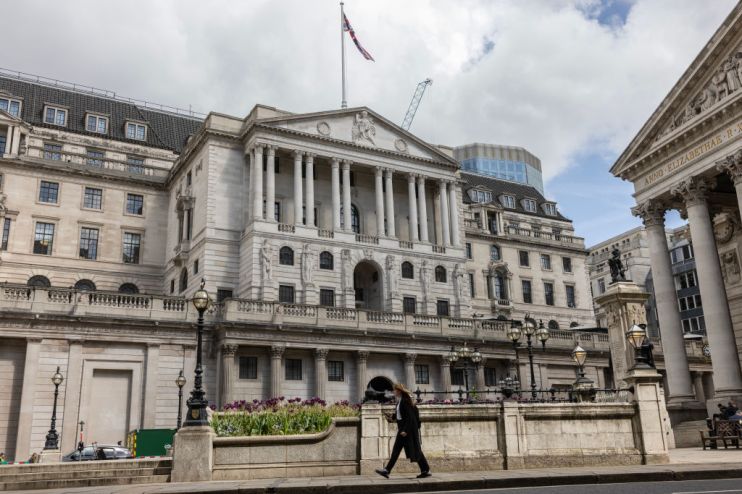
Bank of England building on Threadneedle Street, London, showcasing its historic architecture and financial significance

Share this article

  • Facebook
  • X
  • LinkedIn
  • WhatsApp
  • Email

Similarly tagged content:

Sections

  • Markets & Economics

Categories

  • Economics

Related Topics

  • Bank of England
  • UK inflation
  • UK interest rates

Trending Articles

  • Burnham tax plans spark investor rush to bank capital gains

  • Nothing fails to file accounts months after dissolution threat

  • I’ve taken the best train trips in the world. Here are my 5 favourites

  • Cruyff turn: Starmer allows pubs to stay open for England World Cup game

  • Nottingham Forest owner Marinakis announces £210m stadium plans

More from City PM

  • Interest rates next change ‘far more likely down than up’

    Economics
    The Bank of England's Andrew Bailey will be closely monitoring movements in long-dated bonds
  • Inflation expectations at record high in interest rates signal

    Economics
    Bank of England building on Threadneedle Street, London, showcasing its historic architecture and financial significance
  • Bank of England to ‘tolerate slow return’ to inflation target as interest rates held

    Economics
    Bank of England Governor Andrew Bailey said cited several indicators that the labour market was softening.
  • Inflation stays below three per cent despite price warning

    Economics
    The Bank of England is expected to hold interest rates at four per cent due to stubbornly high inflation.
  • Bank of England should hold interest rates, City PM Shadow MPC says

    Economics
    Bailey Boe in professional attire speaking at a business conference with a presentation screen in the background.
  • Interest rates set to be held as inflation to remain ‘elevated’ despite Iran peace deal

    Economics
    For the first time in months, economists are unsure whether the Bank of England will cut interest rates.
  • Interest rate cut is ‘off the table’, says Bank of England governor

    Economics
    Governor Andrew Bailey has launched a defence of the Federal Reserve's independence.
  • As it happened: Stocks sink after Fed and Bank of England opt for hawkish hold; Oil price tumbles

    Markets
    Bank of England building on Threadneedle Street, London, showcasing its historic architecture and financial significance

City PM — European politics, business and analysis.

Europe

  • Germany
  • France
  • Europe
  • UK & Ireland

Topics

  • Business
  • Markets
  • AI
  • Technology
  • Opinion
  • Energy

More

  • Politics
  • Economics
  • Fintech
  • Legal
  • Sport
  • Life

Company

  • About City PM
  • Editorial Policy
  • Corrections
  • Contact
  • Terms of Use
  • Privacy Policy
  • Cookie Policy
© 2026 City PM · Published by CityPM Media, Bahnhofstrasse 65, 8001 Zürich, Switzerland
About · Editorial Policy · Corrections · Contact · Privacy