
Who’s buying your business? Don’t wait until you’ve built it to decide – here’s why


Investors and founders agree: the moves that make a business genuinely sellable happen years before anyone puts an offer on the table.
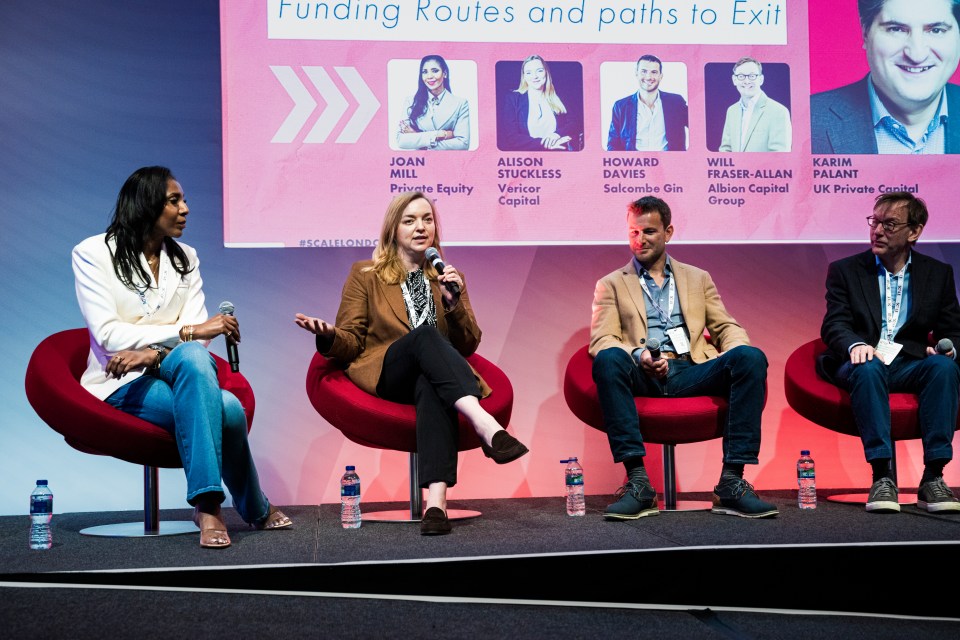
At SCALE London 2026, the summit for entrepreneurs, investors and growth partners, the panel The Long Game: Funding routes and paths to exit had founders glued to the stage.
Founders too often treat exit planning as a late-stage problem, something to sort out once a business is mature enough to attract interest. SCALE’s assembled experts disagreed.
Chaired by Karim Palant, Director of External Affairs at UK Private Capital, the panel brought together Will Fraser-Allen, Managing Partner at Albion Capital LLP, Allison Stuckless, founder of Vericor Capital, Joan Mill, a private equity advisor and tech investor, and Howard Davies, co-founder of Salcombe Distilling Company.
Between them they’ve experienced decades of exits, acquisitions and near-misses. One thing they all agree on is that the decisions that determine whether or not an sale goes well are made years before buyers start sniffing around.
Decide who’s buying you, and build towards them
Howard Davies settled on his exit strategy at a barbecue in 2014, before the first bottle of Salcombe Gin had launched. “From day one we decided to build and structure the business around the idea of being acquired by LVMH,” he said. LVMH (Moet Hennessy Louis Vuitton) had a strong spirits portfolio but to this day there is no gin brand in it.
Naming the acquirer early defined what the business needed to prove. “What would they be looking for in terms of brand differentiation, market positioning, gross margin? What territories would we need to demonstrate we’d succeeded in to be on their radar for acquisition?” Every decision was shaped by trying to answer those questions, Howard explained.
PE investor Joan Mill agreed it was a habit worth copying, whatever sector you’re in.
However mad it might seem, say out loud whoever is the best acquirer for your business. Do your research, look at the businesses they’ve bought in your segment, and get a sense of how you could fit into that category. – Joan Mill
Lesson for founders: Don’t retro-fit your business to your buyer. Pick your likely acquirer early and reverse-engineer what they’d need to see, rather than waiting until you’re actually for sale.
Keep the cap table clean
Joan was direct about what puts her off a deal before she has even looked at the numbers. “I’ve looked at businesses with a cap table of 20 or 25 people, and I’ve said ‘Absolutely not!’ Because when it gets to the next stage, whether it’s series A or B, it gets very complicated when it comes to valuation.”
Howard’s experience backed this up from the founder’s side. Salcombe’s early crowdfunding rounds risked putting hundreds of small investors directly on the cap table. “We were like, ‘no way do we want a thousand people on our cap table’,” he said, until they found a platform offering a nominee structure instead. Keep your shareholder list simple, otherwise it becomes a distraction from running the business, and a red flag to whoever eventually buys it.
Joan’s advice to founders is to work backwards from an ambitious “north star” and build a clear path to it, mapping the financials in detail, because investors (whether Angel, VC or PE) and acquirers want to see that forward thinking has already been done. “Numbers don’t lie. They’re black and white. That’s what investors look for. So do your homework and be prepared.”
Lesson for founders: A clean, simple cap table is worth more at the point of sale. A long investor list just proves early popularity.
Get everyone aligned pre-offer
For Will Fraser-Allen, nothing beats alignment. “There are enough things that can go wrong during an exit process,” he said. For example, your trading might dip. Alignment between buyer and investors is something you’ll need the whole way through. “When you bring in investors, always think; ‘will this investor be aligned with me when we get to that exit?’” he said.
Will pointed to valuation as a common source of misalignment. Founders who optimise for the highest possible price at each funding round can end up with investors “feeling stretched” and wanting an outsized return to feel the deal was worth it.
If someone comes in at a high valuation to get their targeted return, three, five or ten times their money, they will be looking for a very significant sale. That may not be the same as you. – Will Fraser-Allen
Alignment inside the business also matters, says Will. “Is there anybody in this business who is going to feel very resentful about this exit?” whether over their slice of the pie or over who the eventual buyer turns out to be.
Lesson for founders: Check that your investors and your team want the same outcome from an exit as you do. Talk about it long before an offer forces you to.
Check your backers share your values
Allison Stuckless’ model, buying a single, profitable UK business and stepping in as its next chief executive, depends entirely on the quality of the people funding her. It took her 18 months to build a group of 14 investors, and “alignment of values was the biggest factor” because “they’re going to be around for the next 10 years,” she said. “I feel like I have partners, and I’m not doing it by myself.”
Allison was equally candid about what she looks for, and why she often walks away. Owner-led businesses built up over decades often come with relationships that are impossible to hand over. “The owner has so much weight in the business, and so I often have to leave these amazing opportunities because there’s no way that I could continue those relationships,” she said. Her advice to founders thinking about a longer-term exit is to ensure their business isn’t entirely dependent on them.
Lesson for founders: The quality of the people backing you matters as much as the size of the cheque.
Start telling a global story
Asked how overseas sales affect valuation, Will was unequivocal: for his sector, a purely domestic business is a much harder sell. “We wouldn’t even be in the room if it was just a UK story,” he said. “A business that is purely UK-based is going to be less valuable than one that can tell a global story.”
Allison agreed, framing international revenue as a way of de-risking the business in a buyer’s eyes rather than just a growth story.
Allison also flagged a wider issue facing female founders raising capital: investment for women has been stuck at around 2 per cent of equity, and fell further, to 1.3 per cent, in 2025. Her advice was practical: seek out specialist investors and secure SEIS funding early, since it signals to buyers that important groundwork has been done.
Lesson for founders: Proving the model works beyond the UK does more for valuation than domestic growth alone, even if you’re first steps overseas are small ones.
To dive deeper into the themes explored in this article, join SCALE Manchester on 25 November.
Sessions include: Building a Sellable Business, featuring Sam Simpson, Founder Catalyst
Going Global, featuring Bod Buckby, Head of UK Primary Markets, North & Large-Cap at the London Stock Exchange.
Investor Panel in partnership with the EIS Association and PXN
Fairer Fundraising panel and a Women Who Scale funding masterclass