
What does 10 years of Trump mean for the West?

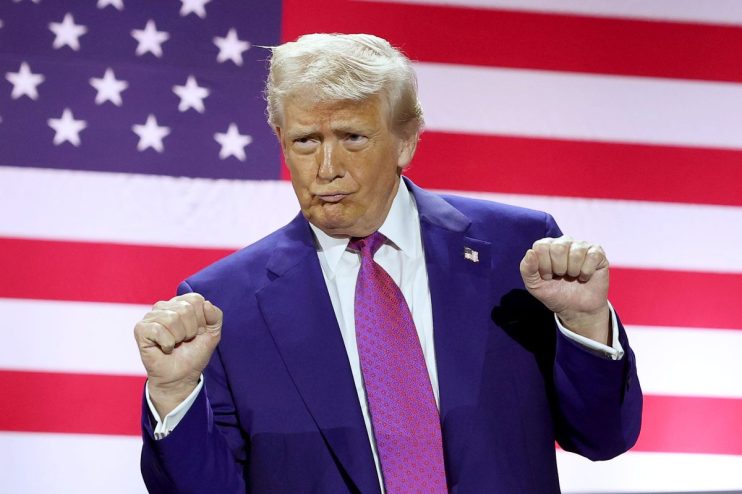
It’s a decade since Donald Trump announced his intention to run for President but it’s still no clearer what he stands for or why he does anything he does, says Eliot Wilson
Ten years ago today, property entrepreneur and reality television star Donald Trump descended a golden escalator in his palace of vulgarity, Trump Tower, and made a speech in which he announced that he would seek the Republican Party’s nomination for President. He had toyed with a Presidential bid before, potentially as a Reform Party candidate as well as a Republican, but the rest of the world took him less seriously than he took himself. When he made his declaration in 2015, Ladbrokes offered odds on his success of 150/1.
It seems like a lot more than 10 years ago. Since then we have seen Brexit, the Covid-19 pandemic, the global rise of Black Lives Matter, the end of coalition operations in Afghanistan, Russia’s invasion of Ukraine, the advance of the populist right in Europe, the Hamas attacks on Israel and the ensuing war in Gaza and the fall of the Assad regime in Syria. Most recently, President Trump announced an extensive system of tariffs, unveiled on what he implausibly styled “Liberation Day”.
By coincidence, tomorrow, 17 June, is the 95th anniversary of President Herbert Hoover signing into law the Tariff Act of 1930, known after the names of its congressional sponsors as the Smoot-Hawley Tariff Act. Intended to protect the American economy from foreign competition and the effects of the Great Depression, it placed tariffs on more than 20,000 imported goods and raised the dutiable tariff rate to nearly 60 per cent, the second highest in US history.
Remember the Smoot-Hawley act
A petition signed by 1,028 economists urged Hoover to veto the bill; Henry Ford called it “an economic stupidity” and Thomas Lamont, CEO of J.P. Morgan, begged the President not to sign “the asinine Hawley-Smoot tariff”. The President was personally against tariffs but yielded to pressure from his party and cabinet. America’s trading partners retaliated, exports plummeted, GNP halved in four years and unemployment tripled.
Trump’s tariffs, as announced, went further than the Smoot-Hawley Act. Looking ahead, America’s GDP is expected to grow more slowly – EY used the phrase “stall speed” – inflation is likely to rise, the labour market is weakening and a full-scale recession remains possible, if not probable. The degree of downward trend varies from commentator to commentator but an economic slowdown of some kind is generally accepted; what is extraordinary, if one takes a step back, is that this is the result of a deliberate, straightforward, unforced policy choice.
To say that economists warned of the damaging effects of tariffs is missing the point. Not only is President Trump disinclined to listen to advice he does not like, he does not really view tariffs as an instrument of economic or trade policy. His universally zero-sum outlook tells him that trade deficits are inherently a sign of weakness, because there can only be winners and losers. The idea of mutual advantage is simply alien.
There is no coherent concept in the Trump administration of the purpose of tariffs. Are they a negotiating tool to force the hand of smaller, weaker nations in various contexts? Or are they, as the president has suggested, a source of revenue so potent that America will be able to abolish income tax?
In the real world, they naturally cannot be both – one role is temporary, the other would be permanent – but one of the advantages of Trump’s profound alienation from reality is that opposites can be reconciled by force of imagination. To borrow from Humpty Dumpty, when the President declares a policy, it means just what he chooses it to mean, neither more nor less. But the question is whether he can make policies mean so many different things.
Analysing a presidency like Donald Trump’s is challenging. His attachment to tariffs is little short of romantic; he has described “tariff” as “the most beautiful word in the dictionary” and has supported them for 40 years. Only a week ago he doubled the tariff rate on steel and aluminium from 25 per cent to 50 per cent. Tariffs are likely to continue to harm America’s economy as well as the world’s but that is not the president’s reality. Ten years on, Donald Trump remains not an interlocutor so much as a hazard to shipping, something around which other world leaders must navigate. It goes against every instinct of logic, rationality, diplomacy and economic policy: at least it cannot last another decade.
Eliot Wilson is a writer