
Why Western weakness stems from a failure to grasp Putin’s motives

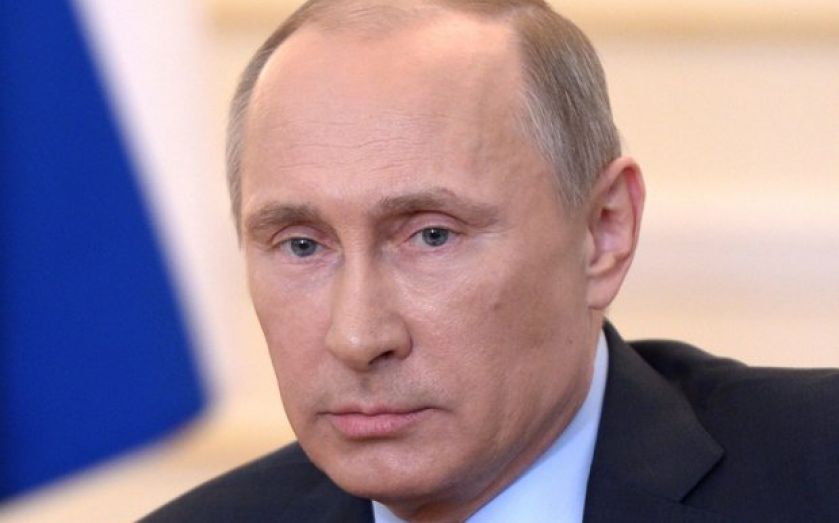
VLADIMIR Putin is having an easy time of it, precisely because the West is so at sea as to who he is and what he is trying to accomplish. The Russian President has painfully exposed our foreign policy elite’s schizophrenic tendencies, veering wildly between hysterical alarmism and useless gestures, both of which make the West look weak, and worse, ridiculous. What is needed above all is a clear-eyed Goldilocks assessment of the Kremlin, which is neither too harsh, nor too soft, but instead assesses Putin just right.
On the one hand, Senator John McCain, the leading American neoconservative hawk, believes Putin is another Adolf Hitler, and that the West must quickly wake up to this horrifying fact. His analytical point of view would have more traction, but for the fact that McCain literally thinks that everyone the West doesn’t like is Hitler: first Slobodan Milosevic, followed by Saddam Hussain, then Muammar Gaddafi, and now Putin. Yet surely every foreign policy challenge does not approximate 1939. Hitler alone was Hitler, with very few other problems posing such a clear cut distinction between good and evil.
Such historical inexactitude would be laughable were it not so dangerous. For if McCain is taken at his word, constant, aggressive action can be the only foreign policy recommended, with the West fighting an almost endless series of wars for negligible interests. In fact, such a neoconservative policy was tried recently during the bad old days of George W. Bush, with disaster as the result.
If the neoconservatives are too hawkish, ex-British Army head Lord Dannatt’s suggestion is one of a series of symbolic acts that are not hawkish enough. He urges that some British troops be retained in Germany to force the Kremlin to realise that the British mean business. But just as McCain is wrong and the year is not 1939, so Lord Dannatt is incorrect; it’s not 1945, either.
The present crisis does not signal a reversion to the Cold War: Russia is simply not strong enough – in terms of its military, economic, and demographic wherewithal – for this to be the case. Nor is Germany the relevant battleground; I live in Germany and defy anyone to find a German national who could accurately guess how many Nato troops are stationed in their country. Simply put, this is no longer the barometer of Western commitment that it was in the Cold War. I doubt Putin could care less. But under-reactions are just as dangerous as over-reactions. We simply must not have the Russian President miscalculate because we are so unserious.
So what does the right response to Putin look like? Here, the present Nato command has it just right. They are worried about the Russian-speaking areas that (like Crimea) are not covered by the alliance’s security blanket, particularly eastern Moldova and eastern Ukraine. This assessment gives the game away as to what Putin is doing; for it is Putin’s actions that matter.
Based on this realist reading, he turns out to be a garden-variety Machiavellian, a Gaullist nationalist intent on restoring the perception of Russian national greatness, after two decades of Western encroachments into what he regards as his sphere of influence. After his astonishing success in Crimea, Putin is now probing for further Western weaknesses, intent on snatching up as much Russian-speaking territory adjoining his country as possible. Hence, both parts of Moldova and Ukraine remain in the Kremlin’s crosshairs.
What should we do to trump the Goldilocks problem; how does the West tailor a “just right” response? First, draw a clear, intellectually defensible line that Putin also believes we are serious about; in this case, the line is Nato membership. To make Putin certain we mean business, troops should be forward deployed – not to Germany, but to the Baltic states, Poland, Romania, Bulgaria – sooner rather than later.
Second, and over the long term, America must rid itself of all impediments to exporting unconventional oil and gas, build export terminals, and see that our central and eastern European allies do the same. For this is a threat Putin will understand, as it both imperils his continued rule by driving down prices (upon which his government is wholly dependent), and by giving Europeans an alternative to Russian energy dominance. Such an approach will take time, but it is real, and solves the Goldilocks problem, threading the needle between over-promising and under-acting.
Dr John C. Hulsman is president and co-founder of John C. Hulsman Enterprises (www.john-hulsman.com), a global political risk consultancy. He is a life member of the Council on Foreign Relations, and author of Ethical Realism, The Godfather Doctrine, and most recently Lawrence of Arabia, To Begin the World Over Again.