Skip to content
City PM
  • Germany
  • France
  • Europe
  • Markets
  • Business
  • Opinion
  • Germany
  • France
  • Europe
  • Markets
  • Business
  • Opinion
Wednesday 17 September 2014 6:09 am  |  Updated:  Friday 07 June 2019 7:12 am

Wages increase by 0.6 per cent, 0.9 per cent behind inflation

By: Billy Ehrenberg

Add as a preferred source on Google

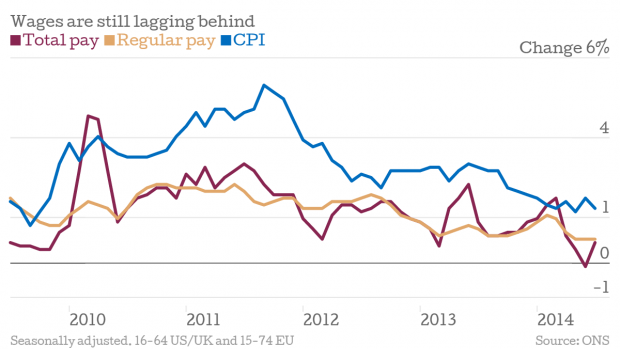
The gap between wages and consumer price inflation is still stubbornly wide, official figures published this morning showed.

Earnings not including bonuses were up 0.7 per cent over the 12 months to the end of July, but inflation is almost a percentage point higher at 1.5 (1.6 during July). 

Unemployment data was also out this morning, with the headline rate down to 6.2 per cent. was also out this morning, with the headline rate down to 6.2 per cent.

The rise in wages, up from a 0.2 per cent fall in June, is an improvement but may mean little. According to analysts at Berenberg Economics: 

Average earnings rose just 0.6 per cent year on year in July. That was up from -0.2 per cent in June, but the rise means little as it just the result of distortions to bonuses from last years tax changes dropping out of the annual comparison. 

The Bank of England has indicated it will consider wage growth as well as inflation when deciding on any interest rate hike. Low inflation is likely to dissuade the Bank from a more hawkish approach, especially as inflation came in at 1.5 per cent, the second consecutive month it has fallen. 
Even given the weak growth, a hike may come sooner rather than later. Berenberg again:

The BoE still has time to wait on interest rates given weak wage growth, but not too long as unemployment is falling like a stone. Weak wages signal there has been plenty of slack in the labour market, but the unemployment rate shows that slack is falling quickly.

Looking at July in isolation (the headline unemployment figures are a three month moving average) the single month unemployment rate reached 5.9 per cent.

We expect the first 25 base point rate hike from the BoE in February next year.

At a speech to the Trades Union Congress, Bank of England Governor Mark Carney said that, in effect, low wages were the price of higher employment. Average weekly pay is now £450 across the UK, before tax and other deductions. Including bonuses the figure is £478. 

The Bank of England released the minutes of the latest Monetary Policy committee meeting today, which suggested low wage growth could be being affected by changes in workforce composition, with the balance of employment moving towards lower-paid workers with fewer qualifications.

Carney himself said at the TUC meeting that he expected wages to rise to meet inflation some time next year and that interest rates rising in the spring would be in line with the Bank's mandate.
 
Our latest forecasts show that, if interest rates were to follow the path expected by markets – that is, beginning to increase by the spring and thereafter rising very gradually – inflation would settle at around  two per cent by the end of the forecast and a further 1.2 million jobs would have been created. 
 

There is upward pressure coming from the housing market, with figures from the ONS showing that the average price rose by 11.7 per cent in the last year and the average price in London moved above £500,000 for the first time.


Share this article

  • Facebook
  • X
  • LinkedIn
  • WhatsApp
  • Email

Similarly tagged content:

Sections

  • News

Categories

  • Business

Related Topics

  • employment and wages
  • UK inflation
  • UK jobs

Trending Articles

  • Top Burnham adviser calls for capital gains and inheritance tax hikes

  • A meeting with the breakfast king of Mayfair

  • Clarkson’s Farm and why businesses must stop blaming the weather

  • As it happened: Supreme Court blocks Trump sacking; Andy Burnham vows ‘greater public control’; Comcast spin-off

  • BT tops FTSE 100 after finding new home for international business with Verizon joint venture

More from City PM

  • London house prices fall as Bank of England rate hikes loom over mortgage market 

    Property
    Housing delivery in London is in a major crisis
  • The Bank of England is keeping Britain in the waiting room

    Opinion
    Andrew Bailey, Bank of England governor, discusses economic policy during a press conference at the central bank headquart...
  • OECD: Growth to remain below one per cent as UK economy struggles with unemployment

    Economics
    Sir Keir Starmer and Rachel Reeves discussing policy at a press conference, emphasizing Labours economic strategy
  • Industry warns Iran war spike to come as food inflation falls

    Retail
    A colorful array of fresh fruits and vegetables displayed on a rustic wooden table, highlighting healthy food choices.
  • UK economy falters as deeper damage to growth to come

    Economics
    Rachel Reeves speaking at an IOD event.
  • Interest rates set to be held as inflation to remain ‘elevated’ despite Iran peace deal

    Economics
    For the first time in months, economists are unsure whether the Bank of England will cut interest rates.
  • Bank of England should hold interest rates, City PM Shadow MPC says

    Economics
    Bailey Boe in professional attire speaking at a business conference with a presentation screen in the background.
  • Job vacancies fall again in unemployment risk 

    Economics
    People waiting outside a job centre, highlighting unemployment issues and job search challenges in the current economy.

City PM — European politics, business and analysis.

Europe

  • Germany
  • France
  • Europe
  • UK & Ireland

Topics

  • Business
  • Markets
  • AI
  • Technology
  • Opinion
  • Energy

More

  • Politics
  • Economics
  • Fintech
  • Legal
  • Sport
  • Life

Company

  • About City PM
  • Editorial Policy
  • Corrections
  • Contact
  • Terms of Use
  • Privacy Policy
  • Cookie Policy
© 2026 City PM · Published by CityPM Media, Bahnhofstrasse 65, 8001 Zürich, Switzerland
About · Editorial Policy · Corrections · Contact · Privacy