

Using AI-powered spacecraft is the only way to clean up space


In 1978 NASA scientist Donald J. Kessler proposed a theoretical scenario in which the density of objects in low Earth orbit due to space pollution becomes high enough that collisions between objects starts to cause a chain reaction whereby each collision generates more space debris, which then increases the likelihood of further collisions. One implication of the ‘Kessler effect’ is that the distribution of debris in orbit could render space activities and the use of satellites difficult for generations to come.
Last week Elon Musk’s SpaceX launched 60 new Starlink satellites into orbit, adding to the 6,000 satellites that are currently circling our tiny planet. Of these 6,000 satellites, approximately 60% are now defunct space junk, according to The Union of Concerned Scientists. But defunct satellites are only a small part of the problem of pollution in space. Over 34,000 items of space junk larger than 10cm in size have been mapped, and there are millions of items of smaller debris that are still large enough to damage a telecom satellite. This number is also growing as the frequency of satellites being sent into orbit accelerates.
A consequence of all of this space junk is that hundreds of collision avoidance manoeuvres are performed each year, including by the International Space Station (ISS) where astronauts live. Removing this debris is expensive. In 2020 the European Space Agency signed a $105 million contract with Swiss startup ClearSpace to ‘snare’ large items of space debris and move them closer to the Earth’s atmosphere where they will burn up. Clearspace is developing a robot-like spacecraft that will have four arms.
Using Space Debris To Propel A Spacecraft
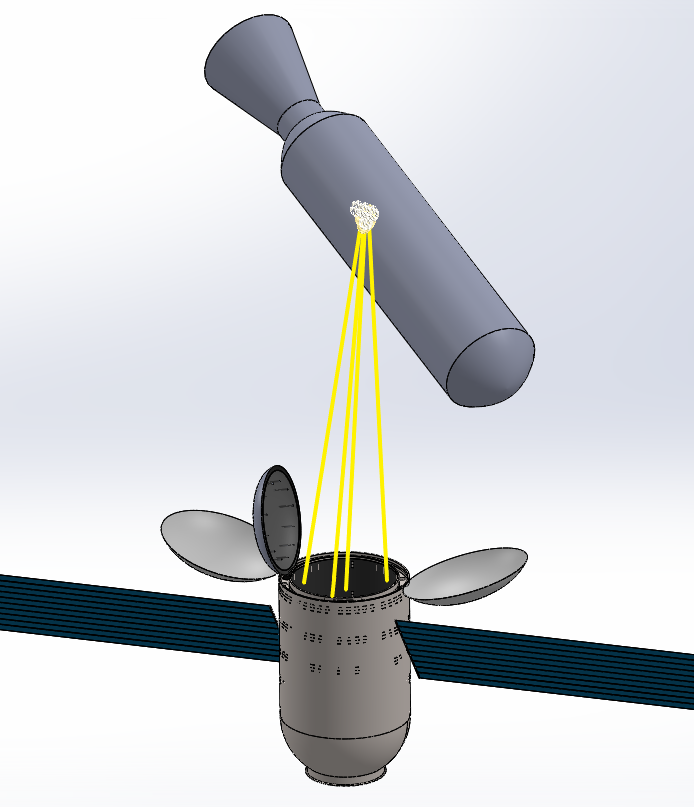
Unfortunately, as well as being expensive, the ClearSpace method of capturing large debris and moving it into the atmosphere is not applicable to thousands of dead satellites or millions of smaller items of space junk. That’s why UK start-up SHIPinSPACE plans to build a ‘Space Debris-fed Spacecraft’ (DefeS). The DefeS will be 4 metres in diameter and powered by solar cells. DefeS will use artificial intelligence to track and search for space junk.

The DefeS system is unique because rather than moving space debris into the atmosphere to burn up, it will capture and burn space debris directly and use the energy to generate its own thrust in a self-perpetuating virtuous loop. First the DefeS will ‘swallow’ space junk into an incinerator, where the space junk will be vaporized by a few robotic-arm-driven lasers. The sublimated vapours will then be channelled through a system that can either use a turbo compressor to supply a gas tank to be used in an ion-thruster or directly discharge to vacuum to create the thrust needed to move the DefeS.

By using space debris to create new propellant that will be used to track other space debris, the SHIPinSPACE approach is efficient and also sustainable. The simplicity of not needing to ‘capture’ debris with robotic arms and then send it back toward earth means that the solution is highly versatile and extremely cost effective, at least in space terms.
Using lasers to sublimate space debris is not new, but the concept of creating a laboratory within an autonomous AI-power spacecraft, where a laser can be used safely, is novel. The benefit is that if something goes wrong with a laser, damage is confined within the DefeS, though the DefeS will also be equipped with lasers that can annihilate larger objects, such as bulky rocket stages, when at close proximity.
Funding The Clean-up Of Space
SHIPinSPACE is a start-up, but what is clear is that the future development budget for concepts such as the DefeS should be provided by international space agencies such as NASA, ESA, ROSCOSMOS, CNSA, JAXA. Private space companies led by billionaire technologists such as Jeff Bezos and Elon Musk also have a responsibility to reduce the space debris risks in order to safely operate their businesses.
Artificial intelligence must drive the operations if continuous debris removal is going to succeed. A spacecraft such as the DefeS must be able to autonomously map debris and use its tracking subsystem to drive the ion-thruster to provide thrust in such a way as to get to the next piece of space debris in an entirely autonomous way. Building ten spacecraft of this size could drop the number of items of large size space debris by 30% in 10 years. Today that figure may seem optimistic, but these projects always seem impossible – until they’re done.