
Two highs and two lows of ‘Super’ Mario Draghi’s reign at the ECB


Mario Draghi will tomorrow chair his final monetary policy meeting as president of the European Central Bank (ECB), bringing to an end a dramatic eight years in the job.
Read more: Euro plunges as ECB president Mario Draghi signals more stimulus
The Eurozone crisis, a long-running argument with Germany, and the US-China trade war are just some of the issues the 72-year-old Italian has contended with.
Here are four of the notable highs and lows of “Super” Mario’s tenure.
Low: The Eurozone crisis
By 2011, the year Draghi became ECB president, it was clear the Eurozone’s existence was under threat.
The single currency area had never recovered from the global financial crisis. Countries such as Greece and Ireland looked unable to pay back exorbitant loans they had received, largely from German and French banks.
Moreover, months before Draghi took over in November, his predecessor Jean-Claude Trichet had raised interest rates during a slump.
Jim Leaviss, head of wholesale fixed income at investment manager M&G, called the move the ECB’s “biggest policy mistake of its young history”.
Draghi quickly reversed the rises, but the area’s economy nonetheless slid into recession. The fear was that if a weak Eurozone country defaulted on its debts, contagion would bring the entire project down.
High: ‘Whatever it takes’
Within a year of taking office, Draghi was being credited with saving the euro.
The turning point came in July 2012, when he spoke at a conference in London, almost within earshot of the Olympic beach volleyball on Horse Guards Parade.
“Within our mandate, the ECB is ready to do whatever it takes to preserve the euro,” Draghi said. “And believe me, it will be enough.”
Read more: Donald Trump hits out at Mario Draghi over ‘unfair’ stimulus
The two sentences reassured investors that there was no risk of the Eurozone falling apart. Greek bond yields, a key indicator of the bloc’s financial stress, quickly plummeted as lenders regained faith.
Low: Tussling with Germany
Draghi’s “whatever it takes” mantra quickly solidified into new policies. Chief among these was a scheme to expand the ECB’s bond-buying programme in a bid to drive down borrowing costs in countries such as Spain and Italy.
Investors cheered the move. But in Germany – a bastion of ultra-orthodox monetary policy – policymakers fiercely objected, saying the ECB was overstepping the mark.
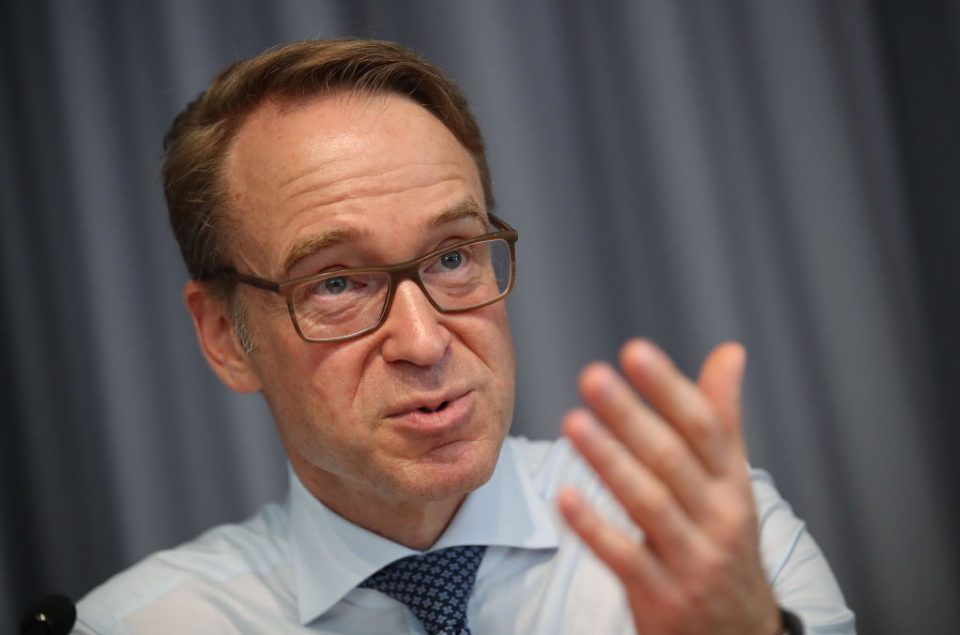
President of the Bundesbank – Germany’s central bank – Jens Weidmann has consistently opposed Mario Draghi’s policies (Image: Getty)
Draghi then stepped up bond-buying in 2015. The ECB has since purchased around €2.5 trillion (£2.2 trillion) of bonds, flooding the Eurozone with money.
German opposition continues. Joerg Kraemer, chief economist at Commerzbank, called the policy “simply disproportionate” and said it created “zombie companies” and risked bubbles.
Last month, after Draghi once again turned on the bond-buying taps, German ECB board member Sabine Lautenschlaeger resigned in protest.
High: An economic recovery – of sorts
Since Draghi took over at the ECB, investors have regained trust in the euro project, allowing countries to fund their borrowing and letting stability return to the single currency area.
Meanwhile, unemployment has fallen dramatically from the 2013 peak of 13 per cent. It is now below eight per cent and wages are starting to rise.
Draghi hands the ECB over to his successor Christine Lagarde at a difficult time, however. The Eurozone economy is once again slowing, buffeted by the US-China trade war.
Most importantly, inflation remains well below the Bank’s target and the internal debate over how the correct response continues to rage.
Read more: IMF chief Christine Lagarde among surprise picks for EU top jobs
Nonetheless, Leaviss said he thinks “history will be kind to Mario Draghi”. He said: “In a world where politicians refused to save the Eurozone through fiscal redistribution, he did ‘whatever it took’. It wasn’t perfect, but it was the best we had.”
(Main image credit: Getty)