
Transport Select Committee sets tests for rail strike minimum service levels

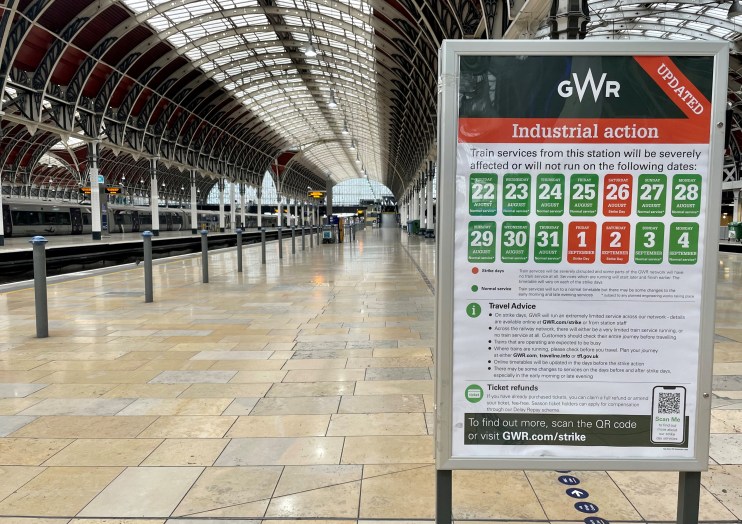
MPs have set the Government a series of tests over its controversial new law on minimum levels of service during rail strikes.
The Transport Select Committee outlined a number of principles for what ministers should include in regulations due to be published following the passing of legislation.
Unions are strongly opposed to the law, warning it is unworkable and could lead to workers being sacked.
The Strikes (Minimum Service Levels) Act became law earlier this year, empowering ministers to make new regulations that will set a required minimum level of service during strikes, which have yet to be announced by the Department for Transport (DfT).
Following an inquiry into the new law, the cross-party select committee challenged the Government to ensure the regulations meet a series of tests.
The MPs said a minimum service level provided on strike days should be at least as good as typically provided on previous strike days and safety on the network for staff and the travelling public must be the “primary consideration”.
The committee also called for minimum service levels to be flexible enough to be applied to different patterns of industrial action affecting different employers, and said greater responsibilities placed on those who must work on strike days to provide a minimum service must be reflected in pay and conditions.
“Resilience in staffing must be improved so that there are trained alternatives able to cover for specialised staff who may want to exercise their right to strike,” said the report.
The committee added that services — or credible alternatives — should be available to passengers in all areas of the country normally served by the network, and those with access needs should receive the same support as they are entitled to on regular travel days.
Committee chairman Iain Stewart said: “This committee questioned an array of witnesses from the rail sector and we consistently heard that they were waiting for clarity from the Government on how minimum service levels might be set, how routes should be prioritised, how safety could be guaranteed and which types of staff might be needed.
“It became apparent that the Government needs to make the first move. Only then will stakeholders be able to feed back on the practicalities, so that regulations can be fine-tuned and plans drawn up.
“We therefore say to DfT, once it has determined which model of minimum service level it plans to implement, that it must consult properly with the industry and carefully build on the response it receives.
“Meanwhile, in the absence of plans for us to scrutinise, the committee has put forward nine tests for the Government that should give any future regulations a realistic chance of working for passengers, rail staff and companies, as well as the wider economy which suffers whenever strikes are called.
“Among the most vital of those nine tests are around safety and accessibility.
“We can’t accept an increased risk of lives being put in danger due to a lack of key staff such as signallers, or of those with access needs being neglected if they experience difficulty.”
Railway workers have been embroiled in bitter disputes over pay, jobs and conditions for more than a year, with no sign of any progress towards a deal.
Members of the drivers’ union Aslef in 16 train operators will walk out on September 30 and October 4, coinciding with the annual conference of the Conservative Party.
Members of the Rail, Maritime and Transport union on London Underground will strike on October 4 and 6 in a separate row over jobs and conditions.
RMT general secretary Mick Lynch said the “profoundly flawed” legislation will lead to more chaos on the railways and increase safety risks.
“Instead of attacking workers’ right to strike, the Government should spend its energy on resolving the national rail disputes.
“We have reached settlement in Scotland and Wales, which demonstrates that the real reason for the current dispute is the union-busting agenda of the UK Government.”
TUC general secretary Paul Nowak said: “These laws are a dog’s dinner. They haven’t been designed to resolve conflicts – they’ve been designed to escalate them, and they will only poison industrial relations and worsen disputes.
“They are unworkable, undemocratic and very likely in breach of international law.
“The transport select committee makes clear that industry have no idea how these rules are supposed to work – and that if ministers do push ahead, further, full consultation will be essential.
“Ministers are ignoring mountains of evidence on the unworkability of these laws and appear intent on ploughing ahead despite significant opposition from employers and unions.
“Let me be clear. We won’t rest until this Act has been repealed, and we won’t stand by and let workers get sacked for defending their pay and conditions.”
Mick Whelan, general secretary of Aslef, the train drivers’ union, said: “There is no way, organisationally, that we can comply with the steps in the consultation papers but, of course, that is the purpose – to take away the voice of British workers.
“Most of the nine tests set out by the committee are not achieved now so cannot, and will not, be achieved under minute service levels (MSLs) and any belief that it will improve industrial relations in any way is utterly naive.
“More importantly, how many lives will be put at risk by trying to run the railway, a safety-critical industry, with MSLs?”
Transport Salaried Staffs Association interim general secretary Peter Pendle said: “The public will see these proposals for what they are – a belated attempt to make this unfair and undemocratic legislation look palatable. But nothing can hide the fact that this law is designed by a hypocritical Tory government to take away workers’ fundamental right to strike.
“One of these recommendations is to pay staff more if they have to work on strike days – a blatant attempt to bribe people to scab.”
A Department of Transport spokesperson said: “It’s only right that we balance the ability to strike with minimising the impacts on passengers, and we will carefully consider the committee’s report to ensure we achieve this balance.”
Press Association – Alan Jones