
Tough at the top: Will the FTSE giants fall from grace?


From dividend cuts, to the accounting scandals just waiting to happen, SVM’s Colin McLean talks to Annabelle Williams about the potential pitfalls facing the UK market.
The last few years have been tough for the UK’s biggest companies, as FTSE giants from supermarkets and banks, to insurers and oil majors, have come under pressure.
While company management teams have strived to reassure the market that their struggles will be short-term, Colin McLean, founder of SVM Asset Management, believes there are signs some of these business models are becoming outdated.
McLean is a well-known fund manager who has been investing in UK and global equities for the last 30 years. After training as an actuary, he founded his own investment fund group, SVM, back in 1990, and his funds now rank among the best-performing in the UK. His SVM UK Growth fund is ranked sixth out of 170 peers in the UK Equity All Companies sector over ten years.
Born in Venezuela but educated in Glasgow, McLean now works from an office in Edinburgh alongside wife and fellow fund manager Margaret Lawson. From small beginnings, the SVM fund boutique is home to nine investment funds covering the globe.

(Photo: Greg Sigston)
BLUE CHIP DINOSAURS
Many companies on the FTSE have struggled with profit growth over the last few years. Far from being shortterm troubles which investors should shrug off, McLean believes these firms are facing serious, long-term challenges.
“For quite some time I have had quite a negative stance on the bigger companies. They have had more than their fair share of accidents. Out of the top 15 in the UK, there are only three or four which have delivered better performance than the market,” he says.
“We have seen Woolworths, HMV, Comet, Phones 4u and other business models just disappear, and there are others in the process of disappearing,” he says. “The biggest companies have found it hardest to tackle deflationary pressures – Tesco and the other supermarkets for example.”

(Photo: Greg Sigston)
DIVIDEND CUTS
Changing habits and attitudes will not just affect retailers. Young people are less concerned with car ownership, which could impact car sales in future, while traditional banks are being challenged by new lending models. “Some of today’s blue chips may turn out to be dinosaurs that fail to adapt and survive,” McLean says.
The immediate impact will likely be upcoming dividend cuts, he warns. “I still see dividend cuts from supermarkets and oil majors. I cannot see them keeping up those payments.”
McLean says these issues are being obscured by the focus on the upcoming general election. Although the country faces the most uncertain election for years, investors and business leaders are unduly worried about this “transient event” which will “sort itself out”.
In the meantime, there are “bigger picture” issues which warrant much closer attention, he says: “In the global scheme of things the British general election is not a big thing.”

(Photo: Greg Sigston)
ACCOUNTING SCANDALS
The accounting scandal at Tesco, which emerged last autumn, has shone a light on corporate reporting practices. The UK’s leading supermarket chain was found to have mis-stated its profits by £263m and is now under investigation by the Serious Fraud Office.
McLean has some concerns that corporate accounting practices may have become too creative. In future, more companies may be found to have misled the market.
SKEWED FIGURES
Since the financial crisis, many businesses have undertaken cost-saving measures and are now struggling to increase revenue, and McLean believes the massaging of figures, often in the form of favourably “adjusted earnings”, is widespread.
“Growth is scarce, and chief executives are under pressure to deliver. This has put more emphasis on presentation. But recent results reveal a worrying pattern of favourable adjustments to reported profits,” he says.
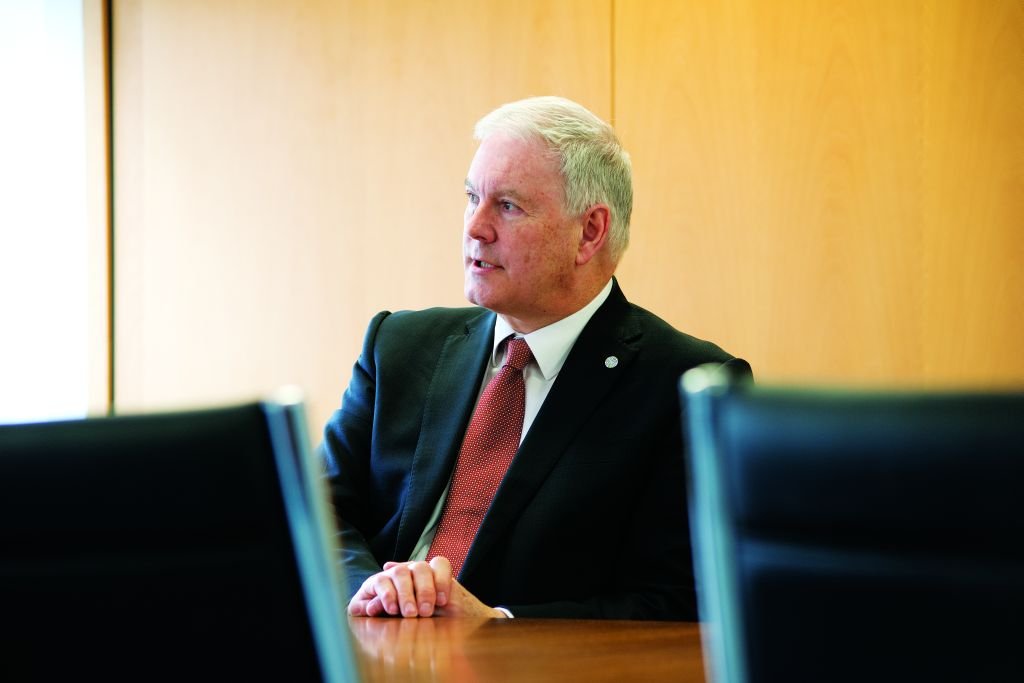
“Some of today’s blue chips may turn out to be dinosaurs that fail to adapt and survive” (Photo: Greg Sigston)
INTANGIBLE ASSETS
To avoid investing in companies which could have overly-adjusted earnings, McLean is steering clear of businesses which rely heavily on intangible assets, such as support services.
FTSE 100-listed services firm Serco is “particularly accident prone,” he says. Other sectors where companies tend to make a lot of adjustments to reported earnings include defence firms and travel agencies.
He prefers companies with hard assets, which are also successfully conquering a niche in the market. A classic example of this is McLean’s favourite stock, the upmarket clothing retailer Ted Baker.
This company has grown from a single store in Glasgow in 1988 to 400 stores worldwide. Ted Baker’s success is down to a simple recipe: “The management understand their niche market well, it is affordable luxury. I think they have quite a classic British look, it is like Burberry,” he says.
PYSCHOLOGICAL TRICKS
At the root of McLean’s concern over outdated business models and adjusted earnings is his belief that even highly-skilled professionals can fall foul of psychological tricks.
Companies, for example, are exceptionally good at presenting information in a flattering light, and people tend to be swayed by charts or infographics which show positive trends.
To avoid being influenced by presentation, McLean makes use of techniques from behavioural finance, an approach which uses psychology to help investors understand their unconscious biases.
There are at least 50 unconscious biases which people can fall prey to, from “overconfidence bias” to “loss aversion bias”. Behavioural finance practitioners help people gain conscious awareness of their biases, with the aim of avoiding them in future.
Investors who shy away from looking at their unconscious biases are missing a trick, he says: “People need to understand their own psychology, not least as a tool to understand their own strengths and weaknesses.”
It is affordable luxury. I think they have quite a classic British look, like BurberryTED BAKER
There is a lot of growth in online gaming and we have seen good figures from this companyPLAYTECH
People miss the value of the growth in ITV’s production and content generation businessITV
It will be very hard for others to replicate what Asos have doneASOS
BIOGRAPHY
Colin McLean was an actuary before moving into investment in the 1980s, when he saw the industry was going through an “interesting time”.
Back then, the prevailing wisdom was that equity markets were so well-analysed that fund managers had no hope of spotting stocks which could outperform the broader market. That philosophy was shaken by the release of ground-breaking work by an academic, Robert Schiller, who came up with a new metric for assessing stocks. He said company shares should be considered good value when their price does not reflect the company’s real potential.
Schiller’s theories, which show that picking good value stocks can lead to superior returns, caused huge change in the industry. Since then managers have strived to find stocks priced below their true worth.
McLean was influenced by the new wave of value-driven investment, and he set up Scottish Value in 1990. The Edinburghbased company was later renamed SVM Asset Management and is home to six topperforming investment funds.