
The government is using Brexit as a scapegoat for its own failures

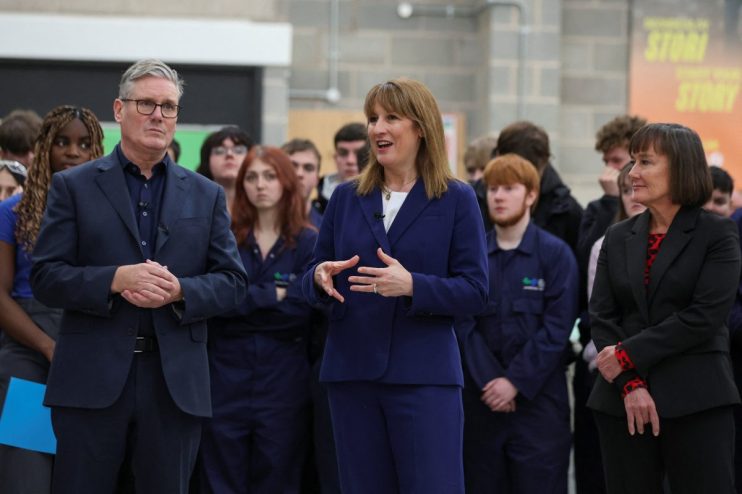
Keir Starmer is clearly manoeuvring to get Britain to rejoin the EU – but Brexit is not to blame for Britain’s appalling growth record, says Paul Ormerod
David Lammy, the deputy Prime Minister, chose last week to reopen the issue of the UK rejoining the EU.
Asked if we will go back into the customs union, Lammy not only refused to rule it out, but seemed enthusiastic about it. “That is not currently our policy. That’s not currently where we are. But you can see countries like Turkey with a customs union seemingly benefiting and seeing growth in their economy, and again, that’s self-evident”, he stated.
The campaign to reverse Brexit is clearly hotting up rapidly. Keir Starmer has been talking about a “reset” with the EU.
The Prime Minister’s denial of the claim that he wanted to rejoin the EU will convince no-one, especially given his track record on U-turns, volte faces. Whatever name you give it, Starmer is an expert at it
The governor of the Bank of England, Andrew Bailey, was part of the warm-up act. Last month, Bailey pronounced that “If you ask me what the impact of Brexit is on economic growth… the answer is that for the foreseeable future it is negative”.
All this is music to the ears of the Chancellor, Rachel Reeves. She had already put the blame for the poor performance of the British economy since the election in July 2024 on Brexit.
Admittedly, Brexit is just one item on a long list which absolves the Chancellor from any blame at all: the previous Conservative government, Donald Trump, Vladimir Putin, Uncle Tom Cobley and so on. But it is nevertheless a persistent theme which Reeves trots out.
The plain fact is that, since the Brexit vote, all the major economies in the EU have grown slowly. The referendum was held at the end of the second quarter of 2016. Between then and the second quarter of 2025, the French economy, for example, grew by a total of 11.5 per cent.
In Italy, growth was 9.5 per cent and in Germany just 5.6 per cent. The UK over the same period has grown by 10.9 per cent.
These are all low growth rates by historical standards.
Even if we calculate the rates from the end of 2019, when Boris Johnson had been elected to “get Brexit done”, the growth rates are similar through to 2025. Italy, which registered zero growth 2016-19, expanded by 9.6 per cent, France by 5.1 per cent, the UK 4.2 per cent and Germany a meagre 0.1 per cent.
In short, the big four economies in Western Europe have all grown at a very similar (and slow) rate over the past nine years.
It therefore seems very unlikely that Brexit is the principal cause of growth stalling under Labour since the election. There are powerful common factors at work across Western Europe.
There is no doubt that, to-date, much of the potential of Brexit has been squandered. Britain has remained enmeshed in attitudes and regulation which discourage innovation and entrepreneurship.
The main point of Brexit from an economic perspective was to enable us to gradually disentangle our economy from the barriers which pervade the major economies of the EU.
Most of the economic models which claim to quantify the impact of Brexit do so in a purely static framework, in which relationships which describe the previous behaviour of the economy continue to hold.
The purpose was to give the opportunity to change these for the better. Both the Sunak and the Starmer governments have failed in this respect.
Indeed, under Starmer and Reeves the problems have intensified.
Instead of addressing the key issues and removing barriers to growth rather than creating them, the government instead prefers to search for scapegoats. But the attempt to pin the blame on Brexit stretches credulity to breaking point.
Paul Ormerod is an Honorary Professor at the Alliance Business School at the University of Manchester. You can follow him on Instagram @profpaulormerod