
The Debate: Should London’s suburbs be spikier?

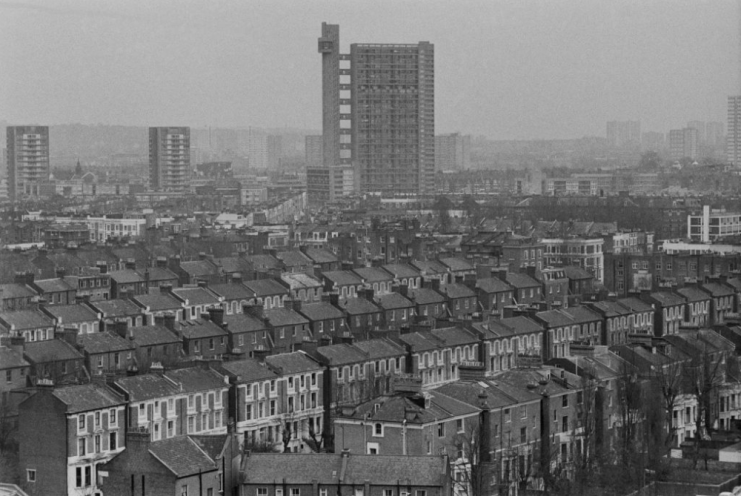
A housing crisis and London’s relatively flat skyline have prompted calls for building taller (or ‘spikier’) in the suburbs.
Growth bros on Twitter are desperate for London to “densify”, i.e. cram more buildings into a smaller space by building taller structures or extending current buildings upwards. Yet London’s outer regions are typically flat with parks, commons and heaths – a relic from their era as villages.
Living in a tower block comes with challenges. So do we really want spikier suburbs?
Yes: In a housing crisis, we have no choice but to build up
London is too low rise. The buildings in Western Europe’s biggest city are just too small, lengthening commutes and pushing up housing costs. London is cramped but not dense.
Compared to London’s true international peers, our city’s built environment is borderline rustic. Research from the Greater London Authority has shown that while more than half of all buildings in New York City and Paris have more than four storeys, and over a third do in Tokyo, in London not even a seventh of buildings have five floors or more.
You can see this with your own eyes. Exit nearly any TfL station in Zone 2 or beyond, and you will usually behold a short parade of shops and flats of at most three or four storeys, surrounded by a sprawl of terraced or semi-detached houses.
If these areas in the vicinity of stations could be redeveloped for mid-rise buildings – between five to 10 storeys – more housing could be built exactly where Londoners need it, with public transport on their doorstep.
Some stations, such as Elephant and Castle, already have very high-rise buildings. But these pockets are exceptions which prove the rule – as the planning system is so restrictive, just six per cent of London’s neighbourhoods have to provide 55 per cent of its new homes, while 43 per cent of neighbourhoods are adding less than one home a year.
London also needs homes for families, and more suburban housing in the capital’s green belt would complement a more mid-rise urban core. Giving every Londoner more space will require us to build both out and up.
Anthony Breach is associate director at the Centre for Cities
No: Tower blocks don’t foster community
When I first arrived in London, from the provinces, many decades ago my student accommodation was on Muswell Hill. Like Dick Whittington, this afforded me an envious view of The City. Wasted hours spent on tubes and buses made me yearn to live in the midst of the metropolis.
As an ageing professor of places I am even more drawn to “downtown” and find myself happily ensconced in a 27th floor City apartment. Where land is scarce and public transport plentiful, high-rise buildings can offer an opportunity to increase office or residential accommodation. However, suburbs are, by definition, less urban. Implanted blocks of flats disrupt the character of a suburb and do nothing to strengthen the community. I know from personal experience that residents of towers interact less with neighbours and tend to be more transient in their habitation.
This is of little matter in a city centre, where “location”, rapid transport and cultural amenities are rated higher than neighbourhood activities. However, successful suburbs depend upon people collaborating in the animation and well-being of their local area. Suburban residents wishing to combat a “spikey skyline” should consider the preparation of a Neighbourhood Plan to give them more control over the shape of change in their area.
Peter Wynne Rees is professor of places & city planning at the UCL Bartlett School of Planning
The Verdict: Stubby suburbs could be a happy compromise
This newspaper has told you before and won’t bother telling you again: we need more homes. The question is where to build them.
Cities take different forms: Paris is compact, made of chic apartment blocks in well preserved Haussmann architecture; LA is sprawling and new. East Asian megacities are particularly spikey.
Our contestants take different approaches. Breach is a pragmatist, and he is not wrong that London is stubby. But his example of Elephant and Castle is a) not a suburb (it’s Zone 2) and b) not an area generally regarded as an aesthetic success. This sadly dents his argument.
Rees opts for a more philosophical take – and not without merit: the centre of cities do indeed serve a different purpose to their satellite neighbourhoods and should we not preserve this dichotomy? Breach interprets ‘spikey’ as four-10 storey towers whilst Rees seems sees them as including if not surpassing 27 floors, which seems more on the nose.
Perhaps there is an intermediate path – stocky suburbs don’t sound so sexy but perhaps they could unite our sharp-minded friends.