

The changing face of income

Henderson High Income Trust celebrated its 30th anniversary in 2019, having launched in 1989. This was the same year that Tim Berners-Lee invented the World Wide Web. Given Henderson High Income provides shareholder with a high dividend income by predominately investing in UK companies, this article looks at how the internet has led the UK market to evolve and created opportunities and challenges for income investors.
One of the main influences that the internet has had on the corporate world is the increase in globalisation. The internet has facilitated fast and efficient communication, global IT infrastructures, electronic payment systems and the mobility of capital. The impact of globalisation on the UK has seen an acceleration away from manufacturing towards a service led economy. This shift has been mirrored in the FTSE 100 with industrials and domestic companies making way for more multinational businesses.
Looking at the FTSE 100 back in 1989, the industrial sector contributed 17% of the market income with large conglomerates offering attractive dividend yields. ICI (6.3% dividend yield), BET (6.0%), BTR (4.1%), Hanson (4.4%) and British Steel (8.2%) were just some of the companies with high dividends yields that made up the sector. It’s no wonder the Trust used to have almost 29% invested in the sector, according to the first annual report. Over the years, however, the sector has shrunk as these companies have either been acquired, split up or fallen on troubled times. The sector now only contributes 5% of the market income and 6% of the portfolio, but that doesn’t mean there aren’t attractive UK industrials. Over the last 30 years the sector has evolved with large conglomerates being replaced with smaller, higher quality engineering companies that dominate their specialist niches. Although dividend yields are typically lower now, the underlying structural growth of these companies support appealing dividend growth.
Another sector that has significantly reduced in size as a component of the FTSE 100 and its contribution to income is Consumer Services (15% in 1989 down to 7% today). Media, retail and leisure companies reliant on the UK economy have been replaced by more global businesses. Who remembers the likes of Sears (6.6% dividend yield), Safeway (4.0%), Maxwell Communication (7.3%) and Forte (4.1%)? Similar to industrials, this is a sector that has evolved. The stronger, higher quality businesses have remained and grown significantly over the last 30 years through investment, organic growth and acquisitions. RELX, InterContinental Hotels and Tesco are three examples from that sector that remain in the FTSE 100 today and have grown their market caps by a combined £57bn.
The sector which has been one of the key beneficiaries of globalisation is the financial services sector. The UK is the highest net exporter of financial services and London, with its convenient time zone, universal language, close proximity to Europe and low financial costs, the World’s financial capital. In 1989 no financial services companies were in the FTSE 100, while there are 6 today with a combined market cap of £54bn. These companies provide income fund managers with either high yield (Standard Life, M&G), attractive dividend growth (LSE, Hargreaves Landsdown) or a combination of both (3i Group, Schroders).
Mining and oil & gas are two large sectors that have also taken up the income slack. Given the commodity super cycle in the 2000s, fuelled by Chinese demand, the mining sector has significantly grown and now contributes 11% of the market’s income from 7% in 1989. Similarly, the oil & gas sector has grown and now contributes 23% of the FTSE 100’s income (from 17%) but worryingly this comes from just 2 companies, BP and Royal Dutch Shell, verses 7 in 1989.
This highlights a key challenge for income investors in the UK today given the level of income concentration; the top 20 dividend payers in the UK produce 74% of the FTSE 100’s income, which compares to 55% in 1989. This becomes a problem if the dividends of those top 20 companies are unsustainable. However, just because the index is concentrated for income, doesn’t mean you can’t construct a well-diversified portfolio. Making sure that no company contributes more than 5% of the Trust’s income or that a sector exposure pays less than 20% (e.g. oil & gas contributes just 9% of the Trust’s revenue) are two ways to limit income concentration. As income fund managers we always try and avoid companies that cut their dividend through the detailed stock analysis process, paying close attention to cash flow sustainability and balance sheet strength. Making sure the portfolio is well diversified means that when dividend cuts do occur they have minimal impact on the Trust’s overall revenue and its dividend paying capabilities. That’s why the Trust has managed to grow its revenues and dividend each year for the last 7 years (since I’ve been involved with the Trust), at the same time as growing the revenue reserves, which now cover 75% of its annual dividend.
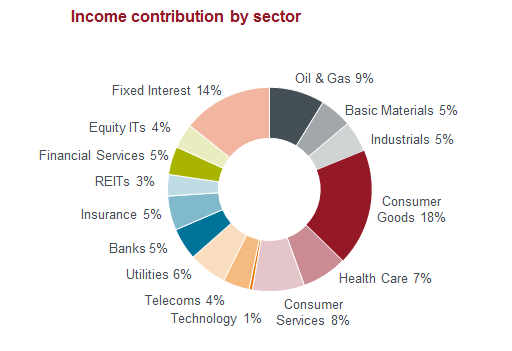
Source: Janus Henderson Investors, as at 30 September 2019
Note: Last 12 months’ income by sector
As the internet has led to an increase in globalisation and the evolution of equity markets over the last 30 years, so will further developments in technology going forward. As income fund managers it’s important to evolve at the same time and recognise the strong companies that embrace new technologies to grow and the new income payers of the future.
These are the views of the author at the time of publication and may differ from the views of other individuals/teams at Janus Henderson Investors. Any securities, funds, sectors and indices mentioned within this article do not constitute or form part of any offer or solicitation to buy or sell them.
Past performance is not a guide to future performance. The value of an investment and the income from it can fall as well as rise and you may not get back the amount originally invested.
The information in this article does not qualify as an investment recommendation.