
The big unknown which will determine the short-term future of the economy

Anyone trying to assess the economy’s prospects has to chart a course for consumer spending, the largest contributor to growth in the UK.
Consumption, which captures how much people are spending on goods and services, makes up around 60 per cent of UK aggregate demand, by far the largest component.
But consumption has taken a much bigger hit in the UK since the pandemic than in either the eurozone or the US.
Even including the most recent upgrades, per capita consumption stands three per cent below pre-pandemic levels in real terms, according to calculations from Goldman Sachs.
This may not seem like a particularly big surprise given the various shocks which the economy has experienced since the pandemic.
However, household income growth has increased relatively strongly over the past year reflecting falling inflation and continued strong wage growth.
Indeed, the Office for National Statistics (ONS) estimates that household disposable income rose 1.3 per cent in the second quarter.
So why hasn’t spending recovered? The facetious answer is that households have been saving instead.
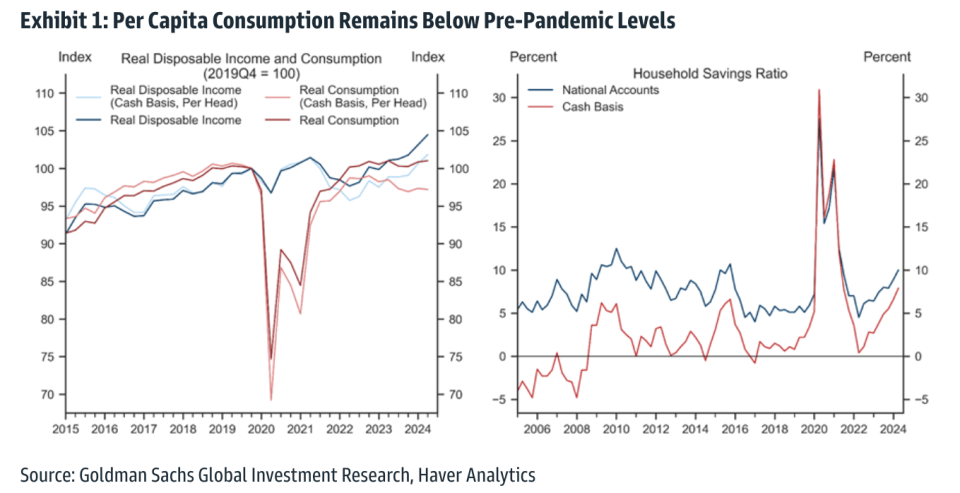
The ONS’s figures, released yesterday, showed that the savings rate stood at 10.0 per cent in the second quarter, up from 8.9 per cent in the first and comfortably above the pre-pandemic average.
Most economists think the increase in saving reflects both the impact of higher interest rates, which encourage saving, and the psychological impact of the various shocks which have occurred since 2019. These shocks have prompted an increase in ‘precautionary savings’.
But there’s a catch. Despite the increase over the first half of the year, the savings rate was actually revised lower compared to the ONS’s first estimate, when it put the savings rate at 11.1 per cent.
In other words, households are saving substantially more than they normally do, but less than economists had first thought.
What does it all mean? Predictably economists are divided.
It all depends on whether you put more emphasis on the downward revision or the fact that the savings rate is still increasing, even if from a lower level.
For Rob Wood, chief UK economist at Pantheon Macroeconomics, “downward revisions to the household saving rate suggest less cautious consumers than previously feared”.
This means that consumers were more likely to underpin sustained growth in the months ahead, particularly as interest rates fall.
Elizabeth Martins, senior UK economist at HSBC, was less convinced. She thought there needed to be an improvement in consumer confidence to get people spending, and consumer confidence has been moving in the “opposite direction“.
Analysts will probably have to wait until after the budget for greater certainty about the longer-term direction of consumer confidence, but uncertainty over the savings rate will be a crucial issue for monetary policy too.
Megan Greene, a rate-setter at the Bank of England, is concerned that a stronger-than-expected increase in consumption could force the Bank to hold interest rates higher for longer.
“If we have consumption recovering more strongly than we expect, they might start feeling like they have pricing power once again and they might start passing through higher costs to end users in higher prices,” she said yesterday.
Either way, the extent to which households start spending their pile of savings will be one of the most important indicators for UK economy watchers in the months ahead.