
Temu targets trademarked brands such as Dyson and Zara on Google and Bing

Chinese e-retailer Temu has bid on the trademarks of more than 80 household-name brands over the past two months, according to data shared with City PM
Out of 145 British brands scanned by artificial intelligence company Marcode AI, Temu has used 84 of these names in advertisements on Google and Bing in the last 60 days.
The majority of these targeted brands are retailers, including Zara, Rayban, Dyson, Curry’s, and Marks & Spencer, along with companies like tech firm Figma and telecoms provider Three.
By bidding on a name, also known as keyword advertising, companies can ensure their ads appear higher in Google’s search results, driving sales through increased visibility.
Marcode, an ad intelligence platform, monitors search results every six minutes to help brands protect themselves from such advertising tactics. Marcode has observed that Temu’s ads appear across a wide range of brands, sometimes unrelated to Temu’s products.
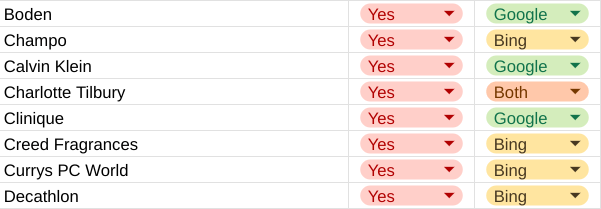
“When we analyse the use of brand names in search ads Temu consistently appears against other brands as demonstrated by the data we have collected,” said Marcode co-founder Andy Cooney.
He described Temu’s strategy as a “scattergun approach” instead of a focus on specific brands, likely due to broad targeting within ad platforms.
Under UK law, companies can bid on any trademark for advertising unless the resulting ad causes consumer confusion about the source of the product.
British footwear brand Dr Martens recently filed a lawsuit against Temu, alleging the use of Google ads to promote knock-off products using keywords like “Dr Martens” and “Airwair,” which it says have gained visibility over Dr Martens’ authentic products in search results.
Faye McConnell, senior associate at law firm Browne Jacobson, explained: “The public policy behind this is to give the consumer access to information about alternatives and competing products and therefore greater choice and options.”
She added that Dr Martens must prove the likelihood of consumer confusion, which can be challenging and costly – something the company may want to avoid amid its current state of weak financial affairs. Instead of legal battles, many brands now respond by increasing their own sponsored ads.
Another option for brands is to report such activity and request Google or Bing to stop it. Microsoft’s policy, which governs Bing, encourages trademark owners to first contact advertisers directly if they believe their trademark is being misused.
Google has a similar policy and says it cannot and does not decide on trademark infringement. “Nor is it in its interests to discourage bidders,” said McConnell. In the fourth quarter of 2023, Google reported a record-breaking $65.52bn in ad revenue.
Both also have complaints policies, but it is a manual and time-consuming process for companies, according to Marcode, who believes the issue extends beyond the brands it scanned. Cooney said the data they collected in this small sample study was “by no means exhaustive”.
Temu said it is “dedicated to fair competition and responsible advertising practices” and uses “robust processes” to avoid targeting brand names. “In rare instances, brand names may inadvertently appear in our ads due to automated keyword insertion processes on platforms like Google,” the company added.
It added that they are constantly refining systems to minimise these occurrences. City PM provided the list of trademarks to Temu, which it said it will review and “take immediate action to rectify any issues.”
Like its “shop like a billionaire” motto, Temu has a big-spender approach to advertising. Bernstein Research estimated that Temu owner PDD Holdings spent $3bn (£2.3bn) on marketing last year to compete with the likes of Amazon and Shein.
According to the Financial Times, Temu has reportedly paid around $1.2bn (£95bn) in advertising on Meta alone and secured a lucrative Super Bowl advertising spot in 2024.
However, some analysts have said this aggressive strategy may be unsustainable for Temu, especially when coupled with its extremely low prices.
Goldman Sachs has estimated that the retailer loses around $6 (£4.70) for every order in the US, while China Merchants Securities calculated that it loses between $588m (£453m) and $950m (£742m) per year.