

Is it still worth investing in bank shares?

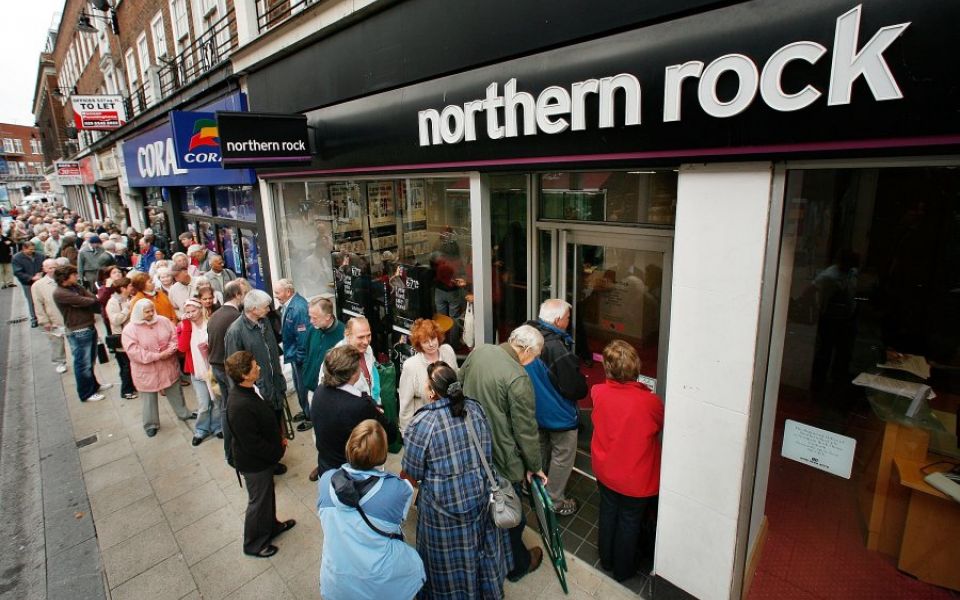
Bank shares rose sharply toward the end of 2016 leaving many investors questioning whether the rally would continue.
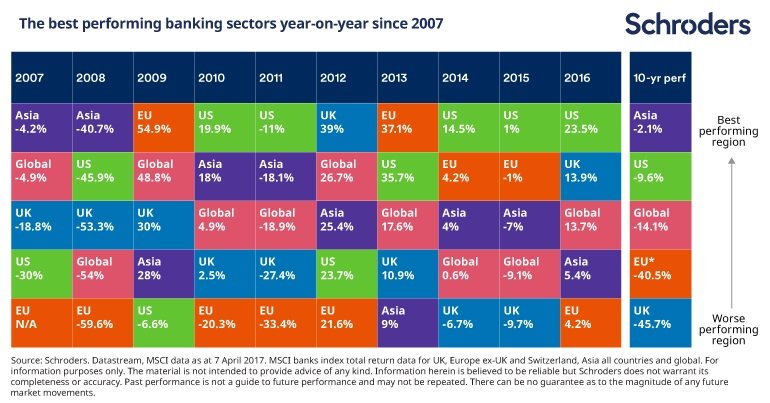
The global banking sector returned 13.7% in 2016 with dividends included, according to MSCI data. In comparison, the MSCI World index returned a more modest 8.2%.
Among banks, the biggest gains were made by the US and UK, although Asian and European banks were also significantly higher.
However, the gains have come after years of underperformance which began with the global financial crisis a decade ago. It was the trigger for a wider economic malaise and also led to a crackdown on the banking sector by regulators.
Even after 2016’s gains the MSCI world banking index was still 14.1% lower than it was 10 years ago. If you had invested $1,000 in MSCI world banking index on 31 December in 2006, your investment would be worth $859, as of 31 December 2016.
In comparison, $1,000 invested in the MSCI World Index over the same period would today stand at $1,497. Again, these are total return figures that include the payment of dividends.
Are banks a missed investment opportunity?
US banks led the way in 2016, rising by 23.5%, according to MSCI data.
Valuations rose too. US banks traded at a 47% premium to their 10-year average price-to-earnings ratio (P/E) by the end of 2016. UK banks were 80% above their 10-year average P/E.
The P/E ratio compares the current share price with earnings. If a share, sector or index has a P/E below its long-term average then it might be considered good value, or at least better value than it has been historically. Lower numbers suggest better value.
- Can this chart really tell you what will happen next to the stock market?
- How cheap (or expensive) are the world's major stock markets?
European and Asian banks have become more expensive too, but their P/Es remain below their 10-year averages, according to MSCI data.
Ian Kelly, Fund Manager, Equity Value, takes the analysis further. He said: “We have seen banks shares perform well recently, but the sector remains among the cheapest in the world today.
"Bank balance sheets have improved dramatically in the decade since the financial crisis, and profitable new business has helped them build significant excess capital.
"Our focus is on ‘normalised’ profits, which are adjusted to remove the effects of seasonality, revenue and expenses that are unusual or one-time influences. That allows us to consider a ‘normalised’ dividend, which we see as being very substantial when considered against today’s share prices.”
Why have banks rallied?
This was primarily because Donald Trump was elected president. His pro-trade, pro-spending rhetoric raised inflation and interest rate expectations.
Rising interest rates are good for banks which get most of their money from deposits, such as savings accounts.
Banks then lend that money back out to other customers at a higher rate. With higher rates they can lend out those deposits at an increased cost.
Some investors also believe that the banks are nearing the end of the process of fixing their balance sheets – effectively a restocking of their financial reserves.
What has happened to bank shares?
Schroders’ analysis of MSCI and Datastream data shows total returns (with dividends included) between 31 December 2006 and 31 December 2016:
- £1,000 in MSCI UK banks would be worth £543
- $1,000 in MSCI US banks would be worth $904
- €1,000 in MSCI European ex-UK and Swiss Banks (data only available from 31 December 2007) would be worth €595
- $1,000 in MSCI Asia all country banks would be worth $979
Why have investors deserted banks?
Regulators have tried to crackdown on the bad practices which contributed to the global financial crisis.
Banks have been forced to sell assets and reduce their exposure to risk. They have been more heavily regulated in other ways, which has hurt their profits.
This turbulent period has inevitably tested investors’ confidence in banks.
How do I value banks?
The P/E ratio is a good start, but it only measures the view the market has of the banks. It doesn’t reveal how healthy the banks are, which has been a source of concern.
In the UK, fund managers Nick Kirrage and Kevin Murphy lead a value team that has examined closely banks’ balance sheets. In particular, they focus on their liabilities versus the assets they hold.
In times of crisis the assets they hold can mean the difference between banks' survival or failure.
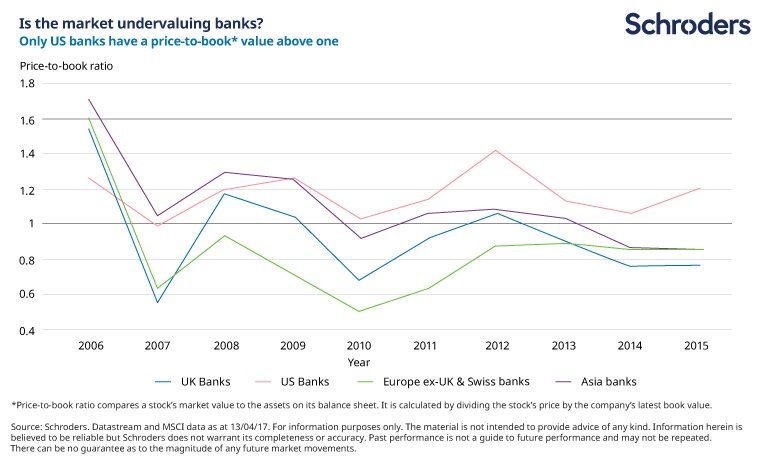
One measure that investors use to gauge how much value investors are placing on the assets on the company’s balance sheet is the price-to-book ratio (P/B).
A figure below one suggests that a company is being valued at less than the value of the assets on its balance sheet. So, in theory, if the company were to sell all its assets they would be worth more than the current value of its share price.
UK, European and Asian banks all have a P/B value of less than one. US banks, with a P/B value of 1.2, appear to be less cheap.
Andrew Evans, another fund manager within the equity value team, has analysed the “Big Four” UK banks.
He said: “Barclays, HSBC, Lloyds and RBS have all been through a period of significant ‘de-risking’ – now holding a lot more equity relative to the liabilities on their balance sheets and the size of their businesses – and yet the market is giving them absolutely no credit for that whatsoever. As such, we remain very comfortable with our exposure to the sector.”
Blog posts from the value investing team:
-
Can this chart really show what will happen next to the stock market?
-
When to buy a company with a falling share price – and when not to
-
The calmest markets in 20 years – and why that should make you nervous
Important Information: The views and opinions contained herein are those of David Brett, Investment Writer and those named in the article, and may not necessarily represent views expressed or reflected in other Schroders communications, strategies or funds. The sectors and securities shown above are for illustrative purposes only and are not to be considered a recommendation to buy or sell. This material is intended to be for information purposes only and is not intended as promotional material in any respect. The material is not intended as an offer or solicitation for the purchase or sale of any financial instrument. The material is not intended to provide and should not be relied on for accounting, legal or tax advice, or investment recommendations. Reliance should not be placed on the views and information in this document when taking individual investment and/or strategic decisions. Past performance is not a guide to future performance and may not be repeated. The value of investments and the income from them may go down as well as up and investors may not get back the amounts originally invested. All investments involve risks including the risk of possible loss of principal. Information herein is believed to be reliable but Schroders does not warrant its completeness or accuracy. Reliance should not be placed on the views and information in this document when taking individual investment and/or strategic decisions. The opinions in this document include some forecasted views. We believe we are basing our expectations and beliefs on reasonable assumptions within the bounds of what we currently know. However, there is no guarantee than any forecasts or opinions will be realised. These views and opinions may change. Issued by Schroder Investment Management Limited, 31 Gresham Street, London EC2V 7QA. Registration No. 1893220 England. Authorised and regulated by the Financial Conduct Authority.