
Standing at the Sky’s Edge is way duller than the estate it’s based on

Standing at the Sky’s Edge is a boring musical that does a disservice to the fascinating story of Sheffield’s Park Hill estate, writes Lucy Kenningham
Standing at the Sky’s Edge star rating: ★★
Standing at the Sky’s Edge should have worked. The material is so, so promising. It’s ostensibly the story of a brutalist Sheffield housing estate named Park Hill, although it completely bulldozes over the estate’s history, giving no indication of why you would want to watch a musical – let alone one based on a pre-existing album by Richard Hawley – set there.
Let me explain – because the show doesn’t. In the late 1950s, left-leaning architects and town planners were cross-eyed with reveries about socially cohesive urban estates. Park Hill was an attempt to create a utopia for former slum dwellers in the Steel City out of five brutalist tower blocks. Crucially, they were built with signature walkways connecting them, each one wide enough for milk floats to drive down and grannies to stop and congregate on. The architects’ hope was that these ‘streets in the sky’ would be places to hang out and foster community vibes.
It worked initially but after a couple of decades the estate deteriorated alongside the steel industry and the wider economy. The plot twist: in 1997, it was the unlikely recipient of a lifelong protection award after Heritage England gave it listed status, meaning the flats were refurbished and renovated. The working class had been pushed out, the yuppies ushered in.
This is the premise on which Standing at the Sky’s Edge pivots. On at the Gillian Lynne theatre, the show transferred from a successful run at the National Theatre last year after its debut at the Crucible in Sheffield in 2019.
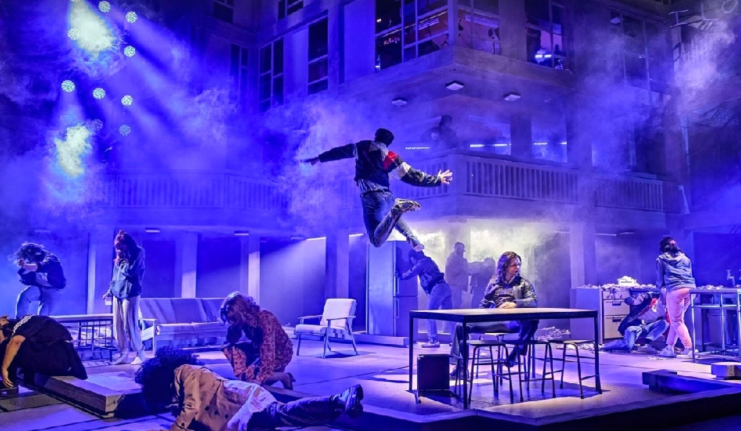
It follows three generations of couples, whose stories dance around each other throughout the show in an impressive feat of choreography. They eat at the same table, for instance, the three storylines weaving in and out of focus. Each thread becomes its own love story: the first, a steelworker and his wife raising their son; the second an immigrant family from Guinea; the third a marketing professional from London. Each has hurdles: unemployment, racism and – erm – a break up. Rather than ultimately exploring community, the musical focuses on these individual stories which we learn, by the end, are intertwined.
Despite the different eras (1960s, 1980s, 2020s), the set – centred around a single apartment – remains the same, with no changes to represent the shift from working class council flats to expensive apartments for young professionals. Characters waltz in and out from all directions on the expansive stage, which doesn’t match the enclosed space that’s so central to the story; the signature streets in the sky aren’t featured at all.
Apart from being a bit dark, there is nothing brutal about this musical nor brutalist about the set. Whilst impressive as a feat of stage construction, there is something incongruously ‘Romeo and Juliet’ about the balcony. Sure, someone gets stabbed at one point but after a intestine-twistingly long amount of time bleeding to death, he simply bounces up and starts singing his heart out to a new track.
A cheesy narrator crops up from time to time to deliver anodyne lines about life and love. The amount of love in this place is sickening, with characters phoning each other from work “just to say I love you” and claiming they wouldn’t have their lives “any other way” than this (I could think of a few basic improvements to their lives, as this particular couple worked day and night respectively, passing like ships in the night and apparently always on the brink of poverty).
The decay of the estate is depicted in one manic scene, which feels like the writer was told to throw in some chaos for dramatic effect. Apropos of nothing, the entire cast starts chucking pieces of paper up in the air and fighting. The crux is someone throwing a sofa off a balcony. But with no plot justification the whole episode just seems silly.
It all feels like Richard Hawley wrote an album and someone arbitrarily decided to turn it into a musical. Which is exactly what happened. This explains why the lyrics have absolutely nothing to do with the plot. For instance, when a character leaves her partner due to his depression, all the characters inexplicably break into a song about… giving up smoking, presumably one of Hawley’s personal vices.
You’ve got to ask why someone didn’t suggest adapting Hawley’s lyrics to the themes or specifics of the plot, especially as the music itself is so boring. I’m not anti sad-man rock – as a solo album, I’m all over it. But this sort of whining guitar music is not well suited to a theatre and is definitely not enhanced by a chorus of two dozen backing singers. Sheffield has produced far more exciting music than Hawley’s and it’s a shame we didn’t get to hear any of it. Iit didn’t help that I’d spotted Hawley’s former bandmate Jarvis Cocker in the audience, who would undoubtedly have produced a more innovative, dirtier and, frankly, cleverer musical score.
This musical is also distinctly unfunny. There are jokes galore about being middle class: Ocado, ‘toxic gin drinking’ and Ottolenghi-style baked aubergine are thrown at us thick and fast in the first half. But it’s 2024 and the Twitter account Overheard in Waitrose was created over a decade ago. The writing confuses being self-referential with conveying something insightful.
I came out feeling angry. I’d come to see a show about an important period of history, one that asks big questions about people, places and psychology, and the impact of gentrification.
But Standing at the Sky’s Edge lacks the imagination to see its subject matter as anything other than a vessel for a few mediocre love stories. It takes a fascinating backdrop and uses it to enact a not-especially-interesting multi-generational soap opera. The truth can be harsh: some things were simply not meant to be put to music.