Skip to content
City PM
  • Germany
  • France
  • Europe
  • Markets
  • Business
  • Opinion
  • DE
  • Germany
  • France
  • Europe
  • Markets
  • Business
  • Opinion
  • DE
Wednesday 15 October 2014 10:40 am  |  Updated:  Friday 07 June 2019 1:50 pm

Sluggish wage growth gives Bank of England a tough choice over interest rates

By: Billy Ehrenberg

Add as a preferred source on Google

Unemployment rate: down. Wages: up a tiny bit. 
 
How does this affect the Bank of England's plans for interest rates? At six per cent, according to the Office of National Statistics (ONS), the unemployment rate is looking healthier by the month.
 
It’s comparable to the US rate (5.9 per cent) and far lower than our neighbours across the channel. France, for example, has a rate of 10.6 per cent and the Eurozone as a whole is running at 10.1 per cent. 
 

The latest US data actually showed 5.9 per cent in September, this is August's rate. UK rate is a three-month average. 

 
All good, but wages are still struggling. Incremental rises in pay, below inflation (1.2 per cent), could affect the Bank of England's position on an interest rate hike.
 
The Bank has a mandate to keep inflation at two per cent, and anything above that would put more pressure on the monetary policy committee to raise rates. A lower inflation rate means pressure not to raise them from their historic low of 0.5 per cent. 
 
Low wage growth also adds pressure on the Bank to keep rates low.
 
Creeping upward
 
Pay including bonuses was up 0.7 per cent compared to a year earlier while pay including bonuses was up 0.9 per cent. This chart compares that growth to that of inflation:
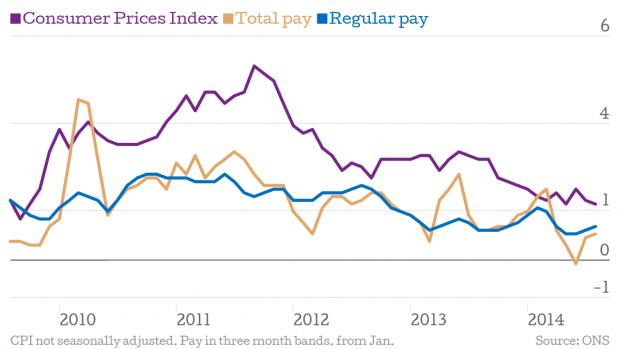


These figures are arrived at by surveys rather than data from everyone in work, so any one figure may be inaccurate. The overall trend though isn’t going upwards at anywhere near the rate the Bank of England would like.

 
Mark Carney has indicated that he expects interest rates to rise before wages catch up with inflation, but continued sluggish wage growth and falling inflation may affect the timing of a hike. 
 
Unemployment is key to any decision, but it is far from being the only factor, as Jonathan Pryor of Investec explains:
 
The six-year low in unemployment is likely to put the Monetary Policy Committee in a quandary about when to hike interest rates. 
 
Mark Carney made the unemployment rate a much publicised key barometer of when to hike rates but the unforeseen drop in consumer inflation and stalling wage inflation has put the Bank of England between a rock and a hard place.
 
For now it appears that investors believe the first rate hike will come much later than the initial forecast of February and due to this the pound remains under pressure this morning, at almost twelve-month lows against USD.
 
In a speech earlier in the year, Carney had said a rate rise in the spring would be seen as the bank completing its mandate, but with no inflationary pressure to act, dawdling wage growth and signs the upward pressure on house prices is easing it may come later. 
 

Share this article

  • Facebook
  • X
  • LinkedIn
  • WhatsApp
  • Email

Similarly tagged content:

Sections

  • News

Categories

  • Business

Related Topics

  • Bank of England
  • employment and wages
  • UK jobs

Trending Articles

  • Burnham tax plans spark investor rush to bank capital gains

  • Nothing fails to file accounts months after dissolution threat

  • I’ve taken the best train trips in the world. Here are my 5 favourites

  • Cruyff turn: Starmer allows pubs to stay open for England World Cup game

  • Nottingham Forest owner Marinakis announces £210m stadium plans

More from City PM

  • As it happened: Stocks sink after Fed and Bank of England opt for hawkish hold; Oil price tumbles

    Markets
    Bank of England building on Threadneedle Street, London, showcasing its historic architecture and financial significance
  • Inflation expectations at record high in interest rates signal

    Economics
    Bank of England building on Threadneedle Street, London, showcasing its historic architecture and financial significance
  • The Bank of England is keeping Britain in the waiting room

    Opinion
    Andrew Bailey, Bank of England governor, discusses economic policy during a press conference at the central bank headquart...
  • Job vacancies fall again in unemployment risk 

    Economics
    People waiting outside a job centre, highlighting unemployment issues and job search challenges in the current economy.
  • Bank of England should hold interest rates, City PM Shadow MPC says

    Economics
    Bailey Boe in professional attire speaking at a business conference with a presentation screen in the background.
  • Interest rate cut is ‘off the table’, says Bank of England governor

    Economics
    Governor Andrew Bailey has launched a defence of the Federal Reserve's independence.
  • Interest rates next change ‘far more likely down than up’

    Economics
    The Bank of England's Andrew Bailey will be closely monitoring movements in long-dated bonds
  • Bank of England chief economist ‘not trying to be a troublemaker’ on rates split

    Economics
    Chief economist Huw Pill said "consistency" was key to the Bank of England's quantitative tightening programme (Photo by: Graeme Sloan/Bloomberg via Getty Images)

City PM — European politics, business and analysis.

Europe

  • Germany
  • France
  • Europe
  • UK & Ireland

Topics

  • Business
  • Markets
  • AI
  • Technology
  • Opinion
  • Energy

More

  • Politics
  • Economics
  • Fintech
  • Legal
  • Sport
  • Life

Company

  • About City PM
  • Editorial Policy
  • Corrections
  • Contact
  • Terms of Use
  • Privacy Policy
  • Cookie Policy
© 2026 City PM · Published by CityPM Media, Bahnhofstrasse 65, 8001 Zürich, Switzerland
About · Editorial Policy · Corrections · Contact · Privacy