
Sir Charlie Bean: Forget Brexit – the UK productivity crisis is a threat to capitalism


Brexit has dominated conversations about the UK economy in recent years, just as it has hung over almost everything else.
But over the last week or so, the country’s festering productivity crisis has come to the fore, with the Bank of England downgrading its growth predictions and studies describing the worst decade for productivity expansion since the early 1800s.
Sir Charlie Bean, former deputy governor of the Bank of England and one of Britain’s most respected economists, says this attention is overdue. Brexit is “small beer” compared to the UK productivity slowdown, he says, which is the country’s biggest problem and even has the potential to undermine consent for British capitalism.
Few people are better-placed than Bean, 66, to talk about the issue. He was a professor at Stanford and the London School of Economics before arriving at the Bank in 2000 and has held roles at the Treasury. He is now the top economist at the UK’s Office for Budget Responsibility (OBR).
A threat to capitalism
But why is the slowdown so important? Productivity is commonly defined as the amount produced per hour worked. Increasing productivity effectively means making more stuff in the same amount of time. It makes an economy richer and lets wages rise and prices fall.
Without it, long-term growth can only really come about through longer working hours or by dragging more people into the workforce.
This is exactly what’s happened in Britain over the last decade, Bean says. Unemployment has fallen to record lows, but productivity is now 20 per cent below its pre-crisis trend, having flat-lined since 2008. The BoE says this has severely limited the UK’s growth potential.
As the economy has failed to become more productive, Britain has undergone “the longest period of stagnation of real wages since before the Industrial Revolution,” Bean says.
“A lot of people feel left behind,” he says. “They see a few people who’ve done very well at the top end of the income distribution, the billionaires and so forth, and feel they don’t have a stake in capitalism.”
“That’s when the consent for the system starts breaking down. People start looking for alternative ways forward, alternative policies [that] actually turn out to be destructive.”
Two productivity crises
So how does Bean explain the UK productivity crisis? Firstly, he says, it must be thought of as two crises, one international and one British.
Productivity has also slowed in the US and Europe, puzzling economists the world over. Of the various proffered explanations, Bean speaks positively of economist Thomas Philippon’s argument about corporate power.
“Economies are becoming dominated by large companies,” he says, “the likes of Google who have less incentive to innovate and a lot of incentive to take over competitors as soon as they come up with a bright new idea.”
He says the economy has become less entrepreneurial and more about “rent extraction”, while the uncertainty of the post-financial crisis world has also acted as a drag.
Yet the UK has languished at the bottom of the productivity leagues. Brexit, and the uncertainty it has unleashed on the economy, is part of this story, Bean says. “Business investment just flattened off after the referendum result” and instead of investing, firms have hired workers they can sack later.
Rising employment has helped the economy expand, but not through new technology. “I think there’s limits to how far you can go with that,” Bean says. “If we say we want to limit immigration as well, that’s also going to be limiting the extent to which the labour input can grow.”
Another driver is the “relatively low level of technical skills in the UK,” Bean says, which prevents the incorporation of the newest, most productive technology. There is also “evidence to suggest that management is not as efficient here”.
How to slay the slowdown
So what is to be done? Bean says Britain must “focus on the things that we know we can do something about”, such as boosting skills, raising infrastructure spending and encouraging investment.
Following the Conservatives’ landslide election victory, chancellor Sajid Javid and Prime Minister Boris Johnson have pledged to do just this.
Yet the former BoE deputy warns: “It won’t simply be a case of spending more in the next year or two and suddenly seeing a huge increase in productivity, it’s much more a long slog.”
Bean, who has been at the OBR, the UK’s budget watchdog, since 2017, also cautions that changes to accounting standards, slower forecasted growth, and previously announced spending have “greatly reduced the room for manoeuvre” when it comes to the public finances.
Could the Bank of England help? The former deputy governor argues against the idea of productivity targets. “The responsibility to do those things should rest with the politicians, not with the technocrats at the bank.”
But Bean is clear in his warning that economists and policymakers must find some way out.
The UK economy can handle Brexit, yet without increased productivity, “you can’t deliver the sort of increased living standards that people want” or deal with an ageing population and climate change. The stakes are high: “That does just challenge the legitimacy of capitalism.”
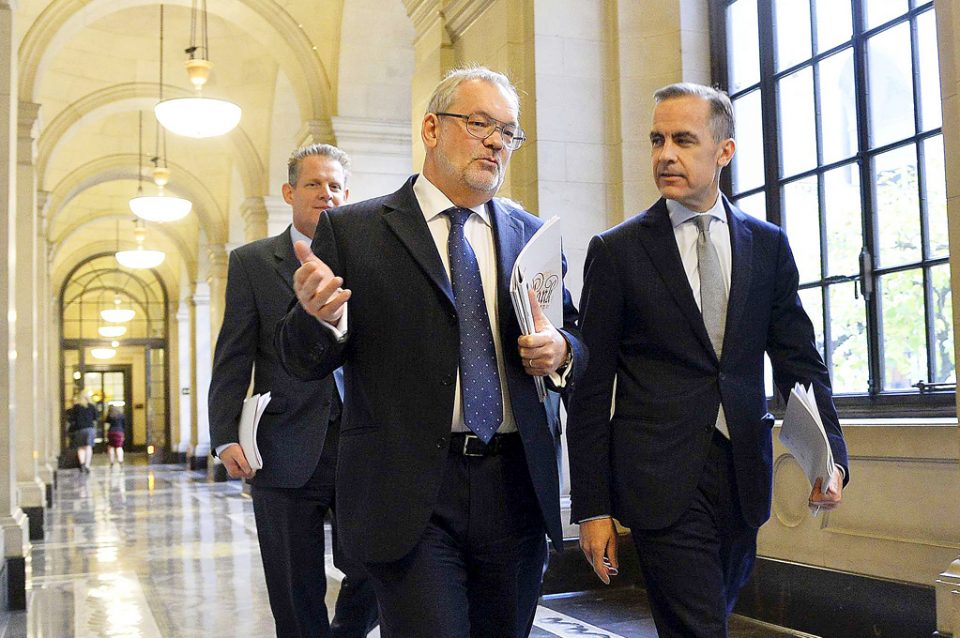
Main image: Sir Charlie Bean, former Bank of England deputy governor. Credit: Greg Sigston/City PM