Skip to content
Saturday 25 July 2026London --:--Frankfurt --:--Zurich --:--
NewslettersSearchEN · DE
City PM

European business, markets and politics

FTSE 100
10,736.23
+0.91%
DAX
25,099.00
+1.36%
CAC 40
8,372.28
+0.88%
STOXX 50
6,280.94
+1.14%
  • Europe
  • Markets
  • Business
  • Economy
  • Technology
  • Politics
  • Opinion
More
GermanyFranceBankingAIEnergyFintechPropertyCapital Markets
  • Germany
  • France
  • Europe
  • Markets
  • Business
  • Economy
  • Technology
  • Politics
  • Opinion
  • DE
Thursday 03 March 2016 9:32 am

Seven years of quantitative easing and 0.5 per cent interest rates by the Bank of England: Who are the winners and losers?

By: Jessica Morris

Add as a preferred source on Google

This Saturday will mark seven years since the Bank of England enacted its historic quantitative easing programme, and cut the UK’s main interest rate to 0.5 per cent, in a bid to save it from the financial crisis which was then tearing across the globe.

Just like any other policy, it has thrown up winners and losers. Investors who piled into stocks, bonds and property would’ve enjoyed rip-roaring rises during this period – however, pension annuity rates have fallen dramatically.

The era of ultra-low interest rates has seen cash savers lose out on £160bn in interest payments, or £6,000 per household, according to the research by financial services group Hargreaves Lansdown. In a reversal of today’s trend, they’ve also been squeezed by increased living costs, with inflation rising 16 per cent during this period.

On the flipside, borrowers have enjoyed low mortgage rates, whittling down the size of their monthly repayments. Hargreaves Lansdown said mortgage rates averaged 3.4 per cent since March 2009, compared with an average of 5.8 per cent in the previous 10 years. 

“Overall, borrowers and investors have had the best of it since QE started in the UK. Mortgage costs have fallen significantly from pre-crisis levels, but this positive effect is laced with an underlying risk,” Laith Khalaf, senior analyst Hargreaves Lansdown, said.

“If borrowers get too comfortable taking on high levels of debt at low interest rates, they could be in for a nasty shock if and when rates rise.”

Click or tap on the chart to see it in a new screen 
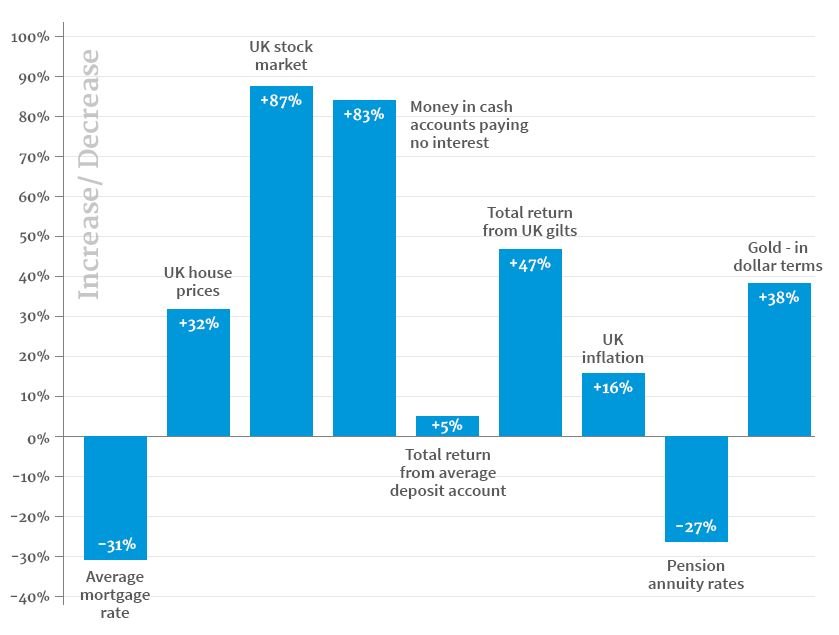
Note: Hargreaves Lansdown also estimates interest lost by savers from September  to be £160bn

Share this article

  • Facebook
  • X
  • LinkedIn
  • WhatsApp
  • Email

Similarly tagged content:

Sections

  • Markets & Economics
  • News

Categories

  • Business
  • Economics

Trending Articles

  • BT braces for loss of 800,000 customers as it banks on fibre to keep turnaround ‘on track’

  • Wise denied US banking licence in blow to expansion plans

  • Regulator flags BDO’s ‘unacceptable’ audit issues for fifth year in a row 

  • Housebuilder hits a wall: How did Vistry become the UK’s most shorted stock?

  • Scotch whisky sales are falling, but what’s really behind the decline?

More from City PM

  • IMF warns Bank of England against cutting interest rates

    Economics
    IMF Chief Kristalina Georgieva issues caution to Bank of England amid economic concerns
  • ‘Door is open’ to interest rate hike as inflation fears return

    Economics
    Bank of England headquarters in 2025, showcasing modern architecture and iconic London skyline in the background.
  • Bank of England warns Burnham of UK economy’s ‘big issue’

    Economics
    Bank of England Governor Andrew Bailey said the future of interest rates was "more uncertain".
  • Interest rate cut is ‘off the table’, says Bank of England governor

    Economics
    Governor Andrew Bailey has launched a defence of the Federal Reserve's independence.
  • House prices rise as mortgage rates ease from Iran war highs

    Property
    Starmer plans to build up to 12 new towns.
  • UK borrowing costs soar as Iran ceasefire collapses

    Markets
    Rising borrowing costs depicted amid escalating tensions following the Iran war, illustrating economic impact on global ma...
  • Oil prices return to crisis levels

    Markets
    Close-up of a petrol pump nozzle dispensing fuel at a gas station, highlighting rising fuel costs and economic impact.
  • ‘False dawn’: June inflation falls to 2.6 per cent but analysts say rises ahead

    Economics
    Till sales growth slowed to 2.7 per cent in the last four weeks
CityPM

Independent European business, markets and political news for decision-makers.

Morning Briefing

Europe

  • Germany
  • France
  • Europe
  • UK & Ireland

Business

  • Markets
  • Banking
  • Technology
  • Energy
  • Property
  • Fintech

Editorial

  • Opinion
  • Editorial Policy
  • Corrections
  • Contact

Company

  • About City PM
  • Privacy Policy
  • Terms of Use
  • Cookie Policy
© 2026 City PM Ltd · Published by CityPM Media, Bahnhofstrasse 65, 8001 Zürich, Switzerland
Privacy · Terms · Cookies · Facebook