
Send in the clowns… don’t bother, they’re already here

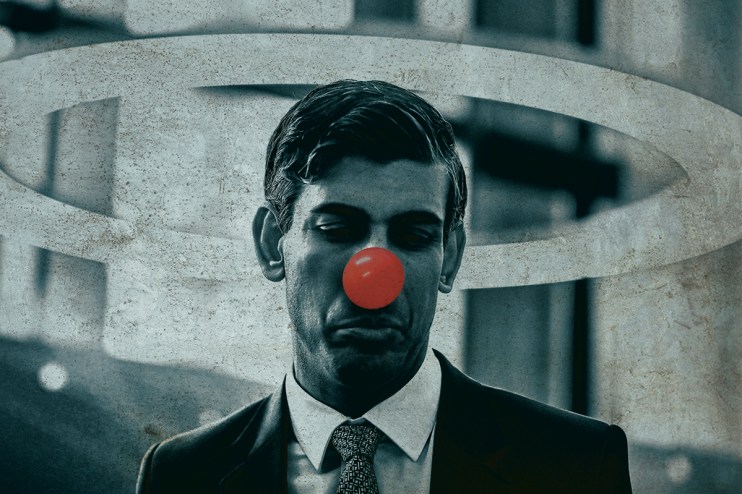
The PM’s decision to leave the D-Day commemorations early had all the hallmarks of a classic gaffe. Jessica Frank-Keyes takes us through the history of political gaffes and asks why some are more memorable than others
It’s every politician’s nightmare. Waking up to front pages, news bulletins and Twitter storms, not on their latest policy brilliance, but an awkward and downright embarrassing error.
I’m talking, of course, about political gaffes. Think of Gordon Brown being caught on a hot mic, Boris Johnson hiding in a fridge, bits of stage collapsing around her as a prankster handed Theresa May a P45, or even Neil Kinnock falling over.
A gaffe is defined as “an unintentional act or remark causing embarrassment… a blunder”.
Journalists – weary from days of spin, stump speeches and stunts – may see them differently. A chance for an amusing headline, eye catching photo – or a glimpse behind the curtain to what politicians don’t want you to see.
For voters, gaffes often firm up existing issues, wobbles or worries about a person, into something concrete.
“They only really cut-through when they reinforce existing narratives, but ultimately it depends on the severity of the gaffe and what it is,” Chris Hopkins, political research director at Savanta, tells me.
“The big ones of the last 15 years strike me as Brown and Gillian Duffy – aka Bigot-gate – and Sunak and D-Day.”
For Rishi Sunak, the defining image of this campaign may end up being those photos of the Prime Minister, drenched through, announcing the election as the heavens opened above him. A bad omen, absolutely. But a gaffe – I’d argue perhaps not. A gaffe must expose something – rather than simply not reading the weather forecast.
Bigot-gate was revealing for precisely that reason: Brown had spoken politely to the woman to her face, only to reveal his true feelings – he thought – in private. And when Johnson ducked into that fridge rather than answer questions it revealed that behind the ‘Boris bluster’ was a man who recognised that not all was or would be sunlit uplands.
They also can’t be too large-scale – and have to be funny, for at least some of us.
“May’s big gaffe was policy – the dementia tax,” Hopkins adds. “I guess Partygate was a gaffe of sorts. Trussonomics too, but you don’t really call them gaffes. They feel too serious.”
However, it’s hard not to argue that Sunak soon made up for lost time with a run of mini-gaffes’. In Wales, he greeted voters by asking if they were looking forward to the Euros – a tournament the nation hadn’t qualified for.
In Belfast, he visited the Titanic Quarter, and posed on a plane in front of a sign marked Exit. Awkward, but salvageable.
But in a move that launched a grenade into the midst of his campaign, the PM’s decision to leave the D-Day commemorations early had all the hallmarks of a classic gaffe. Unintentional, apparently so. Embarrassment, tick. Potential to derail an election and define your political legacy? Very possibly.
That gaffe has gone on to shape the campaign; framing questions on his commitment to Ukraine, to defence, to the statesman like qualities of the job, of being a physical symbol of the British state.
Labour has – at time of writing – avoided major gaffe territory. But for balance’s sake, I’d point you to Emily Thornberry contradicting the party line on private school VAT, and Wes Streeting appearing to forget the hospitals Labour was pledging to rebuild.
Similarly Keir Starmer was slow to reject Sunak’s £2,000 tax rise claim during the ITV debate. But again, this felt more of a misstep than a fully fledged gaffe, in that it didn’t reveal something previously unknown about Starmer’s lawyerly, ponderous qualities.
D-Day may not have the visual quality of Ed Miliband scoffing a bacon sandwich, or the cringe factor of, again, Miliband’s infamous ‘Ed Stone’. Hopkins says he’s still “unsure” whether it’s changed anything fundamental.
But it plays into the somewhat tragic nature of the gaffe as a genre. The hubristic sense that it is at their most honest, when they fail to play the game, that politicians crumble. That being authentically themselves, is sometimes the worst thing they can do.