
Renationalisation won’t get our railways back on track

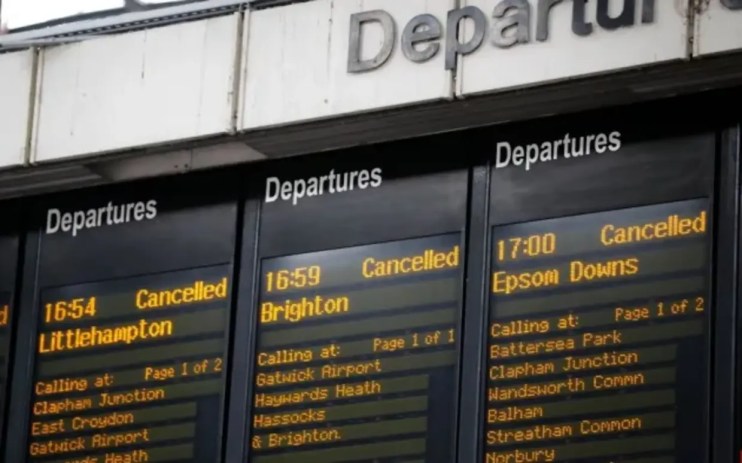
Slow, crowded and expensive, there’s no doubt our railways need a major overhaul – but it’s far from clear that Great British Railways is the answer, says Emma Revell
One of the many delightful quirks of our democracy is the State Opening of Parliament, where the government’s legislative agenda for the coming session is set out by the monarch from a gold throne wearing heavy robes and a shiny crown.
For me, nothing will beat the totally incongruous sight of the late Queen Elizabeth II uttering the words “plastic carrier bags” back in 2014, when Cameron and co decided a 5p levy was going to save the planet, but this year’s King’s Speech had its fair share of things you wouldn’t expect King Charles to come up with on his own.
A man with his own train, albeit one technically owned by the taxpayer, last week announced plans to reform rail franchising, establish Great British Railways and bring eight train operators into public ownership. This isn’t the worst case scenario, at least for the taxpayer, because Labour have signalled their intention to bring into public ownership the franchises naturally, when they come up for renewal, rather than buy out the existing private operators – but that should be small comfort.
The Labour Party claims nationalisation is necessary to improve our beleaguered rail network and ‘usher in a decade of growth, innovation and service improvement’. There are just a few small problems with that plan.
Firstly, it is by no means clear that nationalisation will work. Under Great British Railways, any funding for future investment – whether that’s to fund increased pay demands (which will surely come from such a heavily unionised and strike-happy workforce) or improvements to stations, tunnels, tracks, and trains – will have to come from the public purse.
This puts the burden of paying for rail travel onto people who rarely use it – 1.4bn journeys taken on National Rail services in the year to March 2023 sounds like a lot, but that pales in comparison to 3.7bn bus journeys, and the 84 per cent of people who travel by private car at least once a week. Is it really fair to say to the 27 per cent of people who travel by train less frequently than every six months, or the 21 per cent who say they never use trains, that their taxes are going to be used to make train travel cheaper for those who do?
Nationalisation also puts rail funding in direct competition with everything else. A competition for which the winners are already well known. Public money will always be spent on core state and public priorities – education, defence, pensions, servicing national debt, and of course, our precious NHS.
Budgets for rail improvements would constantly be chipped away or diverted to other national priorities. The infamous Beeching Cuts to local rail routes across the country were in part due to a desire to reduce the cost of rail subsidies to the taxpayer. The current subsidy is around £4bn per year, with the network only bringing in 80 per cent of pre-Covid income. It is far from clear Labour’s nationalised solution will deliver more for less.
Secondly, the problems that beset our railways which, let me be clear, do exist – just ask anyone trying to commute between Manchester and Leeds – are not the fault of privatised operators.
There are two elements of the conversation around rail performance that are most frustrating. Firstly, much of what happens on our railways is not within the control of operators. In the first quarter of this year, 50.4 per cent of all cancellations were due to issues with Network Rail – the public body which owns and operates the infrastructure. Capacity issues on the network, which contributes to train overcrowding and lower speeds on congested routes, can only be solved through modernisation, electrification, and major infrastructure overhauls like new tracks and wider tunnels – all of which is the responsibility of Network Rail.
Secondly, we have a perfectly good example of where competition does work. If the West Coast Mainline is a case study in how to not manage links between your capital and other major cities, we only need to look to the other side of the country for the answer.
Anyone travelling up the East Coast Mainline will find themselves with a number of different operators to choose from because the line runs under an open access model. The vast majority of my train journeys outside London are up the East Coast Mainline, either via Doncaster to visit family or passing through York towards the North East to catch a Sunderland game. Every time I book a ticket I am able to choose between LNER, Hull Trains, and Grand Central, weighing up cost, journey time, seat comfort, or even whether I’m travelling over lunch and want to go for the best on-board catering.
And it works. Earlier this year Hull Trains reported 96 per cent overall customer satisfaction with their services. In the first quarter of this year, just under a third of LNER’s cancellations were related to the operator, compared to 69 per cent of Avanti West Coast’s cancellations. It works so well in fact, that one of Britain’s most beleaguered routes – Euston to Manchester – has an open access application, with Lumo looking to break Avanti’s monopoly and bring its own 96 per cent approval rating from the East Coast line to the West.
Better, cheaper, more reliable train travel is key not only to Britain’s economic growth, but to achieving our ambition to reduce carbon emissions. Labour’s commitment to that end is not in doubt – just the methods they believe will get us there.
Emma Revell is external affairs director at the Centre for Policy Studies