
Regular rapid testing reassures that you aren’t spreading the virus without knowing

As a country, we’ve certainly put the hard yards in to bring Covid-19 cases down. Lockdowns are tough on everybody, but it’s that discipline that’s meant we can slowly start getting back to the things we love.
But to keep on top of Covid-19, we can’t just rely on the rollout of vaccines. One other part of the equation is continuing to identify Covid-19 cases as quickly as possible, and for those people who have the virus to self-isolate immediately.
This would be easier if everybody who had Covid-19 knew it – but around one in three of those with the virus show no symptoms. This means that they can spread it without them knowing.
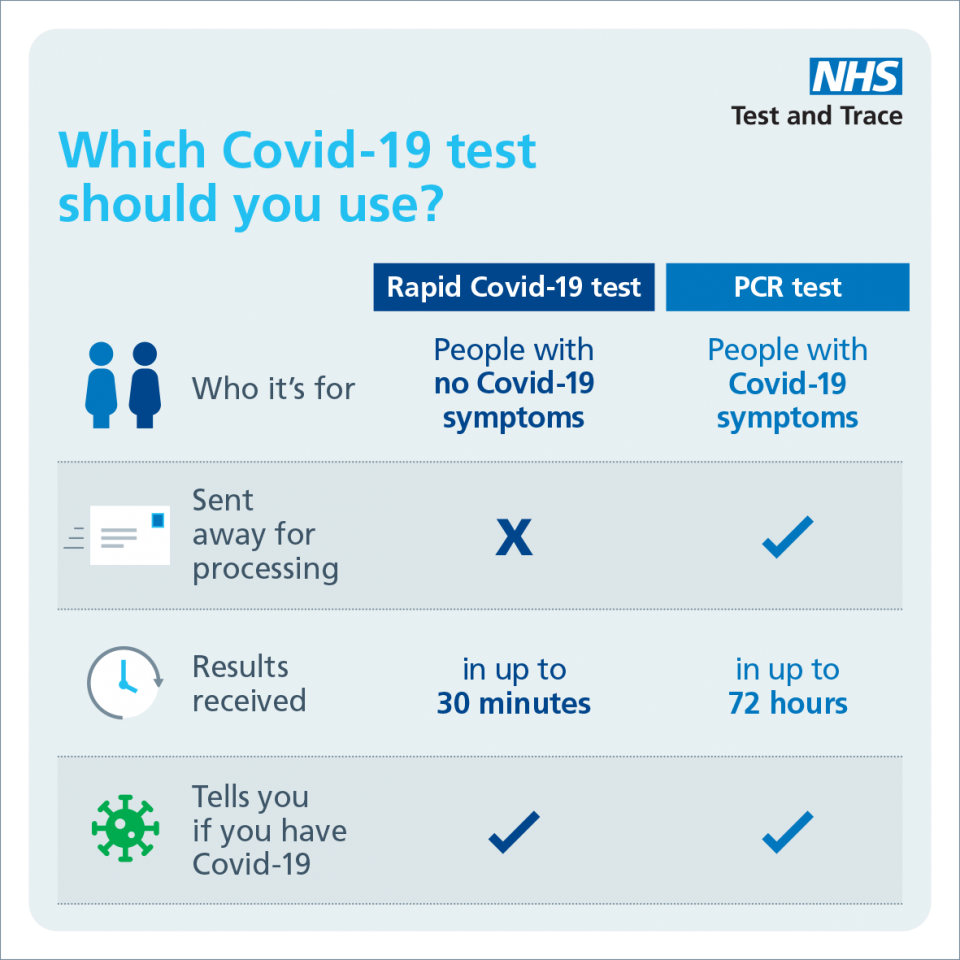
So as Britain gradually unlocks, regular testing is going to be part of all of our lives. Rapid Covid-19 tests give results in thirty minutes and all of us need to play our part, testing ourselves twice a week and helping to ensure that we don’t go backwards in the fight against Covid-19.
Are the tests accurate?
GP Dr Amir Khan told City PM that the lateral flow tests used in rapid Covid-19 testing are “a very good test,” accurately identifying people who have no symptoms but who are highly infectious.
“Testing ourselves for coronavirus using lateral flow tests is vital to us keeping ourselves and others safe and keeping infection rates in our communities low. When done correctly, the tests are at least 99.9 per cent specific – which means that the risk of a false positive is extremely low, less than one in a thousand,” he continues.
How often should I test myself?
GPs recommend testing yourself every three to four days or twice a week – the frequency of testing is vitally important. If you take the tests further apart, you may miss the period when you are most infectious.
Are people really testing themselves?
Following the Prime Minister’s announcement that everyone without symptoms can now get regularly tested with free rapid Covid-19 tests, millions have been taking advantage – ordering them online, from participating pharmacies or picking them up from tests sites.
So far, more than 58 million tests have been taken, with hundreds of thousands of cases amongst people with no symptoms identified. Those people have then self-isolated, rather than unknowingly spreading the virus to those who might well have fallen seriously ill.
I didn’t fell unwell at all – but my test came back positive
Twenty-nine year old South London plumber Shaun McGarrett discovered he had Covid-19 whilst taking a rapid test – and with a vulnerable father, he’s glad he did.
“My dad has chronic lung disease so from the start I have been extra careful about Covid-19 and making sure I can’t possibly be bringing it near him,” he told City PM
Taking a rapid Covid-19 test (for people without symptoms) is a similar process to taking a PCR test for people with symptoms, and Shaun had been taking them at the local community centre near his home.
“It was never a pain to do and it made me feel reassured that I could carry on working – seeing to all my clients, some of whom are quite elderly and infirm.
“I didn’t feel unwell at all, and had none of the symptoms associated with Covid-19. But then one day, the test came back positive,” he recounts.
Shawn immediately self-isolated, protecting his loved ones, work colleagues and customers by ensuring that he didn’t pass on the virus to anybody in his family or in his community.
Nobody likes having to self isolate, but Shaun recognises it’s for the greater good.
“There are simple rules which we are being asked to follow and if we do them, then the sooner we can all get back to life as we once knew it.”
What happens if I test positive?
Like Shaun, you should self-isolate straight away along with the rest of your household and order a confirmatory PCR test online or by calling 119. As Dr Khan has explained, the chances of a false positive are less than one in a thousand, so scientists and experts have faith in these rapid Covid-19 tests and that a positive test does mean you’re infectious – and at risk of spreading the virus to the community.
It’s also important that you report your test results straight away whether positive, negative or void at gov.uk/report-covid-19-result or by calling 119. That allows scientists to track the pandemic through anonymised data.

“I went for a run and was about to start my shift – then I tested positive”
Kim Tobin, 54, from Southend works in a local supermarket. Just as the New Year started, she went for her usual morning run then headed to work.
Because her job involved lots of interaction with others in the supermarket, her firm had implemented the rapid Covid-19 tests for all staff before they started their shift.
After Kim’s run, she went to work – with a very, very mild sore throat.
“I didn’t even think anything of it. I was all dressed for work, ready to go. And I went and had the test. We had to wait for 20 minutes.
“Then the lady that was doing the test came up to me and said ‘you need to go home right now because you’ve got it, you’ve tested positive’.”
Kim says she was shocked at the diagnosis, and went to a safe and secure Covid-19 testing site to have a PCR test to confirm the result.
After that, she went home and isolated with her family. Further testing also revealed that her daughter had Covid-19, too – without any symptoms.
That did change, however. About four or five days after the positive result. Kim says, she lost her sense of taste and smell as well as feeling tired.
Her daughter Eva, 23, had it worse says Kim.
“She’s really struggled with her breathing, and her lungs feel really heavy. We’ve been trying to go keep active inside but she couldn’t really walk any further than for half an hour and she’d be puffed out.”
Now back at work, Kim is being tested twice a week, either by the supermarket or by herself at home – and is convinced of the value of regular testing.
“There’s a lot of people who could have no symptoms and if you don’t know, if you’re not feeling any of the symptoms, you would probably assume that you haven’t got it,” she says.
“But I do think it’s important (to test regularly) because we know how quickly it spreads just by one person having it and giving it to somebody else.”
Where can I get tests?
Everyone can now get free, rapid Covid-19 tests. They’re easy to do, and results come back within 30 minutes. The more of us that take part, the more we can help protect each other.
Free rapid tests are easy to get from participating pharmacies by calling 119 or online at nhs.uk/get-tested.