
Recent Conservative governments have been more left wing than Attlee

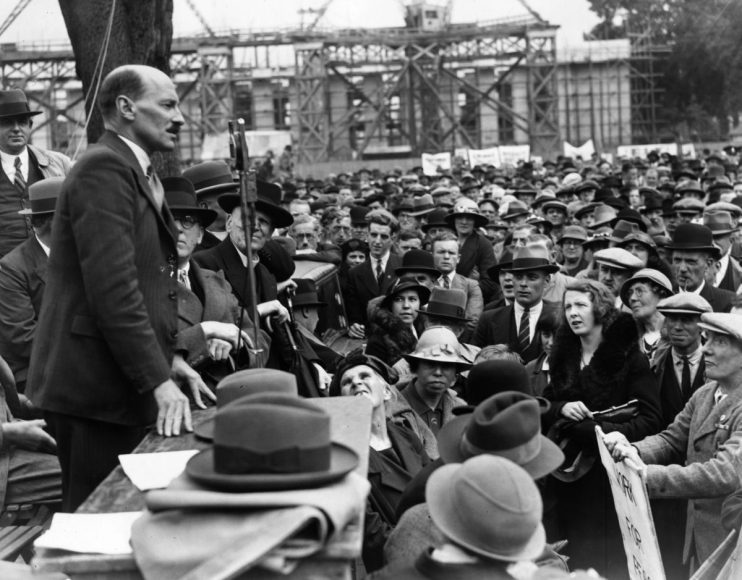
Here’s a Christmas quiz: Which has been Britain’s most left-wing government? According to Paul Ormerod, it’s not the one you think….
The extended Christmas holidays loom. One way of filling the time is to think about crucial questions such as who is England’s greatest ever batsman, which football club side is the best the world has ever seen?
A more esoteric variant is to contemplate which has been Britain’s most left-wing government?
At first sight, the answer is obvious. It is surely Clement Attlee’s post-war Labour government from 1945 to 1951.
When elected in July 1945, the government did face massive problems. Millions of men were in the armed forces and needed to be reabsorbed into the civilian labour force. Substantial numbers of houses and factories had been destroyed by German bombing. Much of the rest of the country’s capital equipment had been run at maximum capacity during the war and was on the verge of collapse. We owed vast sums to the Americans for supplying us with military equipment.
In response, Attlee and his cabinet did enact traditional socialist measures such as the nationalisation of steel, electricity, gas, coal and the railways. In fact, in total around 20 per cent of the entire economy was taken into public hands.
The National Health Service was set up, based on the then fashionable idea of central planning. It was the first of its kind. Other European countries subsequently had the sense not to copy it and have a mixture of public and private in their health services.
The Attlee surplus
But in other respects, the government showed flexibility. By 1951, the extensive rationing of consumer goods which had operated during the war had almost been abolished. The youngest member of the cabinet and future Prime Minister, Harold Wilson, had proclaimed a “bonfire of controls”.
Financially, the Attlee government was extremely conservative. It might be argued that there was no alternative, but it did not shrink from its task and was a model of fiscal rectitude. The public finances were in substantial surplus over the lifetime of the government, including what is by far the largest post-war surplus in 1948, amounting to nearly five per cent of GDP – getting on for £100bn in today’s terms.
We might usefully contrast this with the public finances under the various Conservative leaders from 2010 to 2024. In nine out the 14 years, the public sector deficit exceeded £100bn.
To be fair, David Cameron did come into power on the back of the financial crisis of the late 2000s. He and George Osborne, the Chancellor, inherited a deficit of some £150bn. By 2019, they had reduced this to £50bn. But it was still a deficit, unlike the surpluses run under Attlee.
We then experienced the lunacies of the furlough scheme. Given that the government copied the lockdown policy of the Chinese Communist Party, some sort of support was necessary. But the scheme was both very generous and lasted for far too long. The current talk around an alleged black hole of £22bn is trivial in comparison to the £400bn cost of lockdown.
The legacy of the Conservative governments is that state spending is now a higher percentage of GDP than it was under Attlee and is the highest it has ever been outside the two world wars.
The legacy of the Conservative governments is that state spending is now a higher percentage of GDP than it was under Attlee and is the highest it has ever been outside the two world wars
Despite massive expenditure, public services became increasingly dysfunctional, with productivity in the public sector being lower than it was in 1997.
In practice, the government operated the very left-wing policy of open borders, with few effective controls on immigration.
Marginal tax rates for young graduates successful enough to have to repay student loans were punitively high, being around 65 per cent for someone with a master’s degree.
All in all, there is plenty of food for thought on the question of which has been Britain’s most left wing government.
Paul Ormerod is an economist at Volterra Partners LLP, an Honorary Professor at the Alliance Business School at the University of Manchester and author of Against the Grain: Insights of an Economic Contrarian, published by the IEA in conjunction with City PM