
What is TfL’s Places for London, and is it really tackling the capital’s property crisis?


For nearly a year, Transport for London’s property arm has been operating as Places for London, a public company built to consolidate TfL’s extensive property portfolio—they own 5,700 acres of land—and now help to ease some of the city’s property problems.
These problems have become increasingly pressing as London has found itself in a ‘race for space’ to develop homes and offices. Building new homes has also become a route for TfL to help fund its chronic funding issue.
City PM caught up with Places for London to see how it is addressing issues in the capital.
First off, what is Places for London?
Places for London is the current name for Transport for London’s (TFL’s) property division. The name was changed from TTL Properties last year.
During the pandemic (when TfL lost most of its income overnight), the transport network was unable to fund its property division without government support.
TfL then agreed to set up a commercial property division – TTL – as a condition of government funding.
At that stage, TTL properties became a separate company from TfL.
TTL was established in 2014 as a wholly-owned subsidiary of TfL to consolidate TfL’s property activity.
How is it related to TfL now?
Places for London is still owned by the transport network, and dividends flow back to TfL, which is ultimately run by London Mayor Sadiq Khan.
According to company director Graeme Craig, the property division made £90.1m in income and £36.2m in profit in the last financial year.
“We’re part of TfL… whatever it is that we’re doing across London, we always look for every opportunity we can in order to deliver those local improvements to the transport network,” Craig said.
A total of £20m of this was paid to TfL via a dividend last year. “In the context of TfL, those are relatively small numbers, but of course, it’s still £20m that’s reinvested in the transport network,” Craig said.
Places is now financially independent from TfL.“The way we’re set up now, TfL doesn’t put in any money at all into [it],” he added.
Places currently holds £1.7bn in assets. This figure is expected to grow to £4.34bn in the next 10 years.
What are they doing to develop London real estate?
Residents are increasingly finding their wallets squeezed by rocketing rents for flats further and further out of the city.
According to Savills, London needs at least 42,500 affordable (sub-market) homes per year, compared to an average of 7,900 sub-market homes delivered annually since 2015.
“The biggest single challenge London has is a housing crisis, and more particularly an affordable housing crisis… We see it as critical that we bring forward as many affordable homes as we can,” Craig said.
The company is working to build 20,000 homes over the next 10 years, half of which are affordable.
“That’s the biggest target we’ve got because that’s the biggest challenge that London faces,” Craig said.
The public company also develops space for small businesses, encourages construction training and develops sustainability initiatives.
“The question is: how do you make the best use of every square foot the TfL has? How can we use that to deliver the most sustainable office space yet built in the UK? How can you use that to deliver and homes, particularly high levels of affordable homes?
[We] provide incubator space for new business retail space, particularly focused on small local businesses. We’re in an enormously privileged position… We’re in a position to give people a front door roof over their heads and a safe space.” Craig said.
Spaces redeveloped recently include commercial office space above Moorgate station, 350 homes in Walthamstow (half of which are affordable), and the development of a construction trading scheme, Build East, with The Skills Centre.
Isn’t that the councils’ job?!
London councils face a £4bn shortfall over the two financial years to 2024-25, and 22 London authorities missed their housing targets between 2019 and 2022.
Is Places having to plug a gap left by councils?
Not necessarily, Craig said. He argued that they are well-placed to work together to achieve their goals rather than it stepping on any toes.
“I think we’re on the same page. We want the same thing. I’m not someone who complains about councils. You’ve just got to get on and get stuff done,” he said.
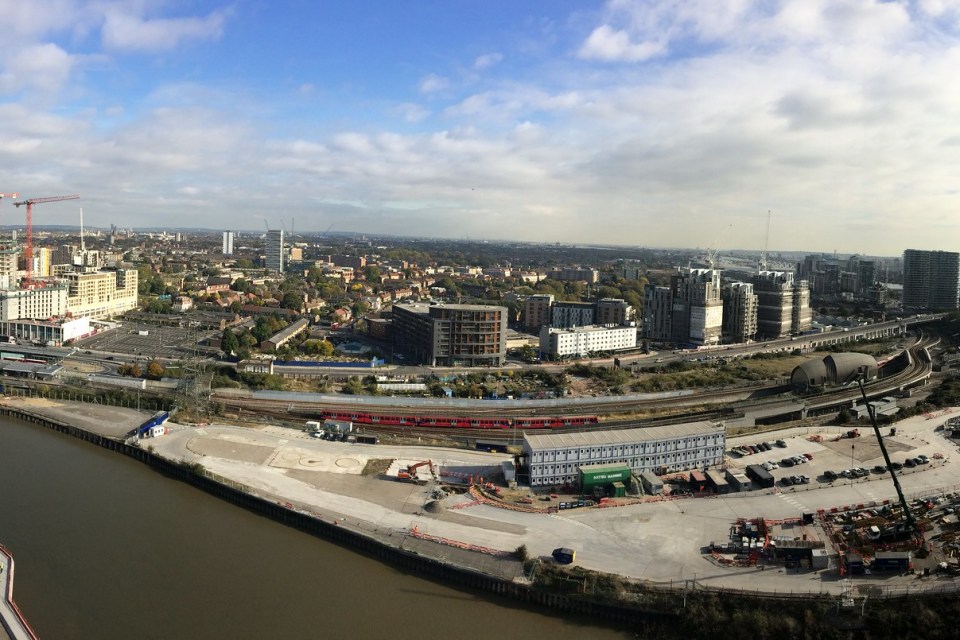
Although the firm has “historically had issues with planning consent”, Craig said that their status as a public body makes it well-placed to engage in discussions about local needs with councils.
“The relationships that we have with boroughs, with local communities, with London government – I think that helps our schemes to be more successful,” he said.
What about net zero?
Last year, GRESB rated it the third most sustainable diversified developer in the world. The company is on track to reach net zero by 2030.
Places for London was awarded a five-star GRESB rating for the last three years, and in 2023, it was again ranked first in the UK and third overall in Europe.
It is currently operating a joint venture with property company Helical to develop sustainable commercial offices over Bank station this year.
“The climate crisis ranks up there along with the housing crisis in terms of challenges that London faces… and we’ve got our responsibility as an industry to help to address that.
“From a commercial point of view, that there’s more commercial value in delivering a sustainable product… We know that the premium that businesses will pay to be in the most sustainable buildings with the highest well-being standards is extraordinary,” Craig said.
The firm works to bring sustainable initiatives to corporate joint ventures, Craig said.
“We’re never going to tell Barratt London how to build a house… we bring the sustainable focus, the desire to see apprentices employed. We’re in a much better position than a private company to be having those sorts of discussions.
“We’re in this for the long term… we are the stewards of this land, [which] is going to be around for a long time,” he said.