
On this day: The special relationship is born with the Atlantic Charter

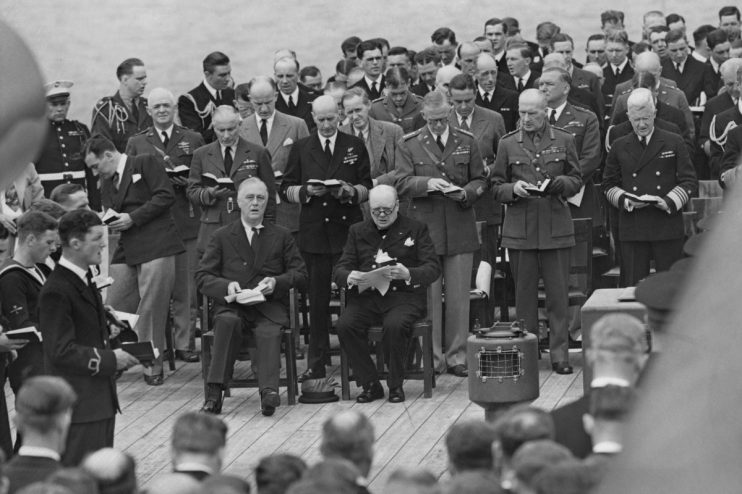
On this day in 1941, Churchill and Roosevelt made a joint statement that would come to be known as the Atlantic Charter – and the start of the special relationship, writes Eliot Wilson
It is a cliche that the “special relationship” is a cliche. In one form or another, though – whether with Britain as the Greeks to America’s Rome as Harold Macmillan liked to believe, or a more obviously mismatched partnership in more recent years – ties to America have mattered to the British, more than any other bilateral relationship.
What is the Atlantic Charter?
Today in 1941, in Little Placentia Bay in Newfoundland, Franklin Roosevelt and Winston Churchill met to finalise a statement for the press. The “Joint Declaration by the President and the Prime Minister” was rebranded “the Atlantic Charter” by The Daily Herald; Churchill’s acute ear caught the name, and he used it in his first radio broadcast the following week. And the Atlantic Charter is where it all began.
The relationship between Britain and America was born of antagonism. Next year the United States will celebrate the 250th anniversary of the Declaration of Independence, but the new nation hung in the balance until Washington’s victory at Yorktown in 1781. Relations remained warily, spikily distant until the closing years of the 19th century.
Winston Churchill had become Prime Minister in May 1940. It was a dark time in the Second World War: at dawn on that very day, 10 May, German forces stormed across the border into the Netherlands, Belgium and France. When he first addressed the House of Commons the following week, he was frank.
“I would say to the House, as I said to those who have joined this government: ‘I have nothing to offer but blood, toil, tears and sweat’. We have before us an ordeal of the most grievous kind. We have before us many, many long months of struggle and of suffering… You ask, what is our aim? I can answer in one word: it is victory, victory at all costs.”
Politically, Churchill had been a busted flush, an ageing maverick. But at that very moment in history, he was indispensable. He was determined, passionate, romantic, instilled with a profound sense of destiny and the nation – and he was half American. His mother Jennie was from a New York family with Huguenot antecedents and on her mother’s side an unproven family tradition of some Iroquois ancestry.
After the fall of France, there was no obstacle to Hitler’s dominance of the continent. Britain remained in the war, but seemingly helpless. Churchill believed otherwise, and knew the immense symbolism of merely remaining a combatant, but he also knew that he needed America as an ally in the conflict.
The American isolationist tradition was strong, and after losing more than 115,000 soldiers in the First World War, many US politicians had no intention of allowing participation in another “foreign” war. Roosevelt, though ruthlessly calculating, was more sympathetic to Britain’s cause.
The agreement Churchill and Roosevelt reached was a vision rather than a treaty. It set the parameters for a post-war world when such a thing was hard to imagine: no territorial conquests, self-determination for those who wanted it, reduction of trade restrictions, global cooperation, general disarmament. Both leaders imagined themselves leading players in this new world of internationalism.
Myth-making and the ‘special relationship’
The Atlantic Charter was a piece of theatre. It had no legal status: in fact, there was no physical document formally signed by Roosevelt and Churchill, just different texts with manuscript amendments before it was released to the press on 14 August 1941.
On the British side, “the right of all peoples to choose the form of government under which they will live” was an ominous phrase for an empire with a quarter of the world’s population. Churchill, fundamentally a Victorian imperialist, would say in 1942 “I have not become the King’s first minister in order to preside over the liquidation of the British Empire”, and he flatly denied that self-determination applied.
With his profound sense of history and grasp of language, though, Churchill saw the Atlantic Charter as something more, a screen onto which Anglo-American relations could be projected, rethought and reinterpreted. Once the United States formally joined the war after Japan’s attack on Pearl Harbor, it became a vital expression of purpose and sentiment, on which the Allies would then build the Quebec and Hyde Park Agreements, and the lineaments of the UK-US relationship for the next 80 years.
There have been peaks and troughs, like any long-standing relationship. The Suez Crisis was the nadir; neither Wilson nor Heath felt a bond with Washington. But Reagan and Thatcher proved profoundly simpatico, while Tony Blair staked a great deal of political capital on his intimate connection with both Bill Clinton and George W Bush.
When Churchill addressed Congress at the end of 1941, he framed the transatlantic bond in sacred terms:
“I avow my hope and faith, sure and inviolate, that in the days to come the British and American peoples will for their own safety and for the good of all walk together side by side in majesty, in justice, and in peace.”
This was myth-making in real time, and it only made sense because of the spirit which infused the Atlantic Charter. For 84 years, we have expected the bond between the US and the UK to be strong, and regarded it as deviation when it slackens. The wariness in Sir Keir Starmer’s eyes when he is around Donald Trump speaks of anxiety, but we have been here before. What that short document agreed by Roosevelt and Churchill did was redraw the parameters. And they remain in place.