
On this day: the Royal Navy drinks its last daily rum ration

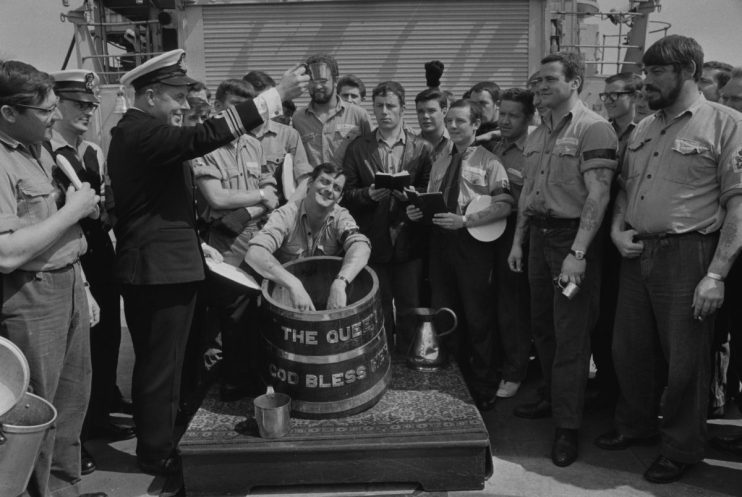
On this day in 1970, sailors’ daily rum ration – a tradition dating back to the glory days of the Royal Navy – was abolished, an occasion now known as Black Tot Day, writes Eliot Wilson
On this date, 31 July, 55 years ago, at 11am, the Royal Navy performed one of its cherished traditions for the last time, before the unforgiving and stern-faced world of modernity brought it to an end. For the last time, sailors on British ships around the world were served their daily tot, or rum ration. It had been abolished for officers in 1881 and warrant officers in 1918, but ratings could still look forward to this daily routine as one of the perks amid the rigours of life at sea.
It is said that Winston Churchill, when First Lord of the Admiralty, was once told by the Board of Admiralty that a proposal would not be in accordance with naval tradition; he is supposed to have responded, “Don’t talk to me about naval tradition! It’s nothing but rum, buggery and the lash.”
Certainly on the first of that trio he was right. English sailors had originally been given a gallon of beer as their daily allocation of drink, but beer took up a lot of space in cramped 16th and 17th century warships and spoiled easily. In 1655 – ironically while the Puritan Oliver Cromwell was Lord Protector of England – a measure of rum was offered as an unofficial alternative, as it was readily available in the Caribbean and kept much better than beer. Sometimes wine or spirits like brandy or arrack were also substituted.
Rum replaces beer
In 1731, the Navy Board officially authorised the substitution of rum for beer or wine when appropriate. The daily allowance was a pint of wine or half a pint of rum, issued neat in two equal amounts. From 1740, the rum had begun to be diluted with a quart of water at the behest of Admiral Edward Vernon, commander-in-chief of the Jamaica Station, to control drunkenness on board warships.
By around 1806, rum had become the standard form of daily alcohol ration, procured from distillers in Barbados, Guyana, Trinidad and Tobago and sometimes Jamaica, all at that time British colonies. It was often served with lemon or lime juice, the citrus fruits being used to combat scurvy among sailors, and was issued between 10am and noon and between 4pm and 6pm.
As the age of sail and shot wore on, and larger-than-life characters like Nelson faded into the past, there was a nagging anxiety that perhaps the British tar was not at his most effective when coddled by hard liquor. In 1823, the rum ration was halved to a quarter of a pint, and then halved again in 1850: the tot was now just – just! – an eighth of an imperial pint, or half a gill.
Abolition of the rum ration was proposed in Parliament in 1850 and again in 1881, but failed on both occasions. The second time, Admiral Sir John Hay, Conservative MP for Wigtown Burghs, argued “there are considerations with reference to climate and other matters which must be regarded before a ration of this kind was discontinued for those who desired it. Sometimes the water supply on board ship is of a very questionable character.”
Rearguard action
In the evening of 28 January 1970, the House of Commons once again debated the daily tot. James Wellbeloved, Labour MP for Erith and Crayford, was fighting a rearguard action.
“The decision of the Admiralty Board to abolish the rum issue,” he warned, “has aroused deep anger and resentment in the Royal Navy… There is some evidence from people who serve at sea in Her Majesty’s ships and in the Merchant Navy that a tot of rum can have a stabilising effect upon the stomach, and this is indeed a matter of considerable importance… So deep is the anger and resentment that there is a real danger that the ghost of the Nore, of Spithead and of Invergordon may once again stalk the Fleet.”
The tide had turned, however. The new First Sea Lord, Admiral Sir Peter Hill-Norton, having proposed the abolition of the rum ration three years before, was now able to carry out his plan. On 31 July 1970, “Up spirits” was piped at six bells in the forenoon watch, around 11am, and rum bosuns across the fleet poured each sailor half a gill of 54.6 per cent ABV rum: neat for senior ratings, diluted with two parts water for junior ratings. Many wore black armbands, some staged mock funerals.
The tot glasses were drained for the last time, to cries of “Stand fast the Holy Ghost!” The rum ration, the fighting spirit of the Royal Navy from its glory days in the 19th century, was a thing of the past. 31 July 1970 has henceforth been known as Black Tot Day – truly the end of an era.
Eliot Wilson is a writer