
On this day: The Bill of Rights is set in motion

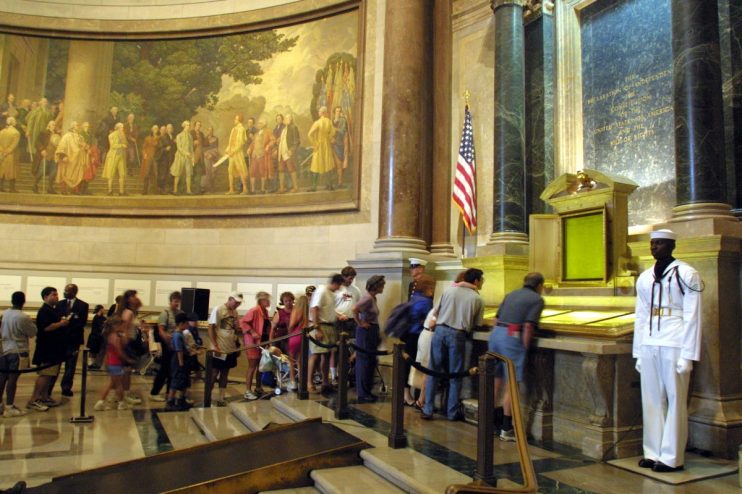
On this day in 1789, the Bill of Rights was sent to the states for ratification. With the right to free speech still hotly contested 300 years later, Eliot Wilson goes back to the start
There is currently intense and passionate debate in the United States over free speech. It was stoked further with the murder three weeks ago of conservative activist Charlie Kirk at a political rally in Utah, but it is only the latest chapter in a long story going back to the country’s earliest days. Yesterday marked one of them, when the Bill of Rights was sent to the states for ratification.
In 1789, the United States Congress, which had only come into being six months earlier, had been in session in New York City’s Federal Hall, at the intersection of Wall Street and Broad Street, through the summer. George Washington had been inaugurated as the first President on the building’s second-floor balcony that April. But the Senate and the House of Representatives were kept busy effectively creating a nation.
The Constitution had been drafted in 1787, but it was a bare-bones institutional framework, dry and bureaucratic compared to the soaring language of the 1776 Declaration of Independence. It had been pared down to ensure its acceptance by the Constitutional Convention, and one omission was any attempt to enumerate the rights of citizens of the new nation.
By the time of the First Congress, there was a widespread feeling that the failure to include a Bill of Rights had been a mistake. There were obvious sources on which the legislators could draw, most obviously the English Bill of Rights passed by parliament as part of the Glorious Revolution in 1689; theorists with a longer view looked back to Magna Carta, drawn up in 1215; and there were homegrown foundations like the Virginia Declaration of Rights (1776) and the Northwest Ordinance (1787).
Rep. James Madison of Virginia, hailed by veteran US columnist George F. Will as “the Founders’ best mind” whose intellect had a “hard, gemlike flame”, championed the addition of a Bill of Rights to the Constitution. He wanted to enshrine fundamental rights possessed by citizens but also to place clear limitations on the federal government, and believed that a clear, unambiguous set of propositions would in the future be a guide for the judiciary in regulating matters of state.
Madison’s initial proposal was that the corrective amendments he had drafted would be applied directly to the text of the Constitution. But some worried this would make the document seem less authoritative; Rep. Roger Sherman of Connecticut argued that the Constitution should “remain inviolate”. The solution was to consolidate Madison’s proposals as a series of amendments and place them at the end of the Constitution as an identifiable Bill of Rights.
Over the summer of 1789, Madison’s initial nine amendments were debated up to 20, then down to 17 and eventually 12. On 25 September, both Houses of Congress passed a joint resolution approving the 12 amendments, and three days later they were submitted to what were then the 11 states of the Union. Articles III to XII were ratified in 1791, and the extraordinary list of fundamental liberties they represent still resonates powerfully.
Freedom of religion, of speech, of the press, of peaceful assembly. The right to bear arms. Protection against unreasonable searches and seizures. The right to due process, to a speedy public trial in front of a jury. Protections against excessive bail and fines, and against cruel and unusual punishments. The presumption of state rather than federal powers. And the stern observation of the Ninth Amendment: “The enumeration in the Constitution, of certain rights, shall not be construed to deny or disparage others retained by the people.”
We should take none of these for granted. When Benjamin Franklin was asked after the Constitutional Convention what kind of government the United States was to have, he meant every word when he said “A republic, if you can keep it”.
Yet we should also always be wary of those who see in these basic rights a tool for their own purposes. Free speech, enshrined in the First Amendment, is not absolute, and excludes obscenity, fraud, incitement and “true threats of violence”, false statements of fact and defamation. Supreme Court Justice Oliver Wendell Holmes famously wrote in Schenck v. United States (1919) that “the most stringent protection of free speech would not protect a man falsely shouting fire in a theatre and causing a panic”. Words have consequences.
These debates are difficult and dense. But democracy is hard: maintaining a free society and upholding civic rights is the most demanding task humans carry out, and the job is never done. James Madison, who went on to be the fourth President of the United States, wrote that it would always be incumbent on politicians “to improve and perpetuate” the freedoms they enjoyed. When London-born John J. Beckley, clerk of the House of Representatives, sent the Bill of Rights to each state yesterday in 1789, it was not the end of a process, but the beginning. It was another vital element of our free society – if we can keep it.
Eliot Wilson is a writer, commentator and contributing editor at Defence On The Brink