
On this day: the arrest of Bernie Madoff

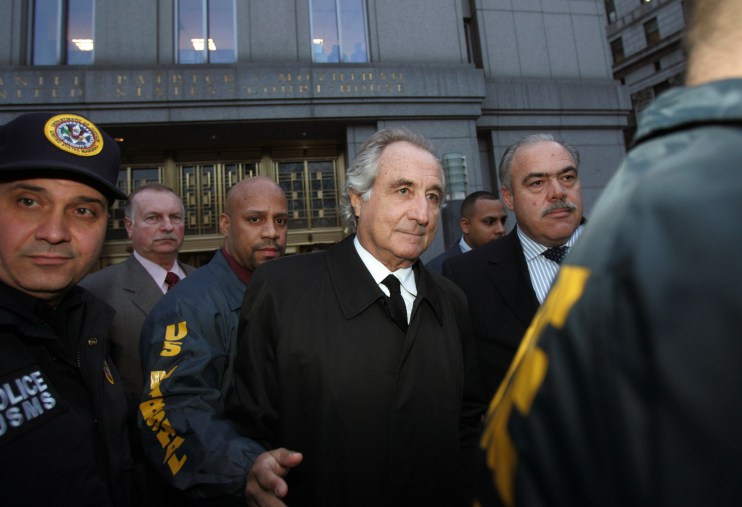
On 11th December 2008, financier Bernie Madoff was arrested for the biggest Ponzi scheme in history, writes Eliot Wilson
The 1990s had been an economic boom time for much of the West, with America growing at more than three per cent a year. It seemed as if the post-Cold War world might be one of progress and opportunity.
Come the new millennium, however, even if the most dire predictions of disaster had proved unfounded, the climate changed abruptly. The dot-com bubble burst in 2000; the al-Qa’eda terrorist attacks on the United States on 11 September 2001 had a seismic effect on global markets; and the spectacular collapse of Enron, the “smartest guys in the room”, three months later began a torrent of financial scandals which would scar the 2000s.
There still seemed to be success stories. Bernie Madoff, the grandson of Jewish immigrants from Queens, New York, had founded a penny-stock brokerage in 1960 with $5,000 saved from working as a lifeguard on Long Island. He had challenged the cloistered world of Wall Street’s white-shoe stockbrokers with aggressive marketing, accepting small-value clients and embracing electronic trading. In the early 1970s he had helped establish the National Association of Securities Dealers Automated Quotations (NASDAQ), an all-electronic rival to the New York Stock Exchange, and he wore his outsider status with prickly pride.
If Madoff felt like an outsider, he was impossible to ignore. By the late 1980s he was making $100m a year and served as chairman of the NASDAQ for several years. His firm promised investors steady returns with low volatility by using split-strike conversion: buying blue-chip stocks, selling call options above the current price and buying put options below. The premium from selling generated returns and losses were limited by buying the puts.
On 1 January 2001, while others were encountering strong economic headwinds, the maverick financier incorporated Bernard L. Madoff Investment Securities as a limited liability company, of which he was the sole director and shareholder. It had three divisions, investment advisory, market making and proprietary trading, occupying three floors of 885 Third Avenue, otherwise known as the Lipstick Building in Midtown Manhattan.
But there was a whiff that something was not right. In 1999, Rampart Investment Management asked one of their portfolio managers, forensic accountant Harry Markopolos, to analyse Madoff’s operation in the hope of emulating his success. When Markopolos examined the revenue stream, he knew within five minutes Madoff’s numbers did not add up. The steady rate of returns being reported “simply doesn’t exist in finance”, and within four hours he thought he had evidence of fraud.
Don’t ask, don’t tell
In 2000, Markopolos filed a complaint about Madoff with the Securities and Exchange Commission, the federal market regulator. Disquiet was growing, and in May 2001 Barron’s Magazine published an article entitled “Don’t Ask, Don’t Tell: Bernie Madoff is so secretive, he even asks investors to keep mum”. But the SEC took no action, and investors continued to flock to Madoff. Three more complaints from Markopolos were ignored by the SEC; Madoff was politically connected, and audit giants KPMG and PricewaterhouseCoopers reported no irregularities.
Then came the financial meltdown. America’s subprime mortgage crisis in 2007 provoked a worldwide liquidity crisis and a stock market crash, and Madoff’s investors began to demand their money. But he didn’t have it: he had not traded since the early 1990s, banking his clients’ investments and paying out enough to reassure them of success. Bernie Madoff had been running a Ponzi scheme.
(In 1920, Charles Ponzi, an Italian-born swindler, had defrauded investors of around $20m, equivalent to $314m today, in a scheme buying discounted postal reply coupons in other countries and redeeming them at face value, promising extravagant returns.)
In fact Madoff had operated the biggest Ponzi scheme in history. By November 2008, with Bear Stearns and Lehman Brothers having collapsed, investors needed access to funds. Madoff desperately fought to stay afloat, but after Thanksgiving he knew the end had arrived. On 10 December, he confessed to his sons Mark and Andrew, who ran the legitimate arms of Madoff Securities, that his asset management business had been “one big lie”. The younger Madoffs spoke to lawyers, who connected them with federal prosecutors and the SEC.
On this day in 2008, 11 December, Bernie Madoff was arrested at his Manhattan penthouse by FBI agents and charged with securities fraud. His firm’s last statements had indicated $64.8bn in client assets; in fact there was only $200m in cash, and his fraud, including fabricated gains, would eventually total $65bn.
In March 2009, Madoff pleaded guilty to 11 felonies, and in June he was sentenced to 150 years in prison and ordered to forfeit $170bn. The judge described his fraud as “extraordinarily evil”, “unprecedented” and “staggering”.
The judge described his fraud as ‘extraordinarily evil’, ‘unprecedented’ and ‘staggering’
Incarcerated in Butner, North Carolina, Madoff was due to be released on 31 January 2137, by which time he would have been 198. He did not quite last that long, dying of chronic kidney disease on 14 April 2021, aged 82. His son Mark had hanged himself in 2010, two years exactly after Madoff’s arrest.
At his sentencing, Madoff had admitted “I have left a legacy of shame… this was something I will live in for the rest of my life. I’m sorry. I know that doesn’t help you.”
That may have been the understatement of the decade. Maybe closer to the mark was the title of Diana B. Henriques’s 2011 account of his rise and fall – The Wizard of Lies: Bernie Madoff and the Death of Trust.
Eliot Wilson is a writer and historian; senior fellow for national security at Coalition for Global Prosperity; contributing editor of Defence on the Brink