
On this day in 1996: the IRA bombs the Docklands

30 years ago today, two men were killed in a massive explosion at Canary Wharf – and the IRA proved that you can bomb your way to the negotiating table, writes Eliot Wilson
At around 5.00 pm, 30 years ago today, a blue Ford Iveco Cargo truck was parked 80 yards from South Quay DLR station, just where the tracks cross Marsh Wall. It was a cold and overcast Friday, barely 6℃, and the sun was setting.
At 7.01 pm, a 3,000lb bomb on the truck’s flatbed was detonated. Plastic sacks filled with ammonium nitrate and sugar had been packed around metal scaffolding poles containing 10lb of Libyan-supplied Semtex, and a two-hour timer had been activated by a switch in the cab. The explosion was enormous and viciously powerful, leaving a crater 32ft across and 10ft deep; it was heard and felt across London, and shook One Canada Square, the 771ft tower which was then the tallest building in Britain, half a mile away.
The Provisional IRA’s 18-month ceasefire had ended.
By the end of 1993, the Provisional IRA (PIRA) had been waging a terrorist campaign for 24 years. In the years preceding, London had experienced two major bomb attacks at the Baltic Exchange in April 1992 and Bishopsgate in April 1993, and a large explosive device underneath One Canada Water had been detected and defused in November 1992. It was two decades since the first PIRA bombings in mainland Britain, with car bombs outside the Old Bailey and on Whitehall in 1973.
Stalemate
The Troubles had cost more than 3,300 lives. John Major had become Prime Minister in 1990 and was determined to put Northern Ireland “on the front burner”. There was a sense of stalemate: three attempts at setting up democratic assemblies in Northern Ireland had failed, in 1974, 1976 and 1986; the 1985 Anglo-Irish Agreement had improved relations between London and Dublin but little else; British intelligence had penetrated the PIRA but terrorist violence persisted on both sides, Republican and Loyalist.
Major felt that something had to change. Sinn Féin, the PIRA’s political wing, had been talking secretly to the moderate Nationalist SDLP since the late 1980s; John Hume, the SDLP leader, maintained the British government had to be involved in any negotiated settlement. His case was strengthened in 1990, when the Northern Ireland Secretary, Peter Brooke, had said in a speech that the government had “no selfish strategic or economic interest in Northern Ireland”.
Drafts of a document were circulated around Whitehall, Dublin, the SDLP, Sinn Féin and the Ulster Unionist Party. On 15 December, John Major stood outside Number 10 with the Taoiseach, Albert Reynolds, a deceptively canny Connachtman, to announce the Downing Street Declaration.
The declaration affirmed the principles of self-determination and consent: a united Ireland would be achieved only if the majority of Northern Ireland voted in favour. It stated that political differences must be “negotiated and resolved exclusively by peaceful political means” but left the door open to parties aligned with the paramilitaries like Sinn Fein to take part in talks if they abandoned violence.
On 31 August 1994, the Provisional IRA announced a ceasefire. On 13 October, the Combined Loyalist Military Command followed suit. The cessation of violence had been called on the understanding that Sinn Féin would then be included in multi-party talks on Northern Ireland’s future. In 1995, Sir Patrick Mayhew, who had replaced Brooke at the Northern Ireland Office, stated that agreeing and beginning a process of decommissioning the terrorist group’s weapons would be a precondition of Sinn Fein’s participation.
Decommissioning was as much symbolic as it was a security issue: any paramilitary group could always acquire more guns and bombs. But Major and Mayhew knew that the Unionists were unlikely to join talks involving Sinn Féin without even a token gesture towards decommissioning, while Republicans regarded that as an unacceptable sign of defeat. At the same time Major’s parliamentary majority had all but disappeared and he was reliant on the nine UUP MPs to maintain control of the House of Commons.
Northern Ireland faced stalemate once more.
The PIRA had had enough. On 7 February 1996, Seamus McArdle of the South Armagh Brigade drove the Ford Iveco from Northern Ireland to Scotland on the Larne-Stranraer ferry. It was another 300-mile journey to Barking, then the short trip to South Quay on 9 February.
At 5.30pm the PIRA released a statement to RTE that “with great reluctance” it would end its ceasefire at 6.00pm. The Irish broadcaster was sceptical and did not immediately run the announcement on the news. The terrorists also sent at least six coded warnings, including to The Irish News which said “there’s a massive bomb beside South Quay station, Marsh Wall, Isle of Dogs, London. Evacuate immediately.” But there was confusion over the bomb’s precise location, some police officers thought it was a hoax, and the truck was not found until 6.48pm. There was no time.
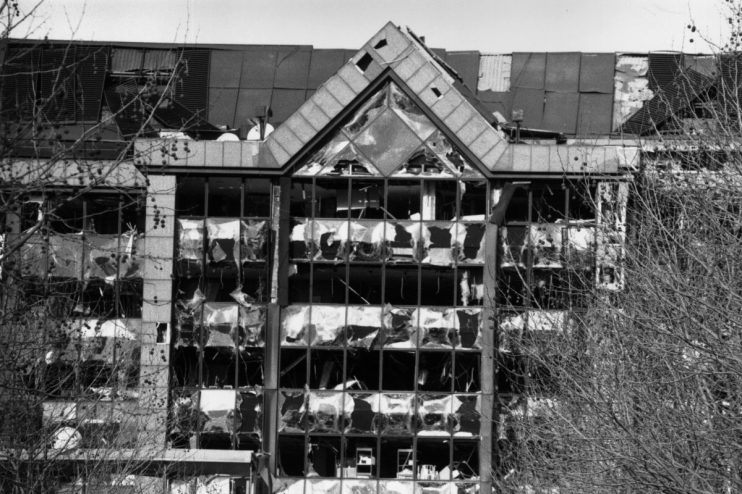
The explosion at 7.01pm instantly killed two men, Iman Bashir and John Jeffries, standing outside Bashir’s newsagency a few yards away and blown through two walls to be buried under rubble. Most of the 100+ injured were hurt by shards of broken glass, 39 requiring hospital treatment; one woman was blinded in one eye and required 300 stitches to her face and arms. Three buildings—the Midland Bank and South Quay Plaza I and II — were destroyed and £150m worth of damage was caused.
It would be unfair to describe this as a failure of security. It was a failure of humanity
The PIRA described the deaths and injuries as “regrettable” but blamed the emergency services for being too slow to evacuate the area. The Metropolitan Police Commissioner, Sir Paul Condon, was mordant in his reply: “It would be unfair to describe this as a failure of security. It was a failure of humanity.”
The PIRA ceasefire had lasted 17 months and nine days. An even larger bomb devastated the centre of Manchester on 15 June but miraculously there were no fatalities. All-party talks without Sinn Fein had begun at Stormont five days before. It would be July 1997 before the ceasefire was reinstated, and two days later Sinn Fein were admitted to the all-party talks at Stormont. The DUP and the UKUP left in protest, and in August the new Northern Ireland Secretary, Mo Mowlam, “accepted the veracity” of the ceasefire. Sinn Féin was admitted to talks the next month.
Decommissioning did not begin until 2001. By then Sinn Fénn in the devolved Northern Ireland Executive. Looking back in 2016, Irish-American former Congressman Bruce Morrison observed, “The great irony for me is that Canary Wharf got the Republicans to the table. The actions of the British said ‘yes you can bomb your way to the conference table’.”
Eliot Wilson is a writer and historian; senior fellow for national security, Coalition for Global Prosperity; contributing editor, Defence on the Brink