
On this day in 1940: Happy birthday Ken Clarke

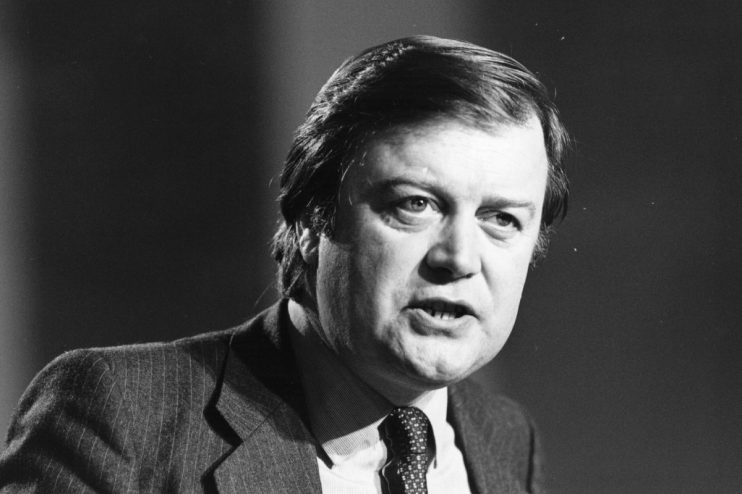
For many in parliament, it may feel as if he’s always been there. But on this day, 2 July 1940, Kenneth Clarke was born. Eliot Wilson tells us more
At the Cabinet reshuffle in July 2014, the oldest face leaving belonged to the minister without portfolio, 74-year-old Kenneth Clarke. It was just over 42 years since he had first joined the front bench in April 1972, as an assistant whip in Edward Heath’s government. For many parliamentarians, Ken Clarke had simply always been there, a confident, funny, irreverent figure whose disdain for image management was in itself iconic.
Clarke’s longevity made him seem like a political objet trouvé for the Thatcher generations and subsequently. He was born today in 1940 in Nottingham – think about that date for a moment: Winston Churchill had been Prime Minister for 40 days and the “Battle of Britain” was a phrase he had recently coined.
A clever and sharp-witted boy, quick to learn, Clarke won a scholarship to Nottingham High School, then, in 1959, he went up to Gonville and Caius College, Cambridge, to read law. He arrived with Labour sympathies but soon became a Conservative and found his niche.
The young men of the “Cambridge Mafia” in the early 1960s came mostly from modest backgrounds, some grammar school-educated. Clarke and his fellow Fenland mafiosi, Norman Fowler, Michael Howard, John Gummer, Leon Brittan, Norman Lamont and Peter Lilley, all reached Cabinet under Margaret Thatcher.
Clarke was elected MP for Rushcliffe in 1970 and by the end of the Heath government he was a senior whip. Then Margaret Thatcher was elected Conservative leader in 1975. It could have been the end, as he and Thatcher were hardly soulmates. But she respected ability and political courage, and Clarke seeing her as a “highly intelligent workaholic”, he served on the front bench as an industry spokesman from 1976 to 1979.
When the Conservatives won the 1979 general election, Clarke was appointed parliamentary secretary for transport under his old friend Norman Fowler. He told Thatcher he knew nothing about the subject, but he resolved, typically, to make the best of it. It was a wise move: he would be one of only five ministers to serve the whole 18 years of Conservative rule.
The ministry of transport allowed Clarke to learn the grind of office, and his experience as a barrister and his natural confidence were great assets. By chance, it also put him in the thick of what became a defining characteristic of Thatcherism – privatisation.
Fowler wanted to divest the state of the National Freight Corporation, the National Bus Company and the British Transport Docks Board, as well as deregulate the bus companies. It would not be achieved quickly or easily, but Clarke saw first-hand from the trenches that border between the public and private sectors.
In March 1982, reshuffling her junior ministerial ranks, Thatcher promoted Clarke to minister of state for health. He had proved his worth and so spent three years in a high-profile brief which led to an opportunity which defined his career.
Thatcher had become politically enamoured by David Young. In 1985 she named him employment secretary, but it was felt that, as a peer, he should have a Cabinet-level Commons deputy. Clarke became his number two and paymaster general with a seat in Cabinet.
The next three years were spent in partnership with Young, first at employment and then, after the 1987 election, at trade and industry. It was an unusual ascent to Cabinet for Clarke, about whom Thatcher still had some lingering ideological reservations, but it worked for everyone. Young was coqueluche du moment with the Prime Minister, but had no party political experience. Clarke served as a parliamentary pugilist and fearless media performer.
Ken Clarke’s public image was crystallising (his puppet first appeared on Spitting Image in 1988): heavyset and baggy; double-breasted suits whose days of buttoning up were in the past; brown suede shoes and the salmon-and-cucumber striped tie of the Garrick Club. He was combative but never sour, and his love of cigars, brandy and late nights listening to jazz at Ronnie Scott’s indicated a man who did not take himself or politics too seriously.
A One Nation Tory Centrist?
Clarke is now held up as a One Nation Tory centrist, but that takes some political retconning. In 1988, he became health secretary, before moving to education in Thatcher’s last reshuffle. In both jobs he was no conciliator: like the Iron Lady, he prickled at vested interests and fought fiercely against the British Medical Association and the teaching profession.
And he championed radical reform. As health secretary, Clarke introduced the NHS internal market and allowed hospitals to become self-governing trusts. At education, he revitalised Kenneth Baker’s reforms including regular testing of pupils, Ofsted inspection of schools and published league tables, and a national curriculum. Using the tools of market forces to break the grip of unions and drive up standards: it could hardly have been more Thatcherite.
Clarke rated Thatcher, calling her “the best politician I have ever witnessed”, but was more at ease with John Major, who promoted him to home secretary after the 1992 election. He was for the first time older than his Prime Minister, more comfortable and unquestionably in the government’s top tier. When Major sacked Norman Lamont as Chancellor in the fall-out from Black Wednesday, Clarke was the obvious choice for the job.
Some of the Conservative Party’s worst years, from 1993 to 1997, were some of Clarke’s best. He was an orthodox free-market Chancellor, cutting the basic rate of income tax, reducing public expenditure and bringing down the deficit. Interest rates, inflation and unemployment all fell, and Labour seemed so threatened by the government’s economic policy that Shadow Chancellor Gordon Brown undertook to retain its spending plans for the first two years of a Labour government.
Clarke was at his best where the fighting was hardest and the biggest of Tory big beasts. Overseeing an impressive economic recovery, he would not allow a cigarette paper between himself and the Prime Minister, declaring that “any enemy of John Major is an enemy of mine”. But his positive stance towards Europe and his support for the Single Currency were increasingly anathema to Conservative MPs. He knew this but it was not his nature to trim his sails.
After its devastating defeat in 1997, the Conservative Party had to find a new leader. In ability, stature and broad appeal, Clarke should have walked it. For the last time, only Members of Parliament would vote for the leader: Clarke led after the first ballot, ahead of William Hague, John Redwood, Peter Lilley and Michael Howard. Before the final round, in an oddly panicky move, he made a pact with Redwood, but not enough MPs were willing to accept his views on Europe. Hague won the leadership with 90 votes, Clarke trailing on 72.
He turned down a shadow cabinet post, while Hague spent a torrid four years treading water: after the 2001 election saw the Conservatives gain a single seat, Hague took responsibility and resigned to allow party members to choose a new leader. They demonstrated their acuity by choosing charisma-free Eurosceptic Iain Duncan Smith over Clarke by 60 per cent to 40 per cent.
Clarke made one more bid for the crown. By 2005, he was 65 and had been out of office for eight years, and there was little compelling about his candidacy. Against David Cameron, David Davis and Liam Fox, he came fourth in the first round and was eliminated, Westminster’s Norma Desmond without the self pity.
There was a quixotic Indian summer to come. In 2009, Cameron appointed him shadow business secretary during the Global Financial Crisis, shadowing Lord Mandelson. When the coalition government was formed in 2010, the business portfolio went to Liberal Democrat Vincent Cable, but Clarke enthusiastically accepted a tentative offer to become justice secretary and Lord Chancellor.
It was not a satisfying experience. Reading them from the party’s website, Clarke found he disagreed with almost all Conservative policies on justice, and his colleagues exasperated him. He moved after two years, staying on until 2014 as minister without portfolio, but it was a game of diminishing returns.
It is a function of Clarke’s longevity that the politician we remember now is the post-office, increasingly detached elder statesman rather than the effective, radical, dominant Cabinet minister; in our heads he has a great future behind him. Should he have led his party? In terms of ability and nous he dwarfs Duncan Smith and is a more rounded figure than a younger William Hague. He had a choice: if he had accepted the mood of the party on Europe and put aside his own views, it is hard to see how he would not have become leader in 1997, and who can say what thereafter?
Many would have struck that bargain. If he had, however, he would not have been the Ken Clarke everyone knew. Fate? No one alive has ever escaped it, neither brave man nor coward – it’s born with us the day that we are born.
Eliot Wilson is a writer and historian; he is a senior fellow for national security at the Coalition for Global Prosperity and a contributing editor at Defence on the Brink