
Olympics should lead way in AI and lighten impossible load on its judges

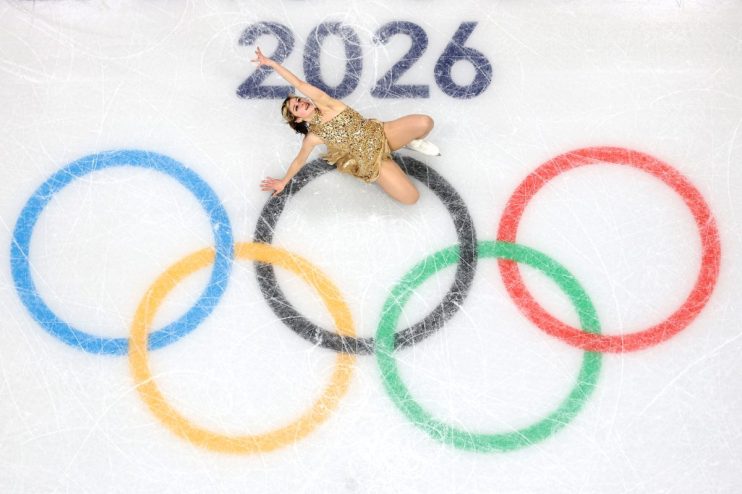
If any sporting body has the means to fund investment in AI judging it’s the International Olympic Committee, writes Ed Warner.
I’ve no idea whether Zoe Atkin’s “amplitude” deserved to bag silver rather than bronze in the freeski halfpipe on Sunday. All I know is she didn’t wipe out on all three of her three runs, which would have crushed her chances.
Everything else I have to cede to the judges’ eyes and experience. That’s the uncomfortable truth at the heart of so many Olympic disciplines: unless you’ve spent a lifetime immersed in their technicalities, you’re essentially trusting a small group of experts to tell you what you’ve just seen with a rating appended.
I say this as a relatively late convert to judged sports. For years I spurned them, convinced they were too subjective, too opaque, too vulnerable to bias. Then I saw the jaw‑dropping skills of gymnasts up close at Athens 2004 and underwent a Damascene conversion. TV simply can’t do justice to the speed, the height, the precision and the musculature required for their delivery.
Suddenly the idea of reducing these athletes’ feats to a number felt less like a bureaucratic exercise and more a necessary act of translation. Yet even so, the vagaries of judging frustrate. How can something so extraordinary be scored in a way that feels so open to inconsistency? How, simply, can meaningful comparisons be made?
Diving is perhaps the clearest example of the need to separate man from medals. Apart from the extent of the splash or the ripples on entry to the water, I defy anyone – no matter how trained – to gauge the execution of a dive without recourse to slow‑mo.
And yet Olympic judges must rely on their naked eyes and the embedded memory of thousands of previous dives. They are, in effect, human databases trying to operate at machine speed.
Taekwondo, gymnastics, freestyle skiing, snowboarding, figure skating, boxing, diving, dressage – the list of sports where the result hinges on a panel’s interpretation rather than a stopwatch or a goalline is long. And history is littered with examples of how fragile that system can be.
The 2002 Salt Lake City figure skating scandal, where a French judge admitted to being pressured to favour a Russian pair, remains the most notorious. The official resolution was to award joint gold medals to the Russians and the Canadian pair they had “beaten”.
Gymnastics had its own moment of very public reckoning when Paul Hamm’s 2004 Olympic gold came after South Korean competitor Tae Young Yang was mis‑scored on difficulty in the parallel bars, prompting days of acrimonious confusion. Hamm successfully resisted pressure to hand back his gold medal. Three judges were suspended.
But boxing has arguably suffered most. Roy Jones Jr’s infamous loss to home fighter Park Si‑Hun at Seoul 1988 still stands as the gold standard of Olympic injustice; the 2016 Rio tournament was so riddled with questionable decisions that officials were sent home mid‑Games; and discontent about scoring continued to cloud the sport at Paris 2024.
“I had the gold medal, but I wanted to give it back to you. It belongs to you.”
Park Si-Hun on handing Roy Jones Jr his 1988 Olympic light middleweight winner’s medal in 2023
These aren’t isolated blips. They are symptoms of systems that rely on human perception in environments where this is at its least reliable: high speed, high complexity, high pressure.
“Two of the judges went for me, three went against me, every round was competitive and close and that’s amateur boxing. It’s just a flip of the coin sometimes and in this case it didn’t go my way.”
British boxer Lewis Richardson is diplomatic in defeat after a Paris 2024 semi-final that many believed should have gone his way
Could and should AI tools be developed to replace – or at least augment – human judging? The technology is already creeping into athlete preparation. Computer vision systems track body angles, rotation speeds, degrees of twist and entry trajectories while sensors measure force and precision.
Machine learning models can be trained on thousands of past performances to identify execution errors invisible to the naked eye. In theory, then, AI could deliver scoring that is consistent, transparent, and immune to national bias or political pressure.
The obvious question is: who pays? The answer is simple. The International Olympic Committee sits on reserves of almost $5bn. If any sporting body has the means to fund a multi‑cycle investment in AI judging infrastructure, it is the one that demands host cities spend billions building venues they may never use again.
The cost of developing robust, sport‑specific AI judging systems would be a rounding error in Olympic accounting, but have the potential to transform the perceived integrity of the events they would adjudicate.
The counterargument is that while we moan endlessly about football referees, the introduction of VAR has only intensified fans’ complaints. If technology can’t fix offside, why should we trust it to score a switch leftside triple cork 1440?
And anyway, do we secretly prefer a world in which officials’ controversial decisions add to the richness of the sporting inquests we conduct on our sofas and in pubs?
Football, though, has a clear victory condition: score more goals than the opposition. The referee’s job is to enforce rules around that objective, not to determine the quality of the football itself. Judged sports are different. They have no inherent victory condition. The scoring system is the sport.
Remove the judges and you remove the sport’s organising principle. Which is precisely why those systems should be as robust, transparent and defensible as possible. Subjectivity can’t be dismissed as a charming quirk. It’s an existential vulnerability.
AI wouldn’t eliminate controversy. Its very design and the sporting success factors embedded within it would be open to disagreement. However, it could eliminate the most corrosive forms of doubt, the allegations of scandal, incompetence, favouritism, or simply inefficient scoring criteria that have dogged judged sports.
Furthermore, it could do so while preserving the human element where it matters: in the interpretation of artistic merit. Let the machines measure the physics and the judges debate the aesthetics.
If the Olympic movement truly embraced AI judging and the science that would entail, the benefits wouldn’t stop at sport. The same technologies could be applied to medical diagnostics, workplace safety, physical rehabilitation, even the design of our built environment, our homes and vehicles.
Systems capable of analysing complex human movement with precision could help detect early‑stage neurological conditions, improve prosthetic design, or assess fall‑risk in elderly populations. Fairness engines honed in the cauldron of competition might audit human bias in hiring, marking, or court sentencing. Sport can become a testbed for innovations with far wider societal value.
The Olympics has always sold itself as a platform for human excellence. Its next step should be to ensure that excellence is measured with tools worthy of the athletes who exhibit it.
The above was written with a little help from AI. I believe I managed to deliver its key aesthetics unaided though.
Square cut
Meanwhile, in another corner of the sporting universe, the International Cricket Council has reportedly decided the game’s future is best entrusted to a global management consultancy. McKinsey & Company, naturally.
When in doubt, hire people who’ve never faced a 90mph bouncer to tell you what fans in Mumbai, Melbourne and Manchester really want from a floodlit franchised thrash.
On one level, it’s almost touching. Confronted with existential questions about its formats, calendars, audiences and Test cricket’s seemingly inexorable decline, the game’s rulers have reached for a familiar corporate comfort blanket: McKinsey with its oft-touted “four box model”.
Expect the very human muddle that is global cricket to be boiled down to traffic‑light dashboards and tidily boxed analysis, the consultants then quietly exiting before their conclusions properly kick in.
This would be amusing if McKinsey’s reputation wasn’t looking a little threadbare these days after its proximity to a few too many corporate and governmental fiascos. The idea that cricket, a sport whose quirkiness is its very essence, can be optimised by applying the same toolkit used on distressed corporations and bloated quangos feels, well, rather optimistic.
Perhaps I’m biased. After all, I was once McKinseyed to exasperation, and I’ve just finished Alexander Starritt’s novel Drayton and Mackenzie, about two unlikely young entrepreneurs which, in passing, deliciously skewers the McKinsey myth.
Still, if nothing else, the ICC will soon have a beautifully formatted PowerPoint explaining why everything in cricket is just so complicated. “Middle and leg please, umpire!”
Ed Warner is chair of GB Wheelchair Rugby and writes his sport column at sportinc.substack.com